[2026 Guide] Voice Phishing Defense: From “Dream Job” to Handcuffs: A Seoul Defense Lawyer’s Diary [LIBRO, English Speaking Lawyer]
Hi everyone. In my practice, I handle many foreign criminal cases in Korea, and I frequently see a recurring tragedy: bright, ambitious expats who accidentally stumble into the world of Voice Phishing.
Today, I want to share two stories from my actual practice. These cases show how easily an innocent person can be branded a criminal—and how the right legal strategy can save a life.
If you want to know about Voice Phishing Job Scam: “I Didn’t Know” & How to Avoid Prison, please refer to this link below.
If you want to know about The Trap of the Police Protocol (Jo-seo) & Your 3 Rights, please refer to this link below.
If you want to know about Korea Police Guide: Avoiding the Trap & 3 Million Won Fine, please refer to this link below.
Tale 1: The “Tech Logistics” Trap (The Power of a Proper Defense)
I once represented a European graduate student—let’s call him Felix. He had lived in Korea for years and spoke the language well. He found a part-time job as a “Quality Control Agent” for a company claiming to export refurbished high-end gadgets.
His job was simple: pick up “security deposits” in cash from local suppliers and bring them to a designated office. Felix was professional; he used his own name, took public transport, and kept all his receipts.
One day, while waiting at a subway station, he was swarmed by police. It turned out the “suppliers” were actually scam victims.
My Strategy
1. Challenging the Evidence: The police had seized Felix’s phone and analyzed his private chats without providing him with a proper, itemized list of the files they took—a major violation of Korean criminal procedure.
2. Proving Lack of Intent: Felix hadn’t hidden his identity. He even had a formal contract. I argued that while the job was “unusual,” there was no evidence he knew it was a crime.
The Outcome
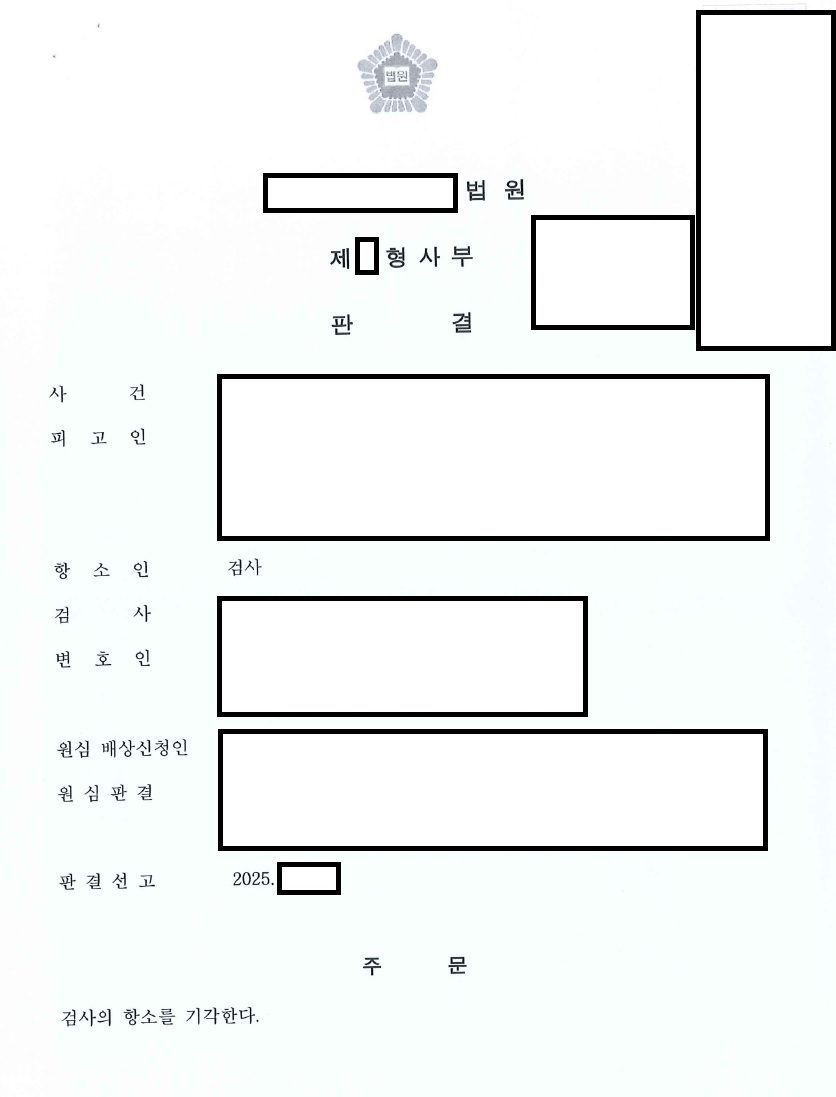
The court declared Felix NOT GUILTY. We proved that “looking suspicious” is not the same as “being a criminal,” especially when the authorities fail to follow the law during their investigation.

Tale 2: The “K-Beauty Export” Mirage (The Art of the Appeal)
My second case involved Elena, a young woman who moved here hoping to work in the fashion industry. She met a “manager” on a social networking app who offered her a job as a “Payment Liaison” for a K-Beauty export firm.
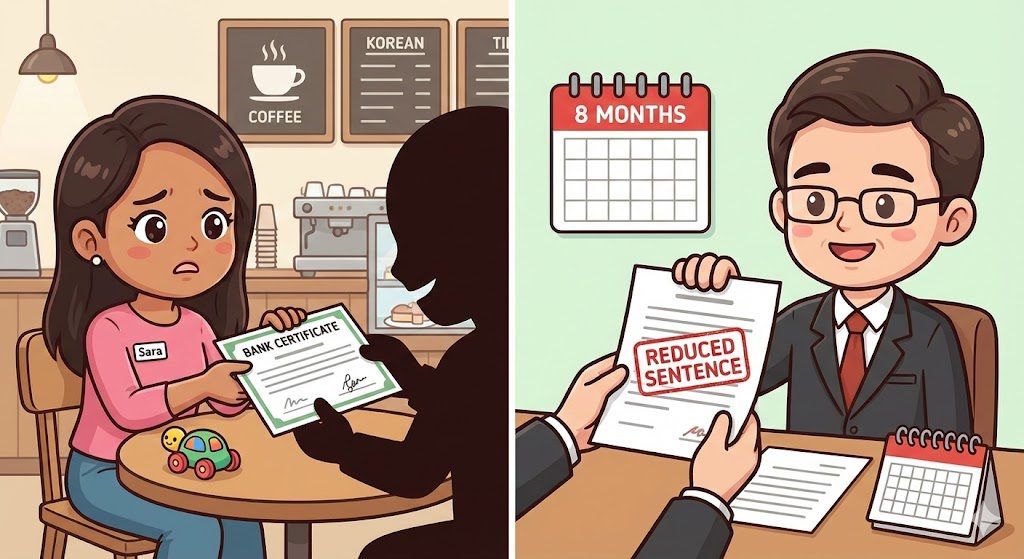
Elena’s mistake was a bit more serious. The manager gave her digital files of “Bank Certificates” to print and hand to clients. Deep down, Elena felt something was wrong—she even used a nickname once because she felt uneasy.
She was arrested for Fraud and Forgery. The lower court was harsh, sentencing her to one year in prison because she “should have known” better.
My Strategy
We didn’t deny the facts. Instead, we focused on humanity. On appeal, I presented evidence that Elena had a young child to support and had never been in trouble before. We worked tirelessly to settle with the victims, showing her genuine remorse.
The Outcome
The high court was moved. We successfully reduced her sentence to 8 months, allowing her a chance to eventually return to her family rather than serving a long, grueling term.
📊 Is Your Job Actually a Crime?
Use this table to evaluate any “freelance” or “part-time” work you find in Korea.
| Red Flag 🚩 (Danger!) | Green Flag ✅ (Safe) |
| Handing over physical cash in bags or envelopes. | Payments are made via official bank-to-bank transfers. |
| Using Telegram or encrypted apps for all work orders. | Using official company email and physical office spaces. |
| Being asked to print bank documents yourself. | All legal/financial documents are officially issued by the bank. |
| You are told to hide your identity or use a fake name. | You are introduced to clients by your real name and title. |
❓ Detailed FAQ for Expats
1. “I didn’t know it was a scam. Can I still be punished?”
Yes. Korean law uses the concept of “Willful Blindness” (Mis-pil-jeok-go-ui). If the court decides that any “normal person” would have suspected a crime, you can be held liable even if you didn’t have 100% certainty.
2. “The police want to search my KakaoTalk. What are my rights?”
If the police analyze your phone, they must allow you or your lawyer to participate in the process. Most importantly, they must give you a “Seizure List” (압수목록) detailing exactly what files were taken. If they don’t, that evidence might be illegal.
3. “What happens to my visa if I’m caught?”
A prison sentence or a large fine usually leads to a Departure Order from Immigration. This is why it is critical to fight for a “Not Guilty” verdict or a “Suspension of Execution” to protect your right to stay in Korea.
4. “Should I talk to the police alone?”
Never. Even if you are innocent, your words can be misinterpreted. As your lawyer, I ensure that your “lack of intent” is documented correctly from the very first interrogation.
A Final Word
Don’t let your “K-Dream” be ruined by a clever scammer. If a job seems too easy and pays too well in cash, it’s likely a trap.
Attorney Paul

![[외국인 전문 변호사][ENGLISH SPEAKING KOREAN LAWYER]](https://lawfirmlibro.com/wp-content/uploads/2026/02/Gemini_Generated_Image_fwxnfqfwxnfqfwxn-768x768.jpeg)