Korean Visa Roadmap 2026: From Entry to F-5 Permanent Residency (Lawyer’s Guide)[English Speaking Lawyer. LIBRO]
Introduction
Living in Korea starts with a clear plan. This Korean Visa Roadmap will guide you from entry to permanent residency.. Whether you are a student dreaming of a career in Seoul, an investor looking for opportunities, or a professional aiming for permanent residency, the path can seem complex.
Based on the official “Visa Navigator” manual published by the Korea Immigration Service (Ministry of Justice), this guide provides a comprehensive roadmap, including visa types, step-by-step paths to F-5 (Permanent Residency), and critical reporting obligations to avoid heavy fines.
1. Korean Visa Roadmap Overview: Which Type Are You?
Korean visas are categorized by alphabet letters. Understanding your category is the first step.
[Table 1] Summary of Key Visa Types
| Category | Visa Types | Target Audience |
| A (Official) | A-1 ~ A-3 | Diplomats, government officials, SOFA status (USFK). |
| B (Exempt) | B-1, B-2 | Visa-exempt nationals, tourists, transit passengers. |
| C (Short-term) | C-3, C-4 | Short-term visitors (tourism/business) or temporary employees (under 90 days). |
| D (Education & Investment) | D-2, D-4 | Students (Degree seeking) and Language Trainees. |
| D-8, D-9 | Corporate Investors, Tech Start-ups, and Trade Managers. | |
| D-10 | Job Seekers and Internship participants. | |
| E (Employment) | E-1 ~ E-7 | Professors, Researchers, Instructors, and Professionals. |
| E-9, E-10 | Non-professional workers (Manufacturing, Agriculture, Maritime). | |
| F (Residency) | F-1, F-3 | Family visitors and Dependents (Spouse/Children). |
| F-2, F-4 | Long-term Residents and Overseas Koreans. | |
| F-5, F-6 | Permanent Residents and Marriage Migrants. | |
| H (Work) | H-1, H-2 | Working Holiday and Work & Visit (for ethnic Koreans). |
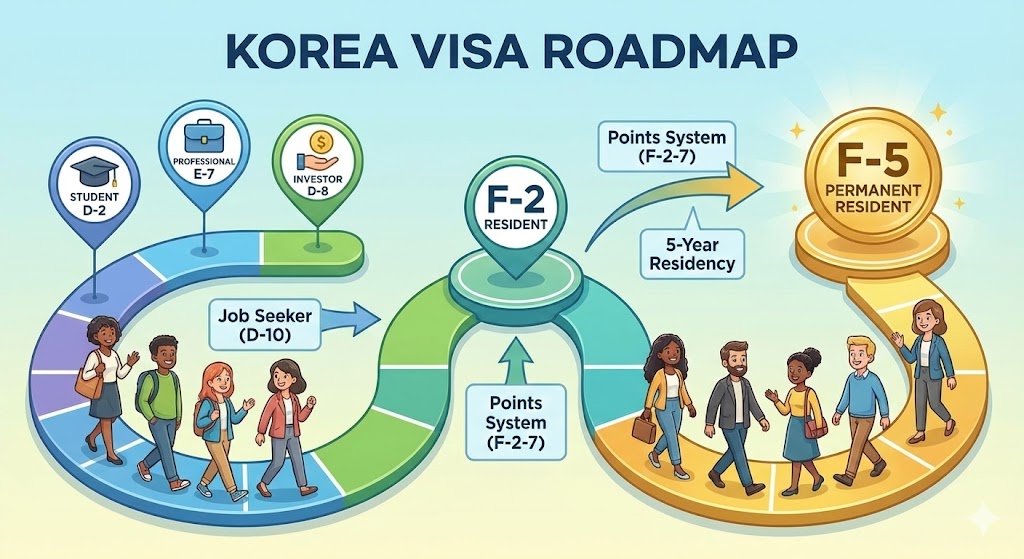
2. The Ultimate Korean Visa Roadmap to Permanent Residency(F-5)
The ultimate goal for many long-term residents is the F-5 Permanent Residency. The Visa Navigator outlines specific “Tracks” to upgrade your status.
Track A: The Student-to-Professional Route
Target: D-2 Students & D-10 Job Seekers
- Step 1: Job Seeking (D-10)
- Graduates can switch to D-10 to search for jobs.
- Exemption: The point system requirement is exempted for those with a valid TOPIK Level 4+ or KIIP Level 4 completion if they graduated from a Korean university within the last 3 years.
- Step 2: Employment (E-1 ~ E-7)
- Secure a professional job to switch to an E-series visa.
- Step 3: Residency (F-2)
- After 5 years (or less for points-based talent), you can upgrade to F-2 status.
- F-2-7 (Points-based): High scores for income, age, and Korean ability can fast-track this step.
- Step 4: Permanent Residency (F-5)
- General: Reside for 5 years on eligible visas.
- Fast Track (High-Tech PhD): Can apply immediately if working full-time in a high-tech field.
- Fast Track (General PhD): 1 year of full-time work after graduating from a Korean graduate school.
[Table 2] Fast-Track Requirements for F-5 (Permanent Residency)
| Applicant Type | Key Requirement for F-5 | KIIP Requirement |
| High-Tech PhD | Overseas PhD in high-tech field + 1 year full-time work | Exempt |
| General PhD | Domestic PhD + 1 year full-time work | Exempt |
| Bachelor/Master | Degree in specific field + 3 years stay + 1 year regular work | Level 5 Completion |
| Tech Investor | D-8 visa for 3+ years + 300M KRW investment + 2 Korean employees | Exempt |
3. Avoid Immigration Fines: Mandatory Reporting (Address Change)
This is the most critical section. Failing to report changes within the deadline can result in massive fines (up to 30 million KRW) or deportation.
[Table 3] Reporting Deadlines and Penalty Examples
| Obligation | Deadline | Max Penalty (KRW) |
| Foreign Resident Registration | Within 90 days of entry | 10,000,000 |
| Change of Residence | Within 15 days of moving (14 days for F-4) | 1,000,000 |
| Change in Passport Info | Within 45 days of new passport issuance | 1,000,000 |
| Change of Employment | Within 15 days of change | 2,000,000 |
| Birth Registration | Granting status within 90 days of birth | 1,000,000 |
| Unauthorized Part-time Work | Must obtain permit BEFORE working | 30,000,000 |
| Unauthorized Workplace Change | Must obtain permit BEFORE changing | 10,000,000 |
| Using KR Passport after Naturalization | Usage strictly prohibited after losing KR nationality | 30,000,000 |
⚠️ Crucial Tip: If you get a new passport, the reporting deadline is 45 days from the issuance date. However, if you received it late, the deadline is 15 days from the date of receipt.
4. D-2 Student Part-time Job (Part-time Work Permit)
Working illegally is one of the fastest ways to lose your visa. Always check the scope of allowed work.
Part-Time Work (Arbeit)
- Eligible: D-2 (Student) and D-4 (Language Trainee after 6 months).
- Permitted Work: Simple labor (convenience stores, restaurants), interpretation, office assistant.
- Restricted: Manufacturing, Construction (unless TOPIK Level 4+), and private tutoring.
- Procedure: You must receive permission from immigration before starting work.
Internships (D-10 Job Seekers)
- General D-10: Can intern for up to 6 months at one company.
- High-Tech D-10: Can intern for up to 1 year in a high-tech field.
5. Smart Immigration Tips (Save Time & Money)
1. Use e-Applications (HiKorea)
Skip the waiting lines at the immigration office. You can apply for extensions, address changes, and re-entry permits online at HiKorea.
- Benefit: 20% Discount on application fees.
2. Mandatory Reservations
Walk-ins are generally not accepted. You must book an appointment online via HiKorea to visit the office.
- Exceptions: Pregnant women, elderly (70+), and urgent medical cases can visit without a reservation.
3. Re-entry Permits
- Exemption: Since April 2022, registered foreigners are exempt from re-entry permits if returning within 1 year (2 years for Permanent Residents).
- Check: Always check your specific visa conditions before leaving.
FAQ: Common Questions
Q: Can I sponsor my parents?
A: Yes, if you are a high-income professional (E-7), investor (D-8), or PhD student (D-2), you may invite parents under F-1 status, provided you meet the income requirements (usually 2x GNI, or 1x GNI for domestic degree holders).
Q: I became a Permanent Resident (F-5). Do I need to renew my card?
A: Yes. F-5 holders must renew their Resident Card every 10 years. Failure to do so results in a fine of up to 2 million KRW.
Q: Can I apply for a visa extension if I am currently abroad?
A: No. You must be physically present in Korea to apply for extensions or status changes.
Disclaimer: This guide is summarized from the Ministry of Justice’s “Visa Navigator (Ver 2023.05)”. Immigration laws change frequently. For the latest official information, please call 1345 (Immigration Contact Center) or visit HiKorea.
Attorney Paul

![[외국인 전문 변호사][ENGLISH SPEAKING KOREAN LAWYER]](https://lawfirmlibro.com/wp-content/uploads/2026/02/Gemini_Generated_Image_fwxnfqfwxnfqfwxn-768x768.jpeg)