
[2026 Guide] Korean Teacher Jobs Law Guide: Understanding Coercion and Assault in Korean Academies [LIBRO, English Speaking Lawyer]
[Legal Guide] Enduring Humiliation is Not Your Job: Understanding Coercion and Assault in Korean Academies
※ Disclaimer: This post is for informational purposes only and does not constitute legal advice. For specific legal issues, please consult with a qualified legal professional. (2026 Korean Teacher Jobs Guide).
In the competitive world of Korean private academies (Hagwons), some operators justify aggressive behavior as “strict management” or “cultural differences.” However, using physical force or intimidation to humiliate an instructor or forcing them to perform acts outside their legal obligations is a serious criminal offense under the Korean Criminal Act.

1. Case Study: What ‘Mark’ Went Through
Mark (pseudonym), a native English instructor at an academy, was recently confronted by his director, who was dissatisfied with his grading of student diaries. Instead of a professional review, the director forced Mark to sit in a humiliating position and repeat out loud, “I am a fool” multiple times. When Mark’s voice wasn’t loud enough, the director hit him on the head and shoulders with a metal pointer to force compliance.

2. Legal Analysis: Why This is a Crime
Under the Korean Criminal Act, these actions fall into two major categories:
A. Coercion (Criminal Act Article 324, Section 1)
Coercion occurs when someone uses violence or intimidation to force another person to do something they have no legal obligation to do.
- Legal Standard: The “violence or intimidation” does not need to be life-threatening. It is sufficient if it restricts your freedom of decision-making or prevents you from acting according to your own will.
- Application: Forcing a teacher to insult themselves or perform demeaning tasks as a “punishment” is a classic example of coercion.
- Penalty: Up to 5 years in prison or a fine of up to 30 million KRW.
B. Assault (Criminal Act Article 260, Section 1)
Assault refers to the exercise of physical force (tangible force) against another person’s body.
- Legal Standard: Physical contact is not always required. For example, slamming objects near a person or aggressively pushing them away can constitute assault.
- Application: Poking or hitting a teacher with objects such as metal pointers, pens, or rolled-up paper is legally recognized as assault.
- Penalty: Up to 2 years in prison or a fine of up to 5 million KRW.
3. Comparison: Professional Feedback vs. Criminal Act
| Category | Professional Management | Coercion & Assault (Criminal) |
| Legal Basis | Labor contract rights | Criminal Act Art. 324 & 260 |
| Objective | Improving work quality | Humiliation and forced compliance |
| Instruction | “Please re-correct these diaries.” | “Repeat ‘I am a fool’ right now!” |
| Physical Action | None | Poking or hitting with pointers/tools |
| Consequence | Performance review | Imprisonment or heavy fines |
4. Real-World Outcome: A Prison Sentence
In cases involving the humiliation of foreign instructors, Korean courts have issued strict rulings. For instance, a director who hit an instructor with a metal rod while forcing them to repeat insulting phrases was found guilty of Assault and Coercion.
- The Verdict: The court sentenced the director to 8 months in prison, suspended for a 2-year probation period.
- The Meaning: This means the director now has a permanent criminal record, which can severely impact their business and social standing.
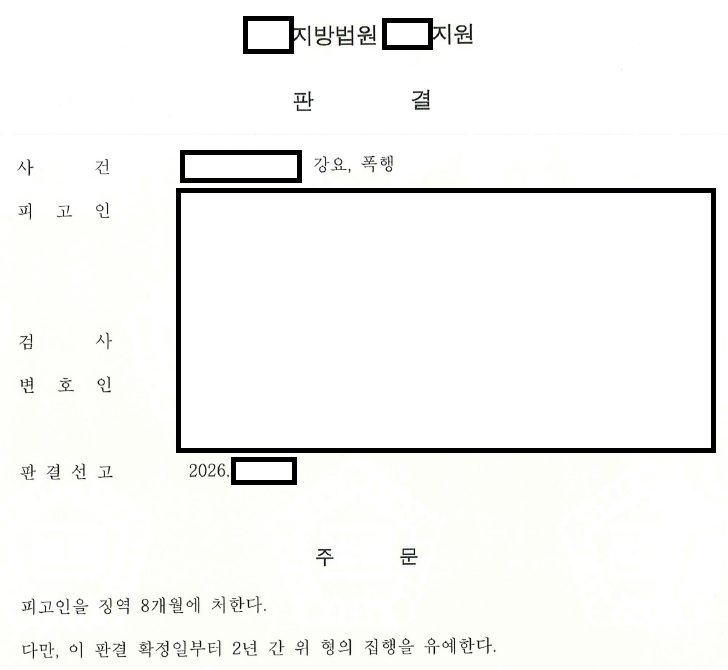
In a criminal judgment involving an academy director charged with coercion and assault, the court sentenced the defendant to eight months in prison, suspended for a two-year probation period.
The court determined that the director’s actions—which included using physical force with a tool and intimidation to compel an instructor to repeat humiliating self-deprecating phrases—went far beyond legitimate management and constituted a serious criminal violation of the employee’s dignity.
This ruling serves as a stern legal reminder that utilizing a position of superiority to inflict mental and physical suffering upon a worker results in significant criminal penalties, even for first-time offenders.
🔍 FAQ: How to Protect Your Dignity
Q1. My director only poked me with a pointer and didn’t leave a mark. Is it still a crime?
A1. Yes. If the act was intended to exert physical force against your will and caused distress, it can be prosecuted as assault. Recordings of the hitting sounds (e.g., ‘thumping’ or ‘clacking’) serve as powerful evidence in court.
Q2. What if the director threatens to sue me for “defamation” or “false accusation”?
A2. Reporting a crime is your right. If you have evidence (recordings, diaries, or witness statements), you are generally protected from defamation charges. Retaliatory threats can actually lead to harsher sentences for the director.
Q3. How quickly should I report the incident?
A3. While the statute of limitations is 5 years for assault and 7 years for coercion, you should report as soon as possible. Fresh evidence and consistent memory are vital for a successful prosecution.

Conclusion: Your Dignity is Non-Negotiable
If you feel physically threatened, leave the area immediately and avoid private meetings with the director. Safety is the priority. Your labor contract is for your teaching skills, not for enduring physical or psychological abuse. If you are in a dangerous situation, take action:
- Secure Safety: Exit the premises if you fear for your physical safety.
- Gather Evidence: Backup all recordings, text messages, and photos of any injuries.
- Medical Records: Visit a clinic immediately if you have any physical pain or bruising.
- Legal Help: Report to the Police (☎112) or the Ministry of Labor (☎1350) and consult with a lawyer or the Korea Legal Aid Corporation (☎132).
Your rights are protected by Korean law. You do not have to endure humiliation alone.
📌 Related Statutes
Criminal Act Article 324 (Coercion) ① A person who, by means of violence or intimidation, interferes with another person’s exercise of his/her right or forces another person to do anything which he/she is not obligated to do, shall be punished by imprisonment with labor for not more than five years or by a fine not exceeding 30 million KRW.
Criminal Act Article 260 (Assault) ① A person who inflicts violence upon the body of another shall be punished by imprisonment with labor for not more than two years, a fine not exceeding five million KRW, detention, or minor fine. ③ The crime… shall not be prosecuted against the objection of the victim.
Attorney Seok Jun Kang


