How to Report to MOEL & Get 10 Million Won Payout (2026 Korean Labor Law Guide)[English Speaking Lawyer. LIBRO][Labor Law 2026]
Introduction: The Panic of Payday
You worked hard for a month. Payday comes, but your bank account is empty. You ask your boss, and they say: “Business is bad. Wait one more week.” One week becomes two. Or worse, you quit, and they refuse to pay your Severance Pay (Toejik-geum).
Do not just wait. In Korea, unpaid wages are a serious violation of the Labor Standards Act, potentially leading to criminal punishment for the employer.
Whether you are an English teacher, a factory worker, or even an undocumented worker (illegal stay), Korean Labor Law protects your right to be paid.
Here is your 4-Step Guide to recovering your money through the Ministry of Employment and Labor (MOEL). Unpaid Wages Korea.
Step 1. The “14-Day” Rule & Evidence Gathering
Before you run to the labor office, you must know the 14-Day Rule.
Under Article 36 of the Labor Standards Act, an employer must pay all wages and severance within 14 days of the payday or your resignation date.
- The Rule: Unless you and your boss agreed in writing to extend the date, delaying payment beyond 14 days is illegal.
- Interest: After 14 days, a 20% annual interest (delayed interest) applies to the unpaid amount.
While you wait, gather these 4 Critical Pieces of Evidence:
[Table 1] The Evidence Checklist (No Contract? No Problem)
| Document | Purpose | If You Don’t Have It… |
| 1. Employment Contract | Proves salary & hours. | Use Bank Statements showing regular deposits from the boss’s name. |
| 2. Attendance Record | Proves you actually worked. | Use Transportation Card (T-Money) history, Google Maps Timeline, or Selfies at work with date stamps. |
| 3. Chat Logs (Kakao/SMS) | Proves the boss admits the debt. | Screenshot messages where the boss says “Sorry, I’ll pay next week.” (This is gold). |
| 4. Boss’s Info | Needed for the form. | You need the Business Registration Certificate. Take a photo of it hanging in the office or keep the boss’s Business Card. |
💡 Lawyer’s Tip: If you worked illegally (no visa), you likely don’t have a contract. Do not worry. Your bank transfer history and KakaoTalk messages are enough to prove an “implied contract” exists.
Step 2. Filing the “Jin-jeong” (Petition)
You are not “suing” the boss yet. You are filing a “Petition for Overdue Wages” (Im-geum Che-bul Jin-jeong-seo) to the MOEL. You can do this without a lawyer.
Method A: Online (The Easy Way)
- Go to the MOEL Minwon Website (labor.moel.go.kr).
- Log in (Requires a Digital Certificate or verification).
- Select “Application for Petition on Unpaid Wages” (임금체불 진정신청).
- Fill in the blanks: Your info, Boss’s info, and the Total Unpaid Amount.
Method B: Visiting in Person (The Sure Way)
If you are not good with Korean websites, go to the local Labor Office.
- Where? You must go to the office that has jurisdiction over your workplace address.
- What to bring? Your ARC (or Passport), the evidence from Step 1, and a calculator.
- Action: Go to the “Customer Service Center” (Min-won-sil) and file a Jin-jeong (Petition).
Step 3. The Investigation & The “Golden Document”
Typically 2 to 4 weeks after filing, a Labor Inspector (Geun-ro Gam-dok-gwan) will summon both you and your boss to the office for an investigation.
The Interrogation
- The Inspector acts as a judge. They review your evidence and ask the boss: “Did you pay him?”
- If the boss admits it (or can’t prove payment), the Inspector orders them to pay by a certain date.
The Goal: “Certificate of Confirmed Unpaid Wages”
If the boss still refuses to pay or is bankrupt, you must ask the Inspector for this specific document:
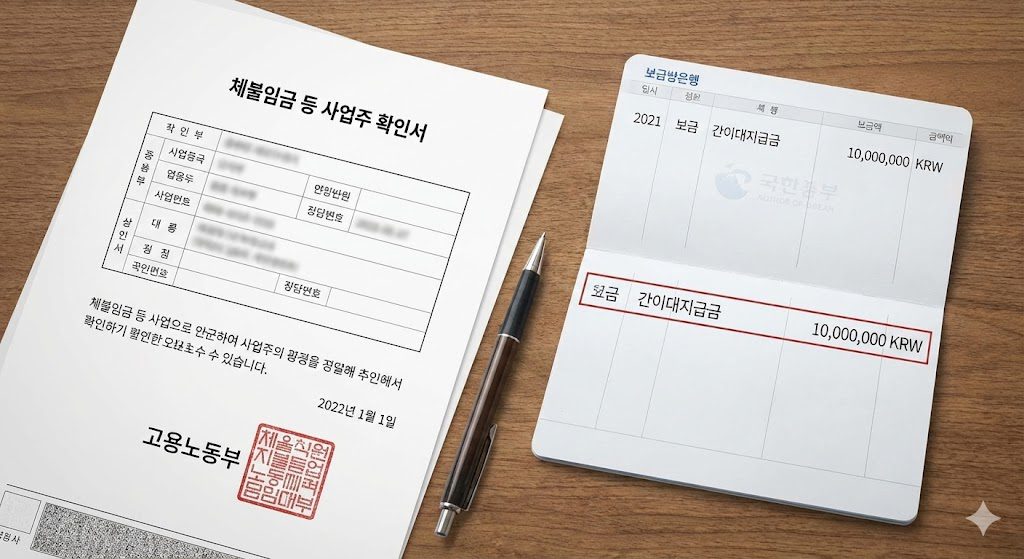
- Korean Name: 체불임금 등 사업주 확인서 (Che-bul Im-geum Deung Sa-eop-ju Hwak-in-seo)
- Why? This official paper confirms the government agrees you are owed money. You need this for Step 4.
Step 4. The Safety Net: “Substitute Payment” (Dae-ji-geup-geum)
What if your boss has no money?
The Korean Government (via the Korea Workers’ Compensation & Welfare Service) can pay you instead, up to a certain limit. This is called “Small Amount Substitute Payment” (Gani-Dae-ji-geup-geum).
[Table 2] How Much Can the Government Pay You?
| Category | Max Amount (KRW) | Notes |
| Unpaid Salary | Up to 7,000,000 KRW | Limited to the last 3 months of unpaid wages. |
| Unpaid Severance | Up to 7,000,000 KRW | Limited to the last 3 years of severance. |
| Total Combined Cap | Max 10,000,000 KRW | You cannot get more than 10 million total. |
- Process: Take the “Certificate” from Step 3 -> Apply at the Labor Welfare Corporation -> Money lands in your account typically within 14 days (subject to review).
Critical Note: Undocumented Workers (Illegal Stay)
“I am working on a tourist visa or expired visa. If I report this, will I be deported?”
The Law & Reality:
The Ministry of Employment and Labor (MOEL) and Immigration are separate.
- Protective Measures: MOEL Inspectors focus on labor law violations, not your visa status. Recently, the Ministry of Justice has also expanded exemptions from notification obligations for victims of wage theft to encourage reporting.
- The Risk: While reporting wage theft does not automatically trigger deportation, the risk is not zero. If your boss maliciously reports you to Immigration first, it can complicate things.
- Strategy: If you are undocumented, consider appointing a Labor Attorney (No-mu-sa) to attend the investigation on your behalf to minimize your exposure.
FAQ: Getting Paid in Korea
Q1: How long does the whole process take?
A:
- Petition & Investigation: Typically 25 ~ 50 days.
- Substitute Payment: Approx. 14 days after application.
- Total: Expect about 2 months to get money in your pocket.
Q2: Does this cost money?
A: No. Filing a petition at the Labor Office is free. If you hire a Labor Attorney, you will pay a fee, but you can do it alone.
Q3: My boss says I am a “Freelancer” (3.3% tax), so I don’t get Severance. Is this true?
A: False. Even if you signed a “Freelancer Contract,” if you worked regular hours (9-6), followed specific orders, and worked for more than 1 year (15+ hours/week), you are likely an Employee under labor law and ARE entitled to Severance Pay.
Q4: Can I get interest on the unpaid wages?
A: Yes. If wages are not paid within 14 days of leaving, 20% annual interest accrues. You can include this in your claim, though collecting it often requires a civil lawsuit.
Summary Checklist
- Wait 14 Days after your last day.
- Collect Evidence: Bank records, KakaoTalks, Boss’s business card.
- File Petition: Visit the Labor Office (MOEL) near your workplace.
- Get Certificate: Get the “Confirmation of Unpaid Wages.”
- Get Paid: Apply for the government “Substitute Payment” (up to 10M KRW).
Are you owed more than 10 Million KRW?
The government safety net only covers up to 10 million. To recover amounts larger than that, you may need a Civil Lawsuit.
Are you planning to quit your job because of unpaid wages? Before you resign, make sure your visa status is safe. Check our [Korea Visa Roadmap 2026] to learn how to switch to a D-10 (Job Seeker) visa without issues.
[Contact LIBRO Global Client Services for High-Value Wage Claims]
LIBRO Global Client Services
Attorney Paul

![[외국인 전문 변호사][ENGLISH SPEAKING KOREAN LAWYER]](https://lawfirmlibro.com/wp-content/uploads/2026/02/Gemini_Generated_Image_fwxnfqfwxnfqfwxn-768x768.jpeg)