The Trap of the Police Protocol (Jo-seo) & Your 3 Rights (2026 Korea Police Investigation Guide)[English Speaking Lawyer. LIBRO]
Introduction: The “Language” Trap
f you have been summoned for a Korea Police Investigation, he most dangerous trap is not the police officer, but the paperwork. You might speak “Survival Korean” well enough to order food or take a taxi. You might think, “I’m innocent, so I’ll just go and explain with my limited Korean.”
This is a fatal mistake.
Legal Korean is a different language. A slight mistranslation of “I pushed him” vs. “I blocked him” can change a Self-Defense case into an Assault conviction (See how to avoid the ‘Mutual Assault’ trap).
The most dangerous weapon in a Korean investigation is the “Suspect Interrogation Protocol” (Pee-eui-ja Shin-mun Jo-seo). While recent legal reforms allow defendants to challenge these documents in court, the “Jo-seo” remains a central piece of evidence. Once you sign it, overturning its contents becomes significantly harder.
This guide explains how to survive the interrogation room using your 3 Fundamental Rights.
1. The “Jo-seo” (Protocol): Why It Is Dangerous
In many Western countries, police record the interview, and that recording is evidence.
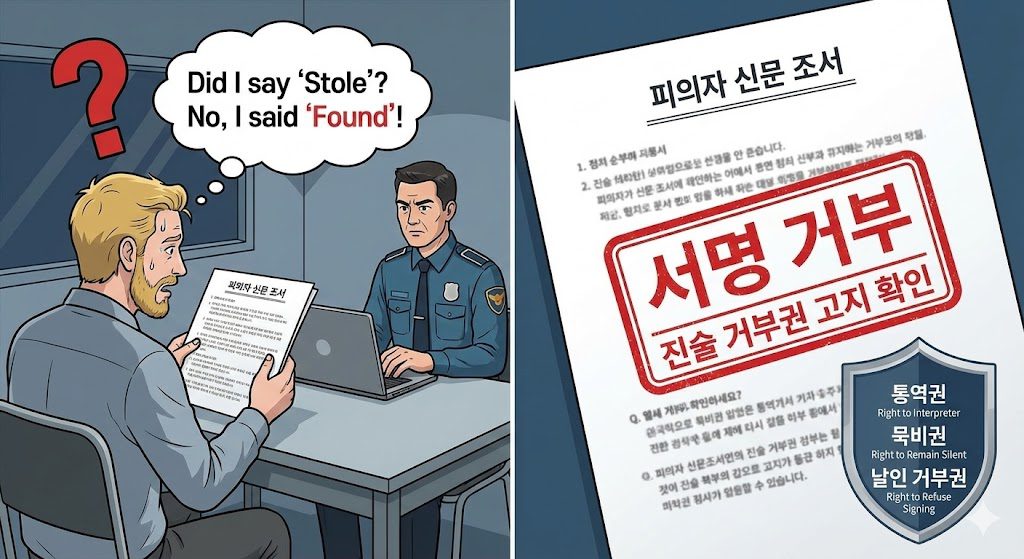
In Korea, the investigator types a summary of what you said into a document called the Jo-seo.
The Danger:
- It is NOT a verbatim transcript. It is the police officer’s summary of your story.
- The Risk: Questions and answers can be abbreviated or distorted.
- You said: “I didn’t mean to steal it; I forgot to pay.”
- Police types: “The suspect admits to taking the item without paying.”
- The Result: If you sign this without correcting it, it becomes powerful evidence against you in court.
2. Right #1: The Right to an Interpreter (Tong-yeok)
“Can I bring a translator?”
Yes. Under the Constitution and Criminal Procedure Act, if you are not fluent in Korean, you have the right to an interpreter.
[Table 1] Police Interpreter vs. Lawyer
| Feature | Police-Appointed Interpreter | Private Lawyer (Bilingual) |
| Neutrality | Supposed to be neutral, but often lacks legal expertise. | 100% On Your Side. |
| Accuracy | May summarize long answers into short “Yes/No.” | Ensures every nuance is translated accurately. |
| Role | Just translates words. | Intervenes if a question is unfair or a translation is wrong. |
⚠️ Critical Warning: Police interpreters are often volunteers or civilians who may not know complex legal terminology. Relying solely on them risks losing the “nuance” of your defense. Bringing a bilingual lawyer is your safest shield.
3. Right #2: The Right to Remain Silent (Muk-bi-kwon)
At the start of the investigation, the police will read you the “Miranda Rights,” including the Right to Remain Silent.
When to Use It:
- Unclear Questions: If you don’t understand the question due to bad translation.
- Memory Gaps: If you don’t remember details (guessing is dangerous).
- Strategy: Using this right is NOT an admission of guilt. It is a smart legal strategy to avoid making mistakes.
How to use it:
Don’t just stay silent (which looks rude). Say:
“I will answer this question after consulting with my lawyer.” (Byeon-ho-sa-wa sang-eui-hu dap-byeon-ha-get-seum-ni-da).
4. Right #3: The Right to Refuse Signing (Nalin-geo-bu)
This is your Final Defense Line.
At the end of the interrogation, the police will print the Jo-seo and ask you to read it and sign (thumbprint) it.
The Review Process (Yeol-lam)
You must read every single line. If the content differs from what you said, or if you cannot read Korean perfectly, DO NOT SIGN.
[Table 2] How to Handle the Signing Phase
| Situation | Action |
| You find a mistake. | Demand a correction immediately. “I did not say ‘hit’, I said ‘pushed’.” Watch them type the change. |
| The nuance is wrong. | Demand they delete the sentence or rewrite it. Do not accept “It means the same thing.” |
| You can’t read Korean. | Ask the interpreter to read the entire document back to you. If they refuse, refuse to sign. |
| You feel pressured. | You have the right to Refuse to Sign (Seo-myeong Geo-bu). An unsigned protocol generally loses its power as primary evidence in court. |
💡 Lawyer’s Tip: Police officers might get annoyed if you refuse to sign. Let them be annoyed. Your future is more important than their paperwork.
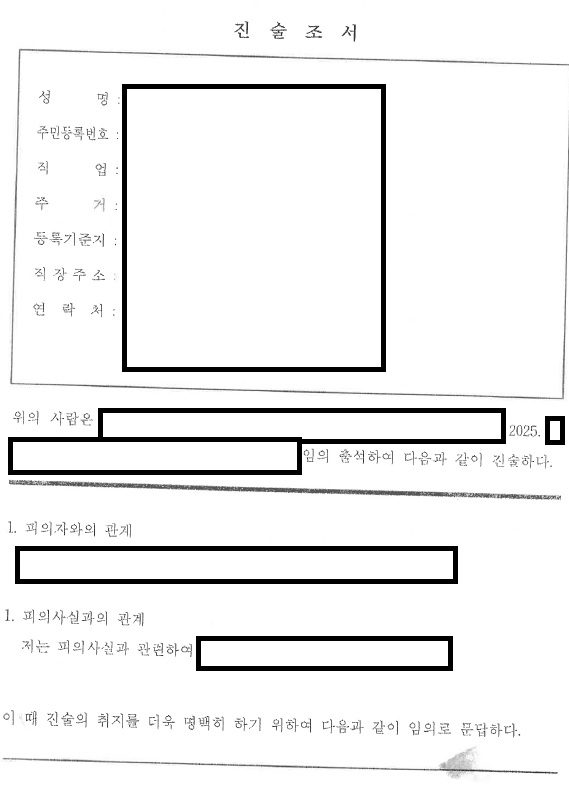
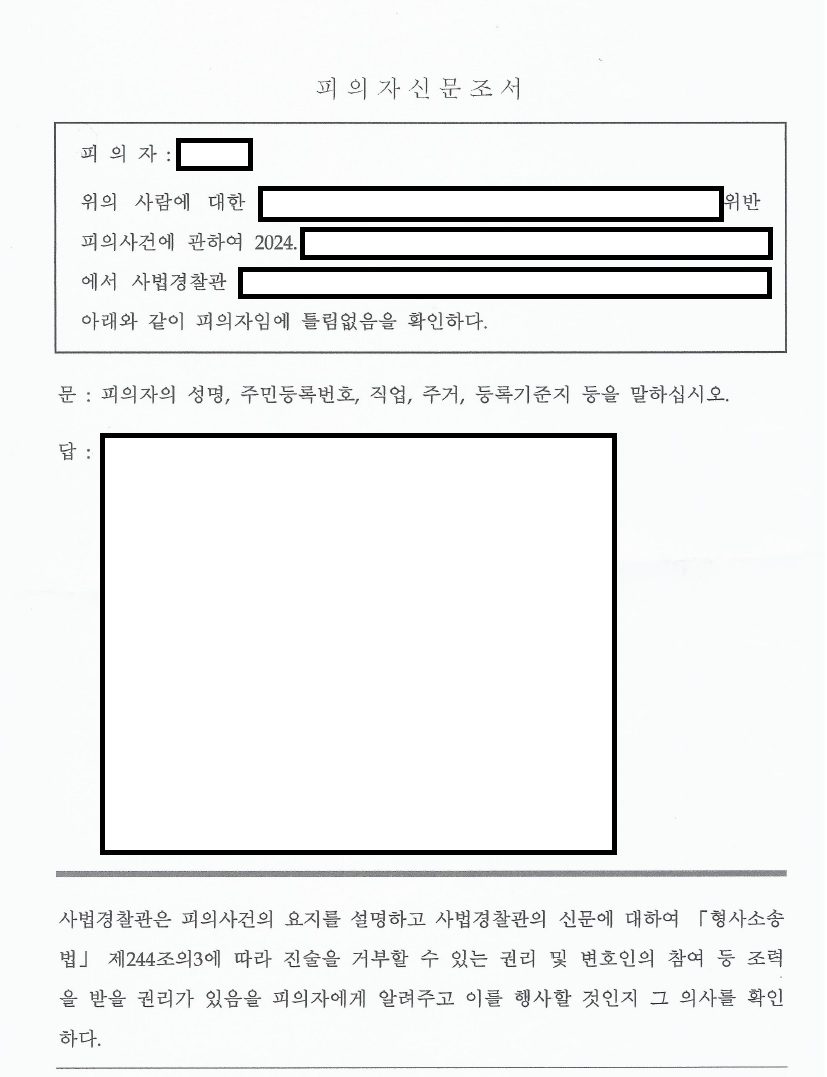
[The provided documents represent core investigative records used by South Korean law enforcement to document testimonies during a criminal inquiry. Attachment 1 is a Statement Protocol (진술조서), typically used for victims or witnesses, which records their personal information and their voluntary account regarding the suspect and the alleged facts of the case. Attachment 2 is a Suspect Interrogation Protocol (피의자신문조서), a formal record of the questioning of an individual suspected of a crime. This document explicitly notes the suspect’s legal rights, such as the right to remain silent and the right to the assistance of counsel under Article 244-3 of the Criminal Procedure Act, ensuring that the interrogation follows due process. Together, these protocols serve as critical evidence and procedural records that form the basis of the investigation file before it is transferred to the prosecution.]
5. Strategy: Why You Need a Lawyer During Investigation
Many foreigners hire a lawyer after they are indicted. By then, the Jo-seo is already written.
What a Lawyer Does in the Room:
- Buffer: We sit beside you. Our presence ensures fair treatment.
- Filter: We catch mistranslations in real-time. “Officer, the suspect didn’t say he ‘stole’ it; he said he ‘picked it up’. Please correct the record.”
- Access: While friends or family are typically not allowed to sit in on investigations due to collusion risks, a Lawyer has a legal right to participate.
FAQ: Police Investigation
Q1: Can I bring a Korean friend to translate?
A: Usually, No. To prevent interference, police generally do not allow friends or family into the interrogation room. Only a registered Lawyer has the legal right to accompany you.
Q2: If I refuse to sign, will the judge think I am guilty?
A: No. It is your legal right. It is much safer to have an unsigned protocol than a signed protocol that contains a false confession.
Q3: I already signed a bad protocol. Is it over?
A: Not necessarily. Due to recent reforms in the Criminal Procedure Act, you can challenge the validity of the protocol in court. However, this is an uphill battle. You need a lawyer immediately to submit a “Written Opinion” to correct the facts before the prosecutor makes a decision.
Summary Checklist for Investigation
- Do Not Go Alone: Ideally, hire a lawyer. If not, ensure a certified interpreter is present.
- Speak Slowly: Short, clear sentences are harder to mistranslate.
- Check the Screen: Watch what the officer is typing (if you can read Hangul).
- Read Before Signing: If anything is wrong, fix it. If you are unsure, DO NOT SIGN.
Summoned by the Police?
Do not risk your visa and freedom on a translation error.A criminal fine could trigger a Sabeom-simsa (Immigration Review) and lead to deportation.
LIBRO Global Client Services provides bilingual legal defense. We sit with you, protect your rights, and ensure your story is told the way you intend.
Attorney Paul

![[외국인 전문 변호사][ENGLISH SPEAKING KOREAN LAWYER]](https://lawfirmlibro.com/wp-content/uploads/2026/02/Gemini_Generated_Image_fwxnfqfwxnfqfwxn-768x768.jpeg)