2026 Korea Money Guide – “My Friend Won’t Pay Me Back!” How to Write a Korean IOU & File a Payment Order [English Speaking Lawyer. LIBRO]
Introduction: “It Started as a Favor…” (Korea Money Guide)
It usually starts with a text: “Hey, can I borrow 1 million won? I’ll pay you back next week.”
Because you trust them (a friend, a coworker, or a fellow expat), you send the money.
Weeks pass. Then months. Now, they are not replying to your messages.
In Korea, recovering lent money can be tricky for foreigners because of the language barrier and unfamiliar legal procedures. However, the Korean legal system offers a powerful, simplified tool called the “Payment Order” (Ji-geup-myeong-ryeong) that allows you to get a court judgment without a full trial.
This guide provides a detailed roadmap to getting your money back.
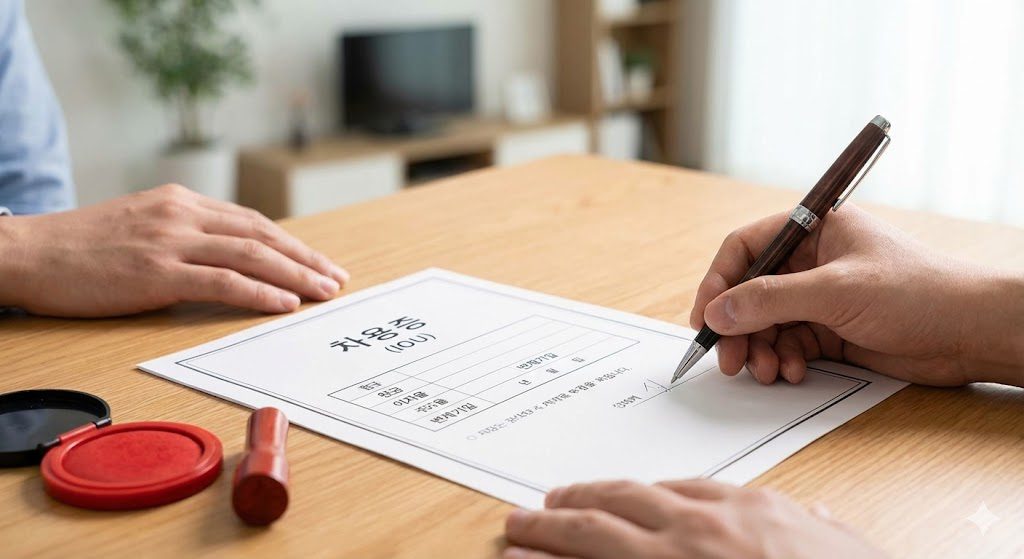
Step 1. Prevention: The Art of the “Cha-yong-jeung” (IOU)
In Korea, a verbal promise is legally valid but incredibly hard to prove. You need a Cha-yong-jeung (차용증), which is a Loan Agreement or IOU. Even if you already lent the money, it is not too late to ask for one now to formalize the debt.
[Table 1] The 6 Mandatory Elements of a Valid Korean IOU
| Element | Korean Term | Why It Is Crucial |
| 1. Principal Amount | 원금 (Won-geum) | The exact amount lent (e.g., 10,000,000 KRW). |
| 2. Interest Rate | 이자율 (I-ja-yul) | Max legal rate is 20% (as of 2026). If undefined, the statutory interest rate (5% Civil / 6% Commercial) applies to delayed payments after a court judgment. |
| 3. Due Date | 변제기일 (Byeon-je-gi-il) | The specific date the money must be returned (YYYY-MM-DD). |
| 4. Personal Info | 인적사항 (In-jeok-sa-hang) | Name, Address, Phone Number, and Resident/ARC Number. |
| 5. Method of Payment | 변제방법 (Byeon-je-bang-beop) | e.g., “Transfer to [Bank Name] Account [Number].” |
| 6. Signature | 서명/날인 (Seo-myeong) | Important: A thumbprint (Ji-jang) is often considered legally stronger than a signature in Korea. |
💡 Lawyer’s Tip: If the debtor refuses to give their Resident Registration Number (Jumin-beon-ho) or ARC number, you must at least get their Date of Birth and Current Address. Without this, filing a lawsuit later becomes significantly harder.
Step 2. The “Golden Rule” of Transfers
Avoid Cash Lending
If you handed them cash, winning in court is extremely difficult unless you have a signed receipt or IOU. There is no paper trail to prove the transaction.
Bank Transfer is King
Always transfer money from your bank account directly to their bank account.
- The “Real Name” Rule: The recipient’s name on the bank account must match the name of the person borrowing the money.
- Memo Field: When sending, write “Loan” (dae-yeo-geum / 대여금) in the transaction memo to clarify intent.
Step 3. No IOU? The “KakaoTalk Trap” Strategy
“I already lent the money without an IOU. Is it hopeless?”
No. In Korea, chat logs (KakaoTalk, WhatsApp, SMS) are accepted as valid circumstantial evidence in civil court.
If you don’t have a contract, you must create evidence by getting them to confirm the debt.
The Script: How to Induce a Confession
Do not just say “You are a liar!” You need them to admit two things: (1) The Amount and (2) The Promise to Pay.
❌ Bad Approach:
You: “Why aren’t you answering me? You are a scammer!”
Them: (Blocks you)
✅ The “Trap” Approach:
You: “Hey [Name], just checking regarding the 2,000,000 KRW I lent you. When can you send it back?”
Them: “I’m really sorry. I’ll send it next Friday.”
📸 SNAPSHOT THIS IMMEDIATELY.
That reply (“I’ll send it next Friday”) acts as a “Digital IOU.” It proves they admit borrowing the specific amount.
Step 4. The “Payment Order” (Ji-geup-myeong-ryeong)
This is the secret weapon of Korean law. It is a simplified lawsuit designed for clear-cut debt cases.
- No Court Hearings: The judge reviews documents only. You don’t need to appear in court.
- Cheap: The fee is roughly 1/10th of a regular lawsuit fee.
- Fast: It typically takes several weeks to 1~2 months, depending on the court.
- Effect: If finalized, it has the same enforcement power (Gang-je-jip-haeng) as a Supreme Court verdict.
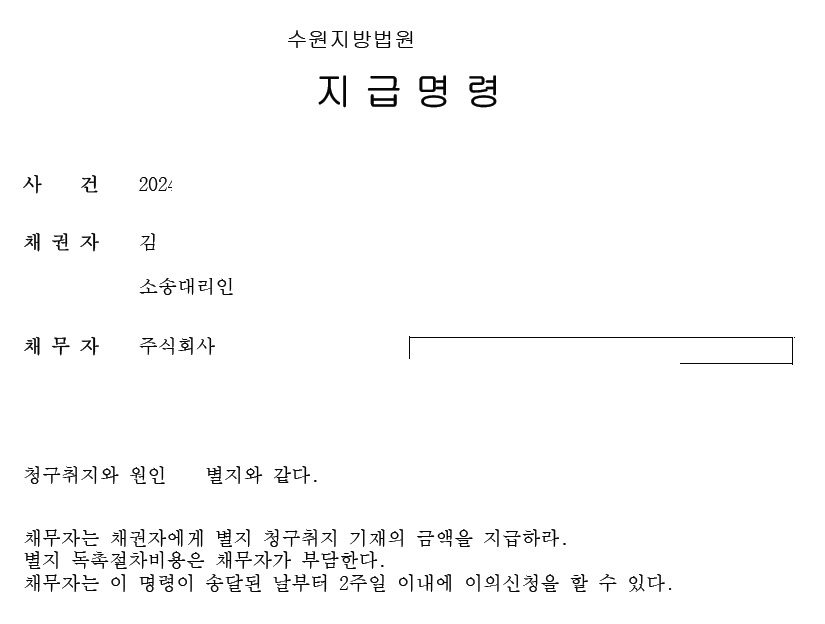
[This document is an actual Payment Order (Order to Pay) issued by the Court in 2024, involving a creditor surnamed Kim and a corporate debtor. The court officially commands the debtor to pay the specific amount and the costs of the dunning procedure as detailed in the attached statement of claim. Under South Korean civil procedure, this order serves as a simplified legal remedy for debt collection; the debtor is granted a two-week window from the date of service to file a formal objection. If no objection is filed within this period, the order becomes finalized and carries the same legal authority as a final court judgment, allowing the creditor to initiate compulsory execution.]
[Table 2] Regular Lawsuit vs. Payment Order
| Feature | Civil Lawsuit (So-song) | Payment Order (Ji-geup-myeong-ryeong) |
| Cost | Expensive (Lawyer + Court fees) | Very Cheap (Approx. 10% of lawsuit fees) |
| Time | 6 months ~ 1 year | 1 ~ 2 months |
| Court Appearance | Required (Multiple times) | None (Document review only) |
| Prerequisite | None | The debtor must receive the mail. (Cannot be used if address is unknown or for “Public Notice” service). |
Step 5. DIY Guide: How to File Online
You can file this yourself via the Korean Courts Electronic Case Filing System (ECFS).
- Website: ecfs.scourt.go.kr
- Prerequisite: You need a Digital Certificate (Gong-dong-in-jeung-seo) and basic Korean reading skills (or Google Translate).
The Clicking Guide:
- Log in with your Digital Certificate.
- Click Submit Documents (서류제출) -> Civil (민사) -> Payment Order (지급명령신청). (Note: Menu structures may change).
- Step 1: Incident Info: Select “Claim for Loan” (Dae-yeo-geum).
- Step 2: Parties:
- Creditor (Chae-gwon-ja): You.
- Debtor (Chae-mu-ja): Them. (You need their Name, Address, and preferably ID number).
- Step 3: Claim Amount: Enter the principal + interest.
- Step 4: Cause of Claim: Brief explanation.
- Template: “I lent [Amount] on [Date] to the debtor. They promised to pay by [Date] but haven’t. I request a payment order.”
- Step 5: Attach Evidence: Upload the IOU or KakaoTalk screenshots (PDF/JPG).
- Step 6: Pay Fees: Pay via bank transfer or credit card.
Result: The court sends a “Payment Order” to the debtor by mail. If the debtor does not object within 2 weeks, the order becomes final. You can then seize their bank accounts.
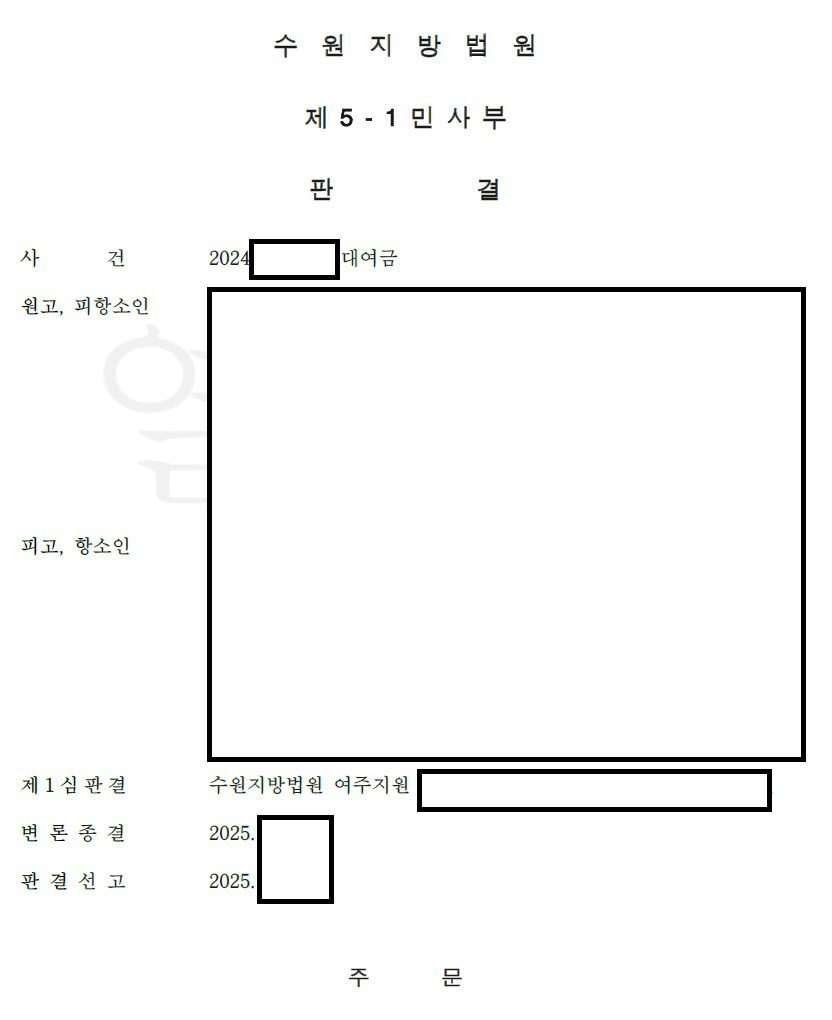
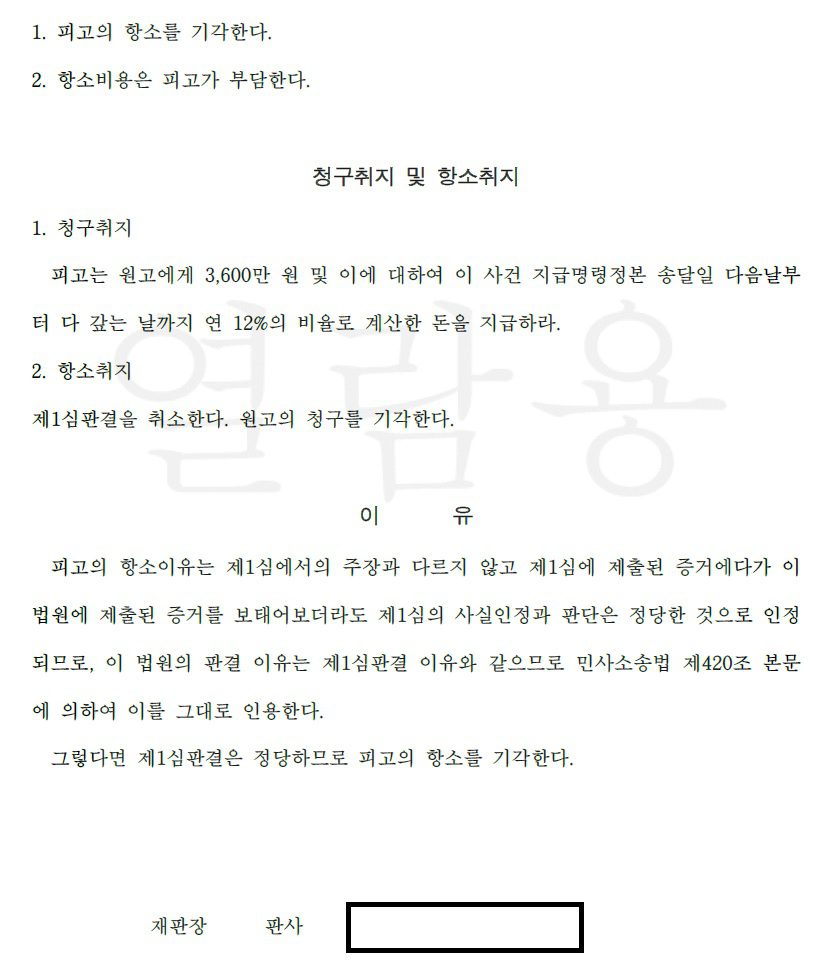
[This legal case involves a loan recovery claim for 36 million KRW, which successfully progressed from an initial Payment Order application to a finalized appellate victory after the defendant filed a formal objection. Representing the plaintiff, we secured a total win in the court of first instance, and when the defendant appealed this decision to the Suwon District Court, the appellate division dismissed the appeal in 2025, ruling that the original judgment was just and based on sufficient evidence. This final judgment confirms the defendant’s obligation to pay the full principal amount plus 12% annual interest, effectively concluding the litigation in favor of our client.]
Lawyer’s Insight ⚖️
“Foreigners often ask: ‘Can I sue them for Fraud (Scamming)?’
In Korean law, simple failure to pay back a loan due to financial hardship is a Civil Matter (Min-sa). Police often reject these cases, advising you to file a civil lawsuit.
It becomes Criminal Fraud (Sagi) only if you can prove they had intent to deceive from the start (e.g., they used a fake name, used the money for gambling instead of the stated ‘hospital bills’, or had massive bad debts when they borrowed). Start with the Payment Order first.”
FAQ: Recovering Money in Korea
Q1: The debtor ran away and I don’t know their address. Can I file a Payment Order?
A: No. For a Payment Order to work, the court must be able to deliver the document to the debtor. If the address is unknown or they are missing, you must file a Full Civil Lawsuit (Min-sa So-song) and use a procedure called “Service by Public Notice” (Gong-si-song-dal).
Q2: What is the maximum legal interest rate in Korea?
A: As of 2026, the maximum legal interest rate for private loans is 20% per year. Even if your contract says 30%, the excess amount is invalid and illegal.
Q3: Can I write the IOU in English?
A: Yes, a contract in English is valid. However, for the Payment Order application, the court requires documents in Korean. You will need to attach a Korean translation of the English IOU when filing. It is best to sign a bilingual version from the start.
Q4: I only have their phone number. Can I find their address?
A: If you file a formal lawsuit (not a Payment Order), your lawyer can request the Court to order the Telecom Company (KT, SKT, LG) to reveal the subscriber’s address and ID number. This is called a “Fact-Finding Request” (Sa-sil-jo-hoe), and the court grants it if deemed necessary for the case.
Attorney Paul

![[외국인 전문 변호사][ENGLISH SPEAKING KOREAN LAWYER]](https://lawfirmlibro.com/wp-content/uploads/2026/02/Gemini_Generated_Image_fwxnfqfwxnfqfwxn-768x768.jpeg)