Korea Immigration Guide – Sabeom-simsa Survival Guide (2026 GUIDE)[English Speaking Lawyer. LIBRO]
Introduction: The Second Nightmare Begins
You were caught for drunk driving (DUI) or got into a physical altercation (Assault). You went through the police investigation, received a court order, and paid a hefty criminal fine of 3 million KRW or 5 million KRW. You thought the ordeal was finally over.
It is not.
A few weeks later, you receive a text or a letter from the Korea Immigration Service: “Please appear for an investigation regarding your violation of the Immigration Act.”
This process is officially called Sabeom-simsa (Immigration Review Korea). The Sabeom-simsa is an administrative review to decide whether you can keep your visa or if you must be issued an Exit Order (Departure Order).
Unlike the criminal court where facts matter most, this review depends heavily on discretion. Your attitude, preparation, and documents can make the difference between staying in Korea and being forced to leave.
Here is the 3-Phase Ultimate Preparation Guide to surviving the Sabeom-simsa(Immigration Review Korea).
1. Understanding the Sabeom-simsa(Immigration Review Korea) Criteria: The “3 Million Won” Rule(2026 GUIDE)
During the Sabeom-simsa, the Immigration Officer has broad discretionary power. They evaluate you based on specific criteria to decide if you are a “danger to the safety and order of the Republic of Korea.”
[Table 1] Immigration Review Korea: How to Pass the Sabeom-simsa The Review Criteria: What They Look For
| Criteria | Key Question | How to Prove It |
| 1. Recidivism Risk | “Will this person commit a crime again?” | Letter of Apology, Pledge of Law-Abiding Life. |
| 2. National Interest | “Does their contribution outweigh their mistake?” | Tax records, high-value employment, special skills. |
| 3. Humanitarian Need | “Will deportation destroy their family/life?” | Family ties in Korea (Spouse/Children), long-term residency. |
| 4. Nature of Crime | “Was it violent, malicious, or drug-related?” | Circumstantial evidence, settlement with victims. |
2. Phase 1: The Mindset & Appearance (First Impression)
The “Suit” Rule
- Recommendation: Wear a formal suit and tie.
- Why? You are asking for mercy and a second chance. Walking in wearing jeans, a hoodie, or slippers signals disrespect for the Korean legal system. A suit demonstrates that you take this situation seriously and respect the officer’s authority.
The Attitude
- Do NOT argue about the crime. The verdict is already out. Do not say, “It was unfair” or “The police were wrong.”
- Show Remorse. Your attitude must be: “I made a terrible mistake, I accept the punishment, and I am deeply reflecting on my actions.”
3. Phase 2: The 4 Critical Documents (The “Golden Set”)
You cannot go empty-handed. You must build a “defense file” that proves your character. These 4 documents are not required by law, but they are required for survival.
[Table 2] The “Golden Set” Documents Checklist
| Document Name | Korean Name | Purpose & Tips |
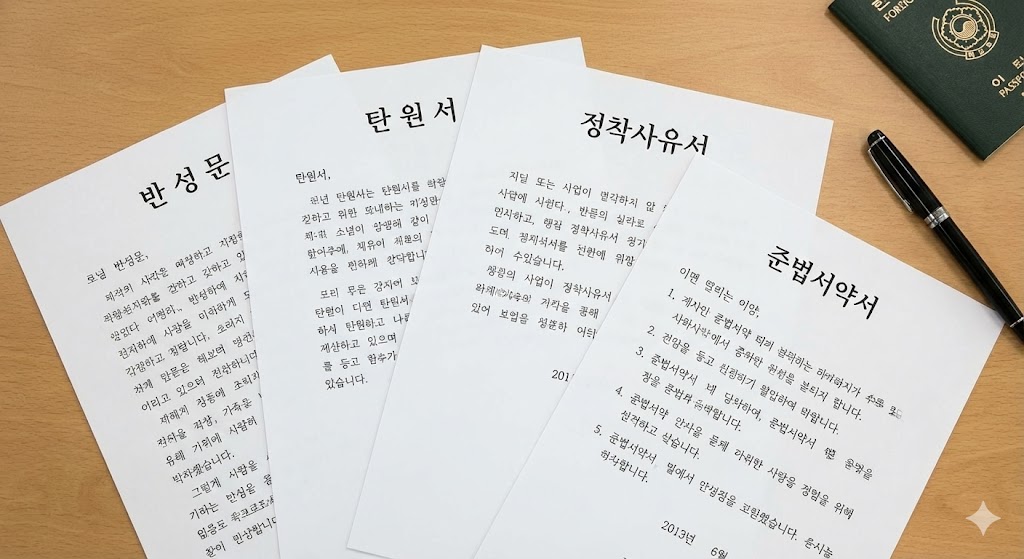
| 1. Letter of Apology | 반성문 (Banseong-mun) | Must be Handwritten. State your fault, your deep regret, and a specific plan to prevent recurrence (e.g., “I sold my car”). If writing in English, attach a Korean translation. |
| 2. Petition for Leniency | 탄원서 (Tanwon-seo) | Written by Korean colleagues, bosses, or friends. “He is a hardworking asset to our company/community.” Attach their ID copy. |
| 3. Settlement Statement | 정착사유서 (Jeongchak-sayu-seo) | Explain why you must stay in Korea. Mention family ties, assets (lease deposit), and your job to prove you are rooted here. |
| 4. Proof of Good Conduct | 준법서약서 (Junbeop-seoyak-seo) | A formal pledge to obey Korean laws in the future. |
4. Phase 3: Proving “Contribution to National Interest”
This is your defense against the claim that you are a “burden” to society. You must prove you are a Good Resident.
Checklist of 5 Contribution Documents:
- Tax Payment Certificate (Nap-se-jeung-myeong-seo): Shows you pay taxes faithfully and are not a financial burden.
- Volunteer Work Certificate: Official records from VMS or 1365 portal showing community service.
- Donation Receipts: Proof of charitable giving in Korea.
- Awards & Commendations: Any awards from your company, city, or government.
- Korean Language Ability: TOPIK scores or KIIP completion certificates (shows effort to integrate).
Lawyer’s Insight ⚖️
“Many foreigners worry about the ‘3 Million KRW’ rule. While there is no automatic deportation line written in the statute, a fine of 3 million KRW is generally treated as a key benchmark for a serious immigration review, significantly increasing the risk of an Exit Order.
Furthermore, be careful of cumulative fines. If your total fines over recent years (often assessed over the last 3–5 years) reach or exceed 5,000,000 KRW, you also become a strong candidate for deportation.
The ‘Sabeom-simsa’ is a plea for mercy. I have seen clients with 5 million KRW fines stay because they prepared excellent apology letters and proof of contribution. Humility, preparation, and professional legal defense are your only tools here.“
FAQ: Immigration Review & Deportation
Q1: Is there a specific fine amount that leads to automatic deportation?
A: There is no fully automatic deportation line written in the statute, but in practice, immigration uses fine amounts as powerful indicators.
- Under 3 Million KRW: In many first-offender cases, this leads to a warning or caution rather than deportation, unless the crime involves drugs, sex crimes, or similar serious offenses.
- Over 3 Million KRW: In practice, this puts you in a high‑risk category for an Exit Order, so preparation for Sabeom-simsa becomes critical.
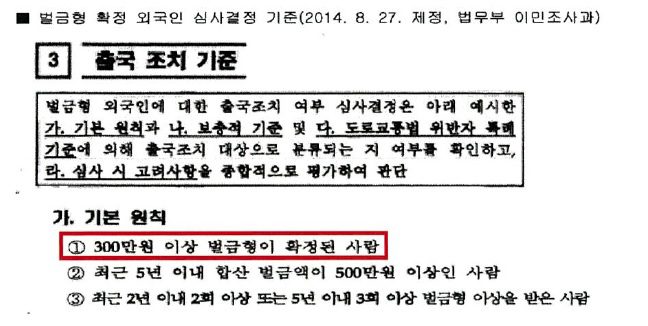
[In the context of Suwon District Court Case No. 2021Gudan2159, this above document serves as the regulatory basis for the immigration authorities’ discretionary power. It demonstrates that a single fine exceeding 3 million KRW (as highlighted in the red box) is a primary trigger for the authorities to initiate a departure order process, regardless of the nature of the crime, unless exceptional mitigating factors are present.]
Q2: Can I bring a lawyer to the Immigration Office?
A: YES. It is highly recommended. A lawyer can accompany you during the interview, ensure your rights are protected, and submit a professional “Attorney’s Opinion Letter” which legally argues why you should stay. Their presence alone signals that you are taking the matter seriously.
Q3: What happens if I fail the Sabeom-simsa?
A: You will likely be issued a “Departure Order” (Chul-guk-myeong-ryeong). You must leave Korea usually within 30 days. If you disobey, it becomes a “Forced Eviction” (Deportation), which carries a longer re-entry ban.
Q4: Can I appeal the decision?
A: Yes. You can file an Administrative Appeal (Haeng-jeong-sim-pan) or an Administrative Litigation to the court to suspend the exit order. However, this is a complex legal battle that requires immediate action (within days of the order).
Q5: I only paid a 1 million KRW fine. Do I still need to go?
A: If Immigration summons you, you must go. Even for smaller fines, they need to close the file. In this case, you will likely sign a “Law-Abiding Oath” and be released with a “Warning.” Do not take it lightly—dress well and apologize to ensure it ends with just a warning.
Attorney Paul

![[외국인 전문 변호사][ENGLISH SPEAKING KOREAN LAWYER]](https://lawfirmlibro.com/wp-content/uploads/2026/02/Gemini_Generated_Image_fwxnfqfwxnfqfwxn-768x768.jpeg)