2026 Korea Divorce Guide- A Foreigner’s Guide to Litigation & The 6 Legal Grounds [English Speaking Lawyer. LIBRO]
Introduction: When “Agreement” is Impossible (2026 Korea Divorce Guide)
Divorce in Korea falls into two categories:
- Consensual Divorce (Hyeop-ui Ihon): You and your spouse agree on everything. Simple and fast.
- Judicial Divorce (Jaepan-sang Ihon): You fight in court because one party refuses to divorce, or you cannot agree on money/custody.
If you are reading this, you are likely in the second category.
Perhaps your Korean spouse served you with papers, or you need to escape a toxic marriage but they won’t let you go.
In a Judicial Divorce, the judge decides your fate based on Article 840 of the Civil Act. This guide explains how to fight this battle and protect your rights.
1. Can I Divorce? The “6 Legal Grounds” (Article 840)
Unlike some Western countries with “No-Fault Divorce,” Korea requires a specific reason to end a marriage in court. You must prove one of the following:
[Table 1] The 6 Grounds for Judicial Divorce
| Ground | Description | Examples |
| 1. Unchastity | An act of unfaithfulness. | Adultery, “emotional cheating,” visiting room salons. |
| 2. Malicious Desertion | Abandoning the spouse without reason. | Moving out, changing door codes, refusing to support the family. |
| 3. Extreme Maltreatment (by Spouse/In-laws) | Severe mistreatment. | Physical abuse, verbal abuse, forcing you out of the house. |
| 4. Extreme Maltreatment (of your Parents) | Spouse mistreating your parents. | Insulting or hitting your parents (rare for foreigners, but applies). |
| 5. Missing for 3 Years | Spouse’s life/death is unknown. | Disappearance for over 3 years. |
| 6. Other Serious Causes | Marriage is irretrievably broken. | Gambling addiction, severe debt, refusal of intimacy, separation with no hope of reconciliation. |
⚠️ Note on “Cheating”: You must file within 6 months of learning about the affair or 2 years from when it happened.
2. Scenario A: “I Received a Complaint (So-jang)”
One day, a court officer delivers a thick envelope. Inside is the Complaint (So-jang) filed by your spouse.
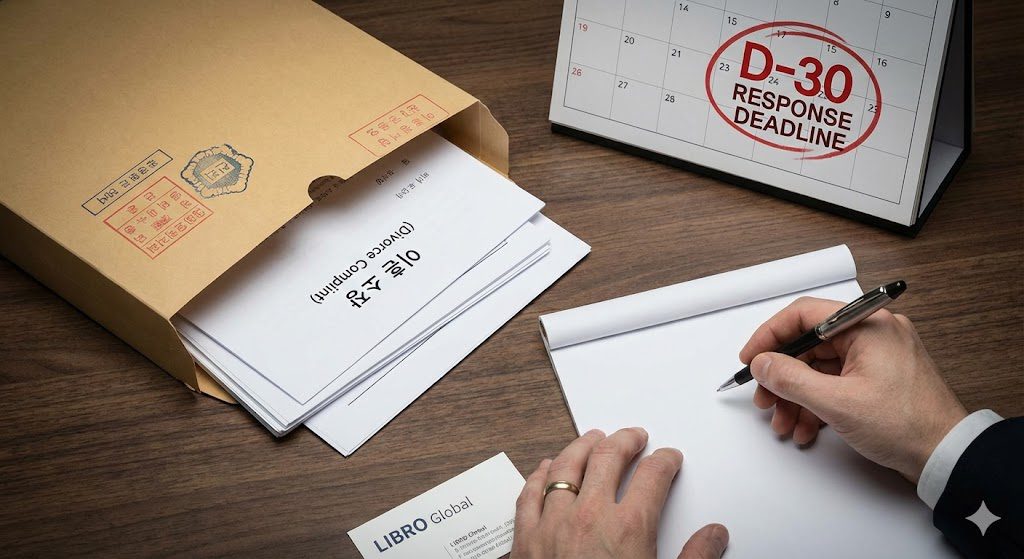
The 30-Day Deadline (Critical)
You have exactly 30 days from the date you received the papers to submit a Written Answer (Dap-byeon-seo) to the Family Court.
- If you do nothing: The court may proceed with a “Judgment without Hearing” (Mu-byeon-ron Pan-gyeol), assuming you admit to all allegations. This makes losing highly probable.
- Action: Contact a lawyer immediately. Do not write the answer yourself in broken Korean. You need to deny the false claims and file a Counterclaim (Ban-so) if your spouse is actually at fault.
3. Scenario B: “I Want to File for Divorce”
If you are the one filing, you are the Plaintiff (Won-go). You bear the “Burden of Proof.”
Preparation Checklist
- Evidence: Photos of bruises (abuse), recordings of verbal fights, screenshots of cheating messages, bank statements showing financial irresponsibility.
- Jurisdiction: You file at the Family Court covering the couple’s last common residence.
- Provisional Attachment (Ga-am-ryu): Before filing, your lawyer should freeze your spouse’s assets so they cannot hide money during the trial.
4. The 3 Main Battlefields: Money & Kids
1. Alimony (Wi-ja-ryo)
- What is it? Compensation for mental suffering caused by the spouse responsible for the breakup (e.g., the cheater or abuser).
- Amount: Typically 10 million ~ 30 million KRW, though it can vary based on severity and duration. Rarely exceeds 50 million KRW.
2. Property Division (Jae-san-bun-hal)
- The Rule: It doesn’t matter whose name is on the apartment deed. It matters who contributed to building the asset.
- Foreigner Strategy: Even if you didn’t work, housekeeping and raising children counts as “contribution” (up to 30~50% after 10+ years). You must list all assets: Real estate, deposits, stocks, and severance pay.
3. Child Custody (Yang-yuk-gwon) – The Hardest Fight
Foreign spouses often fear: “My Korean is bad, so the court will give the kids to my Korean spouse.”
This is not true. The court looks at the “Welfare of the Child,” not just language skills.
How to Defend Custody as a Foreigner:
- Primary Caregiver: Prove you are the one feeding, bathing, and putting the child to sleep every day.
- Auxiliary Caregivers (Bo-jo Yang-yuk-ja): If your Korean is weak, show you have a support system (e.g., a Korean tutor, relatives, or a helper) to assist with schoolwork.
- Stability: Show you have a stable bond with the child. Courts hate changing the child’s environment.
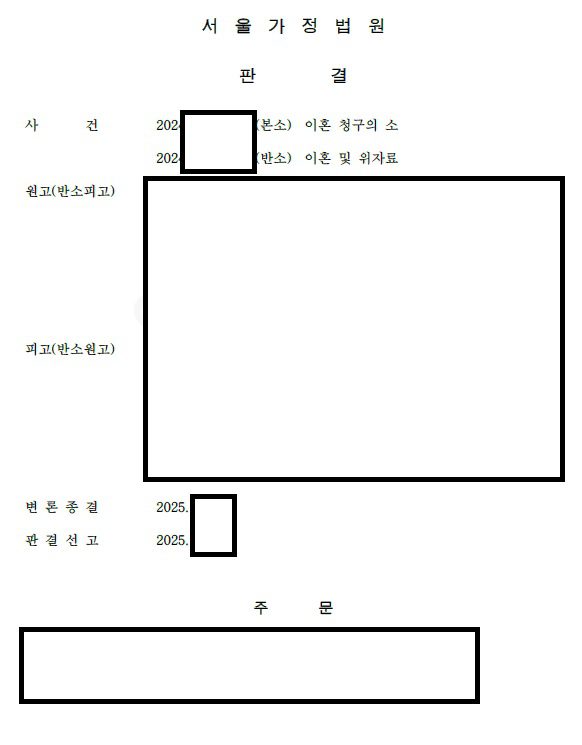
[This document is a formal Judgment issued by the Seoul Family Court in 2025 concerning a legal dispute over Divorce and Alimony (위자료). The case involves both an initial claim and a counter-claim (반소), indicating that both parties are seeking the legal dissolution of their marriage and financial compensation from one another. Following the conclusion of oral arguments in 2025, the court rendered this verdict to settle the terms of the divorce, including the determination of liability for the marital breakdown and the corresponding award of alimony.]
FAQ: Divorce in Korea
Q1: My spouse threatened to cancel my visa if I divorce. Is this possible?
A: If the divorce is due to your spouse’s fault (abuse, cheating), you can extend your F-6 visa or apply for F-5 permanent residency even after divorce. You need the court verdict stating their fault.
Threatening visa cancellation is a common tactic to force an unfair settlement. Do not be intimidated. You can maintain your F-6 status even after divorce if you are the victim. Read the full strategy here: [How to Extend F-6 Visa After Divorce]
Q2: Can I just leave Korea with my child?
A: NO. Taking the child abroad without the other parent’s consent can be considered Child Abduction. You could face criminal charges and suffer a critical disadvantage in the custody battle. You must get a court order first.
Q3: How long does a lawsuit take?
A: A contested divorce typically takes 6 months to 1 year. It involves mediation sessions (Jo-jeong) and family investigator interviews (Ga-sa Jo-sa).
Summary Checklist
- Check Grounds: Do you have evidence for one of the 6 reasons?
- Deadline: If served, file an Answer within 30 days.
- Assets: Freeze assets (Provisional Attachment) before they disappear.
- Custody: Prove you are the primary caregiver, not just the “richer” parent.
Facing a divorce battle in a foreign land?
Do not let language barriers cost you your assets or your children.
Contact LIBRO Global Client Services for aggressive representation in Korean Family Court.
Attorney Paul

![[외국인 전문 변호사][ENGLISH SPEAKING KOREAN LAWYER]](https://lawfirmlibro.com/wp-content/uploads/2026/02/Gemini_Generated_Image_fwxnfqfwxnfqfwxn-768x768.jpeg)