Witness Summons & Testimony in Korea: A Lawyer’s Guide(2026 Korea Court Guide)[English Speaking Lawyer. LIBRO]
Introduction: The “Blue Envelope” from Court (2026 Korea Court Guide)
One day, you receive a registered letter from the Seoul Central District Court (or another local court). Inside is a “Witness Summons” (Jeung-in So-hwan-jang).
Or perhaps you are in the middle of a lawsuit (civil or criminal), and your lawyer tells you: “We need to put your friend/colleague on the stand to prove you are innocent.”
In Korea, witness testimony is often the “Key Card” that decides the outcome of a trial. However, the courtroom is a battlefield. If you (or your witness) are not prepared, aggressive questioning can destroy your credibility.
This guide explains the Step-by-Step Process of being a witness in Korea and how to survive the pressure. [Witness Testimony Korea 2026 Guide)
1. How a Witness is Called (The Application)
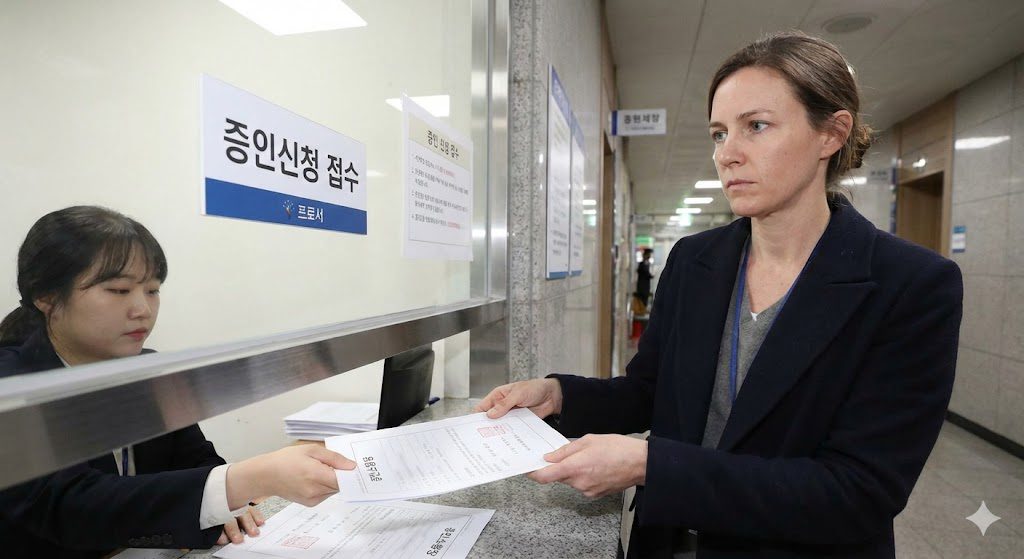
You cannot just bring a friend to court on the trial day. There is a strict procedure.
A. The Application (Jeung-in Sin-cheong)
- Who does it? The lawyer representing the Plaintiff (Civil) or the Prosecutor/Defense (Criminal) submits a “Witness Application” to the judge.
- Content: It must state who the witness is and what they will prove (e.g., “Mr. Smith saw the assault on May 5th”).
B. The Decision (Chae-taek)
- The judge reviews the application. If the witness is unnecessary or irrelevant, the judge will Reject (Gi-gak) it.
- If accepted (Chae-taek), the court sends the official Summons.
C. The Consequence of No-Show
If you receive a summons and do not attend without a valid reason (e.g., severe illness, overseas travel), the court can fine you up to 5,000,000 KRW. In criminal cases, continued refusal can lead to a Warrant of Detainment (Gu-in-jang) or confinement for up to 7 days. Do not ignore the mail.
2. The Courtroom Battle: The “3-Stage” Examination
On the trial day, you will sit in the witness chair. You must swear an Oath (Seon-seo) to tell the truth. Then, the questioning begins.
[Table 1] The Flow of Witness Examination
| Stage | Korean Name | Who Asks? | Purpose & Atmosphere |
| 1. Direct Exam | Ju-sin-mun | Your Side (Friendly) | Comfortable. The lawyer asks prepared questions to let you tell your story clearly. “Did you see Mr. Kim hit Mr. Lee?” |
| 2. Cross Exam | Ban-dae-sin-mun | Opposing Side (Hostile) | Aggressive. The opposing lawyer tries to find lies, contradictions, or memory gaps. “Are you sure? Isn’t it true you were drunk?” |
| 3. Re-Direct | Jae-ju-sin-mun | Your Side (Recovery) | Clarification. If the Cross Exam made you look bad, your lawyer asks follow-up questions to fix the misunderstanding. |
3. Surviving the “Cross Examination” (The Danger Zone)
The opposing lawyer’s job is to destroy your credibility. They will use specific tactics to confuse you.
Common Tactics used against Foreigners:
- Rapid Fire: Asking questions fast to make you slip up.
- Translation Traps: Exploiting nuances in interpretation to make your answer sound inconsistent.
- Provocation: Making you angry so you say something emotional instead of factual.
Counter-Strategy:
- Pause: Wait 3 seconds before answering. This gives the interpreter time and lets you think.
- Short Answers: “Yes,” “No,” or “I don’t know.” Do not volunteer extra information.
- Look at the Judge: Do not look at the angry lawyer. Address your answers to the Judge.
4. The “Perjury” Trap: Lying vs. Forgetting
Article 152 of the Criminal Act: A witness who gives false testimony under oath shall be punished by imprisonment for up to 5 years or a fine of up to 10 million KRW. In Korea, criminal fines exceeding 3 million KRW can trigger an immigration review regarding your visa status. Details on this process can be found here: [Guide to Immigration Review (Sabeom-simsa) & Fines]
The Critical Distinction
Many witnesses panic and try to “guess” an answer because they feel pressure to help their side. This is dangerous.
- Perjury (Wi-jeung): Stating something as true when you know it is false, or stating you saw something you didn’t.
- “I Don’t Remember” (Gi-eok-i An-nam-ni-da): This is a valid legal answer if you genuinely forgot.
- Caveat: If you say “I don’t remember” to everything, the judge may consider your testimony unreliable (low credibility). Use it only when true.
⚠️ Lawyer’s Warning:
If you are asked: “What color was the car?”
- Bad: “I think it was… red?” (If it was blue, you look like a liar).
- Good: “It was dark, so I do not clearly remember the color.”
Never guess.
5. Why “Witness Preparation” is Essential
In the US or UK, “Witness Prep” is standard. In Korea, it is also a critical part of litigation strategy.Note: This is not coaching you to lie. It is preparing you to tell the truth clearly and consistently.
What We Do in Witness Prep:
- Review the Facts: We show you your previous statements (police protocols) so you don’t accidentally contradict yourself due to memory loss.
- Mock Cross-Examination: We play the role of the “Bad Lawyer” and attack you with tough questions so you don’t freeze in court.
- Demeanor Check: We correct bad habits (e.g., looking at the ceiling, speaking too fast for the interpreter).
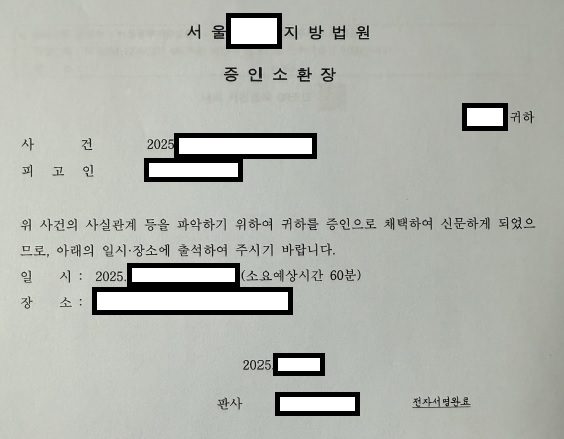
[The provided document is a formal Witness Summons (증인소환장) issued by the Seoul District Court in 2025 regarding a specific legal case. This official notice informs the recipient that they have been selected to provide testimony to help the court clarify the factual circumstances of the matter. The summons clearly specifies the required date and time for the appearance, the exact courtroom location, and the estimated duration for the interrogation, which is noted as 60 minutes in this example. Under South Korean law, receiving such a summons creates a legal obligation for the witness to attend the proceedings, as their testimony serves as essential evidence for the judge to reach a fair and accurate verdict.]
FAQ: Courtroom Essentials
Q1: Can I refuse to testify?
A: Generally, No. Witness duty is mandatory. However, you can refuse to answer specific questions if the answer would incriminate you or your close family (Right to Refuse Testimony – Jeung-eon Geo-bu-gwon).
Q2: I don’t speak Korean. Will there be an interpreter?
A: Yes. The court will appoint a judicial interpreter. However, court interpreters vary in quality. If the case is critical, your lawyer should speak your language to object if the interpreter translates incorrectly.
Q3: Do I get paid?
A: Yes. After the hearing, the court pays a “Witness Daily Allowance” (Yeo-bi) to cover travel and meals. It is usually small (approx. 50,000 ~ 100,000 KRW, varying by distance), not a “fee” for speaking.
Q4: I am afraid of the defendant. Do I have to see them?
A: If you are a victim of a violent crime (sexual assault, organized crime), you can request “Witness Protection Measures.” The court can set up a screen (shield) so the defendant cannot see you, or allow you to testify via video link from a separate room.
Summary Checklist for Witnesses
- Receive Summons: Check the date and location. Do not ignore it.
- Prep: Meet with the lawyer before the trial to review your statement.
- Truth: Do not guess. If you don’t remember, say “I don’t remember.”
- Calm: Keep answers short. Address the Judge, not the lawyer.
Are you calling a witness or being called as one?
A single mistake on the stand can jeopardize the entire lawsuit.Contact LIBRO Global Client Services for professional Witness Preparation and Litigation Support.
Attorney Paul

![[외국인 전문 변호사][ENGLISH SPEAKING KOREAN LAWYER]](https://lawfirmlibro.com/wp-content/uploads/2026/02/Gemini_Generated_Image_fwxnfqfwxnfqfwxn-768x768.jpeg)