Foreigners in Korea 2026: 4 Steps to Survive ‘Hakpokwi’ & Avoid Record(2026)[English Speaking Lawyer. LIBRO]
Introduction: The Call Every Parent Dreads (Foreigners in Korea 2026)
As a School Violence Lawyer in Korea representing foreign families, I have seen too many students unfairly punished because they missed the ‘Golden Time. You receive a phone call from your child’s homeroom teacher or a School Police Officer (SPO).
“Your child has been reported for School Violence (Hak-pok).”
For foreign parents, this is a nightmare. You might think, “It was just kids fighting,” or “My child was the one being teased!”However, in Korea, fighting back is often penalized as Mutual Assault (read more)
Wake up. In Korea, School Violence is not just a school matter; it is a quasi-legal proceeding that can destroy your child’s future.
A record of “Major Measures” (Level 4 or higher) in the Student Life Record (Saeng-gi-bu) is preserved for 4 years after graduation, potentially disqualifying them from top universities or special-purpose high schools. Worse for ex-pat families, a police record involving violence can trigger an Immigration Review (Sabeom-simsa) that threatens your visa status.
Unlike in many Western countries where the principal handles discipline, Korea uses a rigorous legal body called the School Violence Deliberation Committee (Hak-pok-wi). Hakpokwi (School Violence Committee) is a quasi-judicial body in Korean schools that decides disciplinary actions for bullying cases.
If you want to protect your child’s future, you must understand these 3 Critical Stages immediately.

1. Understanding the Risk: The “9 Measures” (Article 17)
The “Hakpokwi” issues legally binding “Measures” (Cho-chi). You must aim for Level 3 or lower to minimize the impact.
[Table 1] The 9 Levels of School Violence Measures
| Measure Level | Action Taken | Impact on Student Record (Saeng-gi-bu) |
| Level 1 ~ 3 | Written Apology, No Contact, School Service. | Conditional Record: Deleted upon graduation if no recurrence. Target Zone. |
| Level 4 ~ 5 | Social Service / Special Education. | RECORDED. Preserved for 4 years after graduation (deletion possible upon deliberation). |
| Level 6 ~ 7 | Suspension / Class Change. | RECORDED. Critical damage to University Admissions. Preserved for 4 years. |
| Level 8 | Forced Transfer (Jeon-hak). | RECORDED. Fatal for Elite Schools. Preserved for 4 years (rarely deleted). |
| Level 9 | Expulsion (To-hak). | Education terminated (High School only). |
⚠️ Critical Warning: “School Violence” in Korea is broadly defined. It includes physical assault, cyberbullying (KakaoTalk insults), coercion, and even ostracism (Wang-ta).
2. Step 1: The “Golden Time” (Initial Investigation)
Before the Committee meets, the school and SPO conduct an investigation. This is where 80% of cases are won or lost.
The Danger of the “Written Statement”
Your child will be asked to write a “Statement of Incident” (Jin-sul-seo).
- The Trap: Foreign children often write, “I hit him because he made fun of me.”
- The Result: This is an Admission of Guilt. In Korea, “He started it” is not a complete defense; it often leads to “Mutual Violence” (Ssangbang).
Action Plan:
- Do NOT let your child write alone. You have the right to be present or have a lawyer review the statement.
- Translation is Key: Do not rely on the school’s interpreter. If your child’s nuance is mistranslated, they become the aggressor.
- School Head Resolution: If the injury is minor (less than 2 weeks), there is no retaliation risk, and a settlement is reached, the school principal can close the case without opening a Committee. This is your best exit strategy.
3. Step 2: The Committee Hearing (Hak-pok-wi)
If the case goes to the Education Support Office’s Committee, it becomes a trial-like setting.
Can a Lawyer Attend?
YES. You can and should bring a lawyer. We argue based on the 5 Judging Criteria:
- Severity of the violence.
- Continuity (Was it repeated?).
- Intent (Was it on purpose?).
- Reflection (Is the student sorry?).
- Reconciliation (Did they settle?).
4. Step 3: The “Double Jeopardy” (Criminal & Civil Lawsuits)
The School Committee is administrative. The Police and Court are separate.
A. Criminal Liability (Age Matters)
- Under 10: No punishment (Criminal Minor).
- 10 ~ 13 (Juvenile Offender): No criminal record, but can be sent to Juvenile Court (Protection Case) for measures like probation or community service.
- 14 ~ 18: Can be criminally charged (Fined or Imprisoned). If the crime is serious, the case is sent to the Prosecutor, but often it is transferred to the Juvenile Department for protective disposition to avoid a permanent criminal record.
B. Civil Lawsuit (Money)
The victim’s parents can sue you for Medical Bills and Psychological Consolation Money (Wi-ja-ryo). Even if your child is cleared by the police (under 14), you (the parents) are civilly liable for “Failure to Supervise.”
5. What if the Decision is Unfair? (Administrative Lawsuit)
If your child receives a Level 4+ Measure unfairly, you must act fast.
The Remedy: Administrative Injunction (Jip-haeng-jeong-ji)
Your lawyer files a lawsuit to “Cancel the Discipline” and simultaneously asks the Court to “Suspend the Execution” until the trial is over.
- Why? This prevents the record from being finalized immediately, buying time for university applications.
- Process:
- Administrative Appeal (Haeng-jeong-sim-pan): A simpler review by the Education Office.
- Administrative Litigation (Haeng-jeong-so-song): A formal court trial to cancel the decision.
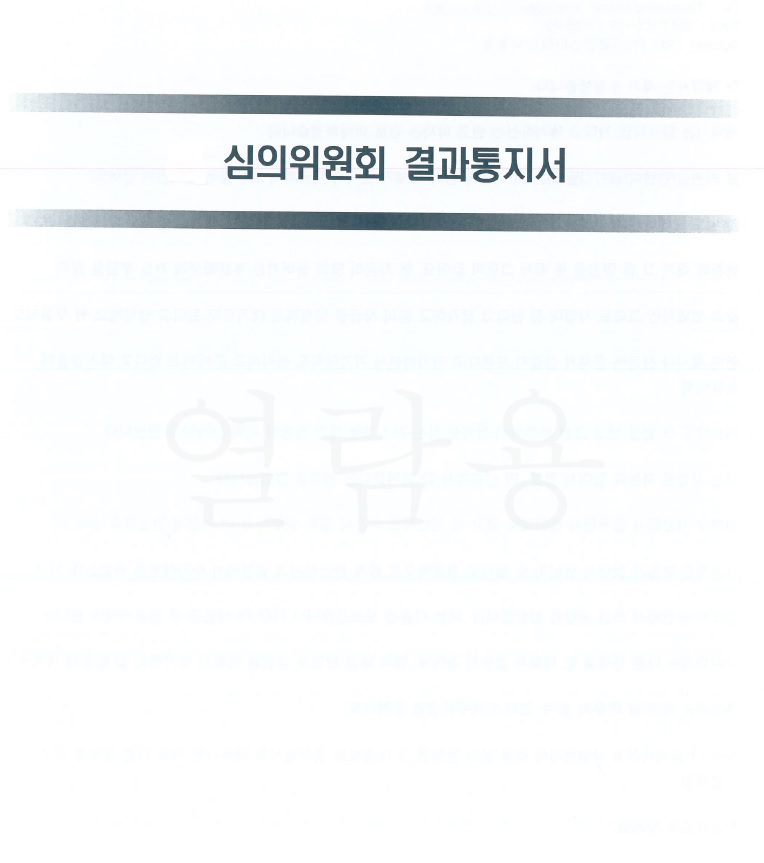
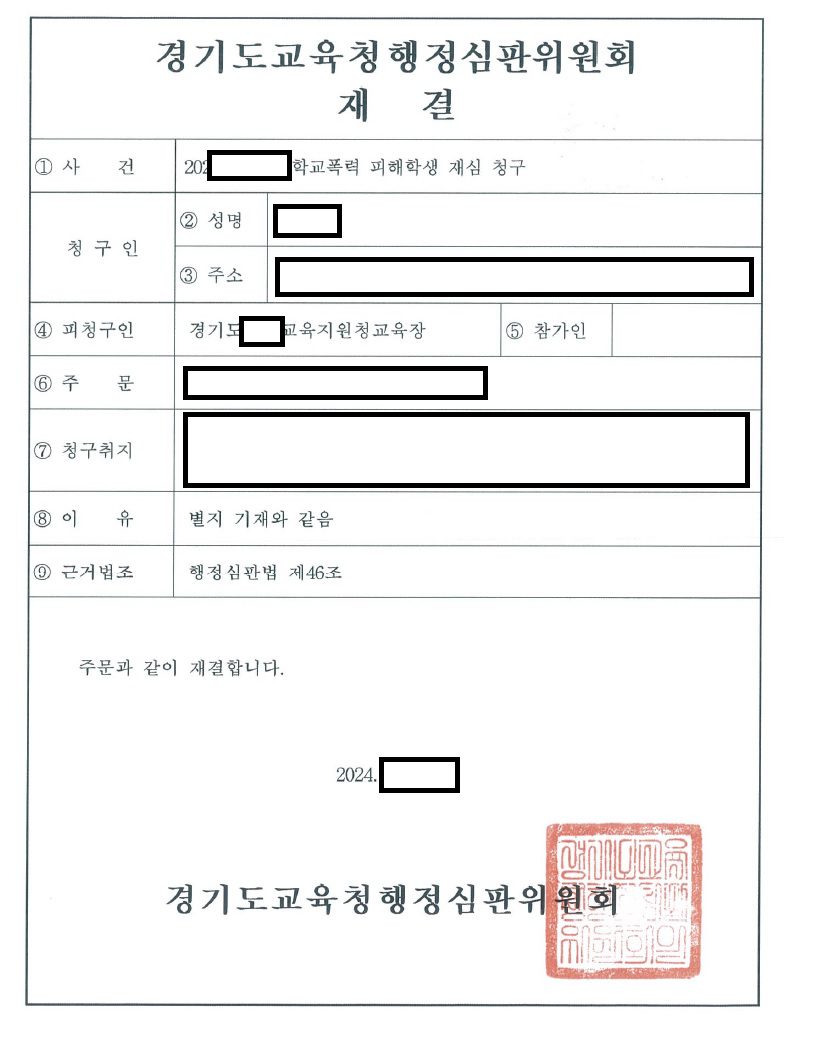
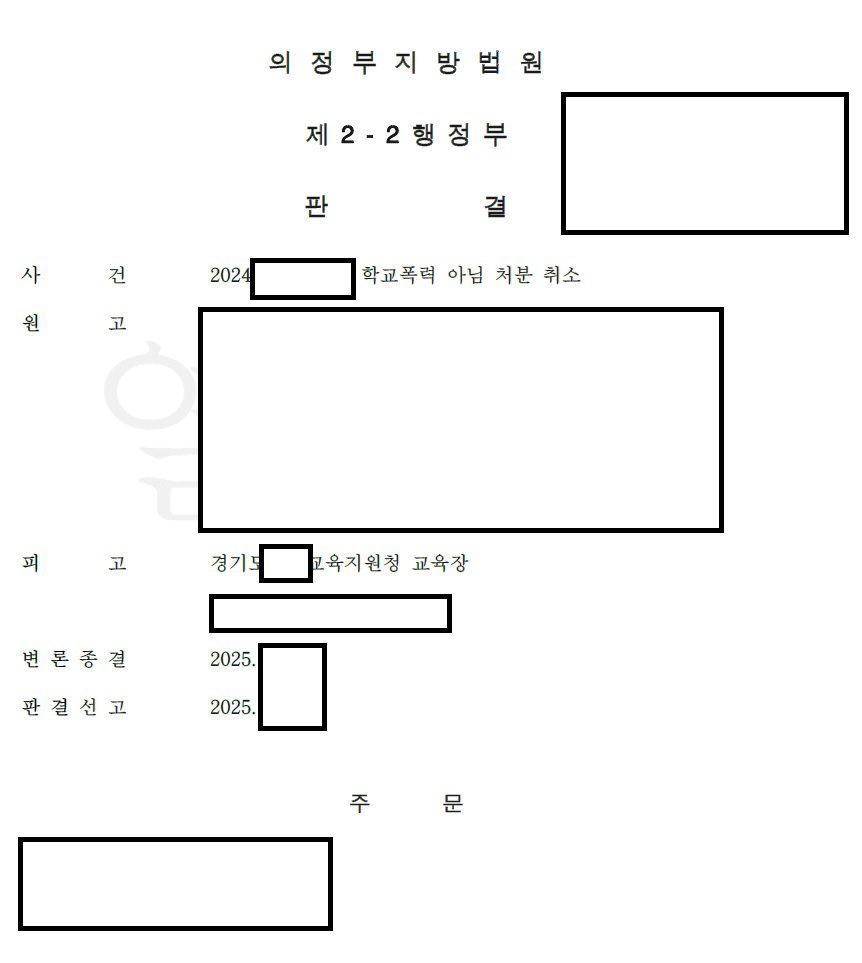
[This legal matter represents a comprehensive and persistent effort to contest a school violence determination through a three-stage legal process. The case initially originated from the School Violence Deliberation Committee’s initial decision. Seeking a more favorable outcome, the petitioner filed an Administrative Appeal with the Gyeonggi-do Office of Education Administrative Appeal Committee to challenge the initial ruling. Ultimately, the dispute progressed to a formal Administrative Litigation at the Uijeongbu District Court, where the plaintiff filed a lawsuit to “Cancel the Non-School Violence Disposition.” This sequence demonstrates a full exhaustion of legal remedies, moving from internal educational deliberations to a formal judicial verdict to ensure a fair and accurate determination of the incident.]
FAQ: Common Questions from Foreign Parents
Q1: My child was bullied first, but fought back. Why is he/she the perpetrator?
A: Korea strictly punishes “Physical Retaliation.” If your child hit back, it is likely “Mutual Violence.” You must cross-file a report against the other student immediately to balance the negotiation power.
Q2: Can I just transfer schools to avoid the record?
A: NO. Once a report is filed, a voluntary transfer is blocked until the Committee makes a decision. You cannot run away from the process.
Q3: Does this affect my visa (F-3, E-7, etc.)?
A: The School Committee’s decision itself is administrative, so it rarely affects parents’ visas directly. However, if the child is over 14 and receives a criminal fine/punishment, it can affect their ability to renew their visa or stay in Korea.
Q4: How do I prove “Reflection” if my child doesn’t speak Korean well?
A: Do not submit a letter in English or poor Korean. Write it in your native language, have it professionally translated, and submit both. The tone must be “I am deeply sorry,” not “It wasn’t my fault.”
Lawyer’s Insight ⚖️
“In School Violence cases, the ‘Truth’ matters less than the ‘Evidence’ and ‘Attitude.’ I have seen students who were actually victims get punished as perpetrators because they shouted at the teachers during the investigation, while the bullies wrote polite apology letters.
For foreign parents, the language barrier is your biggest enemy. Do not let your child face the SPO or the Committee alone. A lawyer acts as a shield, ensuring your side of the story is translated into the ‘legal language’ the Committee respects.”
Is your child facing a School Violence Committee?
Don’t let one mistake define their future. Contact us for a strategy session on Committee Defense or Administrative Lawsuits.
[Contact LIBRO Global Client Services]
Attorney Paul

![[외국인 전문 변호사][ENGLISH SPEAKING KOREAN LAWYER]](https://lawfirmlibro.com/wp-content/uploads/2026/02/Gemini_Generated_Image_fwxnfqfwxnfqfwxn-768x768.jpeg)