The 48-Hour Golden Time & Warrant Review (2026 Arrest in Korean Guide)[English Speaking Lawyer. LIBRO]
Introduction: The Phone Call You Never Wanted (2026 Arrest in Korean Guide)
You receive a call from a police station. Your spouse, child, or friend has been arrested. They are currently in a holding cell (Yuchijang). You are panicked, and the police officer’s English is limited.
Take a deep breath and listen carefully.
In Korea, the first 48 hours determine whether your family member comes home to prepare for trial or stays in detention for several months.
The police have used “Emergency Arrest” (Gingeup-chepo). They now have 48 hours to apply for a formal Detention Warrant. To stop this, you must prepare for the “Warrant Validity Review” (Yeong-jang-sil-jil-sim-sa).
This guide explains how to fight for an “Investigation Without Detention” (Bul-gu-sok Su-sa).
1. The “48-Hour” Rule: Why Time is Critical
In Korea, the police cannot hold a suspect for more than 48 hours without requesting a warrant from a judge.
- 0 ~ 48 Hours: The police investigate and decide whether to request a Detention Warrant.
- The Review: If requested, a judge reviews the case (typically on the 2nd or 3rd day).
- The Decision:
- Warrant Granted: The suspect is moved to a Detention Center (Gu-chi-so) and may remain in custody for a significant period during the trial.
- Warrant Rejected: The suspect is released immediately and goes home (investigation continues while they are free).
Your Goal: Get the Warrant Rejected.
2. The Warrant Review: What the Judge Checks
The “Warrant Validity Review” is a hearing where the suspect stands before a judge. The judge is NOT deciding guilt or innocence yet. The judge is deciding: “Is detention necessary?”
The 3 Fatal Criteria for Foreigners:
- Flight Risk (Do-ju U-ryeo): This is the biggest danger for foreigners. Judges often assume foreigners will flee to their home country.
- Evidence Destruction (Jeung-geo In-myeol): Will they delete chats, hide money, or threaten witnesses?
- Severity of Crime: Is the crime serious enough (e.g., drugs, assault, fraud) to warrant detention?
3. Phase 1: The “Defense Package” You Must Prepare
While your lawyer is at the police station, you (the family/friend) must gather documents to prove the suspect has strong ties to Korea and will not run away.
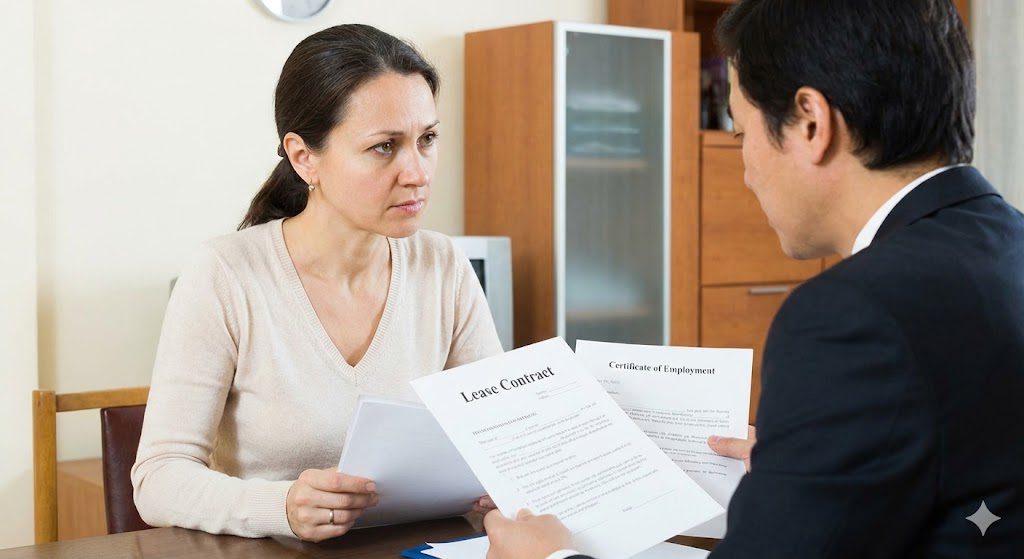
[Table 1] Documents to Prove “No Flight Risk”
| Document | Purpose | Why It Helps |
| 1. Certificate of Employment | Jae-jik Jeung-myeong-seo | Proves they have a stable job and income in Korea. “They won’t leave their career.” |
| 2. Lease Contract | Im-dae-cha Gye-yak-seo | Proves they have a fixed residence (Housing Deposit is tied up here). |
| 3. Family Relation Cert. | Ga-jok Gwan-gye | Proves they have family (spouse/kids) in Korea who need them. |
| 4. Letter of Guarantee | Sin-won Bo-jeung-seo | A Korean citizen (friend/boss) signs a paper promising to ensure the suspect appears in court. |
| 5. Petition for Leniency | Tan-won-seo | Letters from colleagues/friends saying the suspect is a good person and this was a mistake. |
⚠️ Critical Tip: If the crime involves a victim (e.g., assault, fraud), a Settlement Agreement (Hap-ui-seo) is the single most powerful document to prevent detention.
4. Phase 2: The Role of the Lawyer (Access is Power)
During the first 48 hours, family visits are often restricted or limited to brief encounters to prevent collusion. The suspect is isolated, scared, and pressured by police.
Only a Lawyer Can Do This:
- Guaranteed Visitation (Jeop-gyeon): A lawyer has the right to meet the suspect without restrictions on time or frequency, even outside normal hours.
- Psychological Stability: We calm the suspect down so they don’t make false confessions out of fear.
- Strategy for the Judge: We coach the suspect on what to say during the Warrant Review.
- Bad Answer: “I didn’t do it! It’s unfair!” (Judge thinks: They are denying evident facts -> Risk of evidence destruction).
- Good Answer: “I admit the mistake, I am deeply reflecting, and I have a family to support here.”
5. The Hearing Day: What Happens?
- Transport: The suspect is taken from the police station to the District Court.
- The Hearing: The judge asks questions. The Prosecutor argues for detention; the Lawyer argues for release.
- The Wait: The suspect waits back in the holding cell.
- The Result: Usually released via SMS around evening time the same day.
- Success: “Warrant Dismissed” -> Released immediately.
- Failure: “Warrant Issued” -> Transferred to Detention Center.
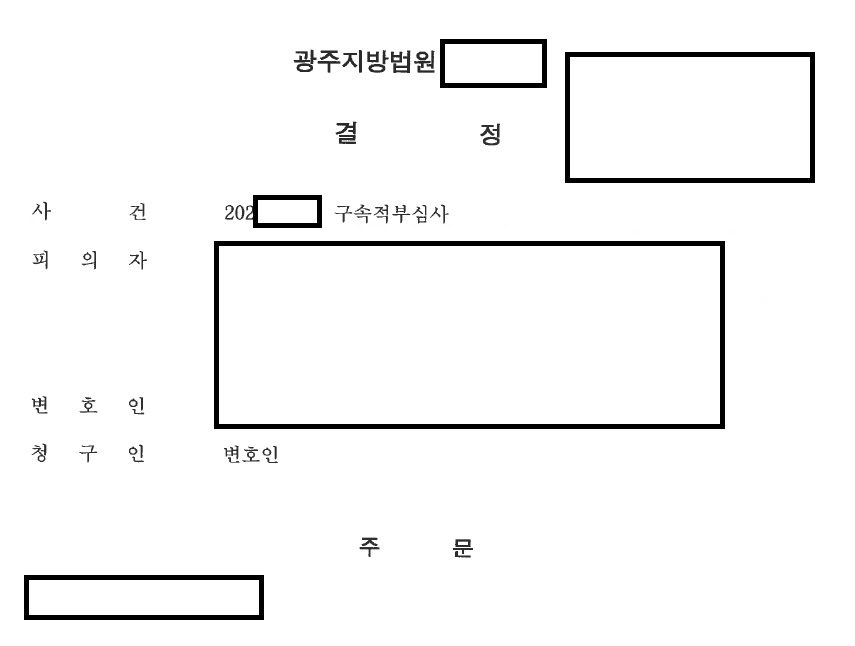
[This document is a formal Court Decision regarding a Review of the Legality of Detention (similar to a Habeas Corpus hearing) issued by the Court. Following a request filed by the defense counsel, the court conducted a judicial evaluation to determine whether the suspect’s current detention is legally justified or if they should be released from custody. In the Korean criminal justice system, this procedure serves as a critical safeguard, allowing a judge to independently verify the necessity of physical restraint and ensure that a suspect’s fundamental human rights are protected against potential investigative overreach.]
FAQ: Arrest & Detention
Q1: Can I visit my family member at the police station?
A: Police may restrict family visits during the initial investigation stage. Even if allowed, conversations are monitored. Only a lawyer has guaranteed, private access.
Q2: Will they be deported if the warrant is issued?
A: If they are detained, it signals the crime is serious. If eventually convicted and sentenced to jail (or a large fine), deportation becomes highly likely. Fighting for “Investigation Without Detention” is the first step to saving the visa.
Q3: Can we use a Public Defender?
A: Yes, the court appoints a Public Defender for the Warrant Review if you don’t have one. However, they typically meet the suspect for only 10-15 minutes before the hearing. For foreigners with complex visa/flight risk issues, a private lawyer who can prepare a detailed “Opinion Letter” is strongly recommended.
Lawyer’s Insight ⚖️
“For foreigners, the ‘Flight Risk’ argument is the biggest hurdle. Prosecutors always argue: ‘He has a passport and no permanent roots here. He will run away.’
To win a Warrant Review, we don’t just argue innocence. We argue Stability. We submit their lease, their Korean bank accounts, their Korean friends’ petitions, and their employment history to show the judge: ‘This person’s life is in Korea. They are not going anywhere.’“
Is your family member in a holding cell right now?
The clock is ticking. You have less than 48 hours to prepare the defense.
[Contact LIBRO Global Client Services for Emergency Visitation]
Attorney Paul

![[외국인 전문 변호사][ENGLISH SPEAKING KOREAN LAWYER]](https://lawfirmlibro.com/wp-content/uploads/2026/02/Gemini_Generated_Image_fwxnfqfwxnfqfwxn-768x768.jpeg)