
The Anatomy of a Perfect Criminal Complaint [Looking for a Criminal Attorney Lawyer near me? English Speaking Lawyer, LIBRO, 2026 Guide]
Looking for a Criminal Attorney Lawyer? Hello there! I am a lawyer dedicated to helping the international community in Korea navigate the complexities of the legal system. Filing a criminal complaint (고소장 – Gosojang) can be daunting, especially when you are dealing with a language barrier and a different legal culture.
Today, I’m going to pull back the curtain and show you how a professional lawyer structures a “perfect” complaint using the standard police template. To protect privacy, I have modified the details of a real-life case I handled, but the logic and “pro-tips” remain exactly the same.
If you want to know about how to write a complaint regarding cyber defamation case, please refer to this link.
If you If you want to know about how to write a complaint regarding cyber defamation case in Korean, please refer to this link.

The Anatomy of a Perfect Criminal Complaint
In Korea, the police provide a standard form. While it looks simple, how you fill it out determines how seriously the investigator takes your case.
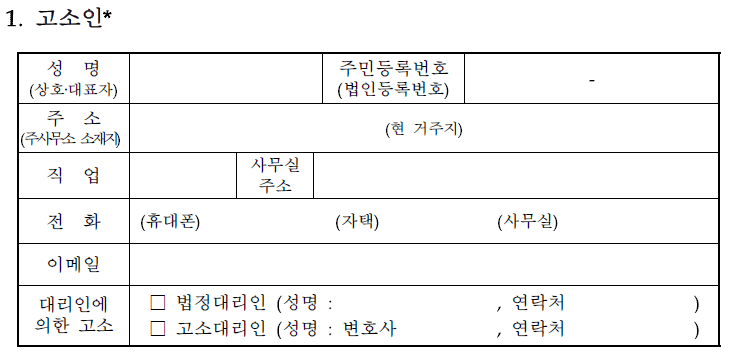
1. The Complainant (고소인 – You)
This section identifies who is filing the charges.
- Pro-Tip: If you have a lawyer, we list our information in the “Agent” (대리인) section. Having a legal representative ensures all communication goes through a professional, which prevents you from being intimidated by the process.
- Essential Info: Name, Passport/ARC number, Address, and Phone Number.
Q: Do I need to use my Korean address or my home country address?
A: Use your current residence in Korea where you can receive mail. If you move during the investigation, you must update the police, or you might miss critical notices.
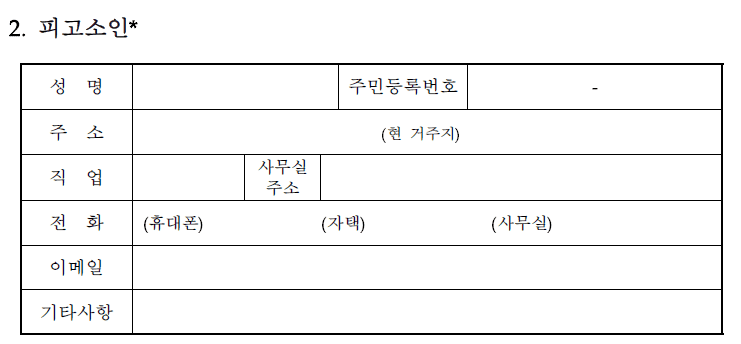
2. The Accused (피고소인 – The Offender)
Who are you reporting?
- The Reality: Often, victims don’t know the offender’s resident registration number.
- Lawyer’s Advice: Provide as much as you know—name, workplace, phone number, or even a physical description/social media handle. The police have the power to “track” the identity if you provide a starting point (like a phone number or bank account).
3. Purpose of the Complaint (고소취지)
This is a concise summary of what you want.
- How to Write It: “The Complainant hereby files a complaint against the Accused for Assault and Intimidation, and requests a thorough investigation and strict punishment according to the law.”
- Key Categories: List specific charges like Assault (폭행), Injury (상해), Coercion (강요), or Threat (협박).

4. Facts of the Crime (범죄사실)
This is the most important part.
As a lawyer, I write this section to mirror a court judgment. Judges and prosecutors look for four specific elements: Time, Place, Method, and Result.
- Bad Example: “He was mean to me at the gym last week.”
- Lawyer Style (The “Perfect” Fact): > “On or around January 15, 2024, at approximately 14:00, within the ‘Alpha Fitness Club’ located in Gangnam, Seoul, the Accused became angry because the Complainant requested a refund. The Accused approached the Complainant, shouted ‘You won’t get a cent!’, and struck the Complainant’s left shoulder twice with a plastic clipboard, thereby assaulting the Complainant.”
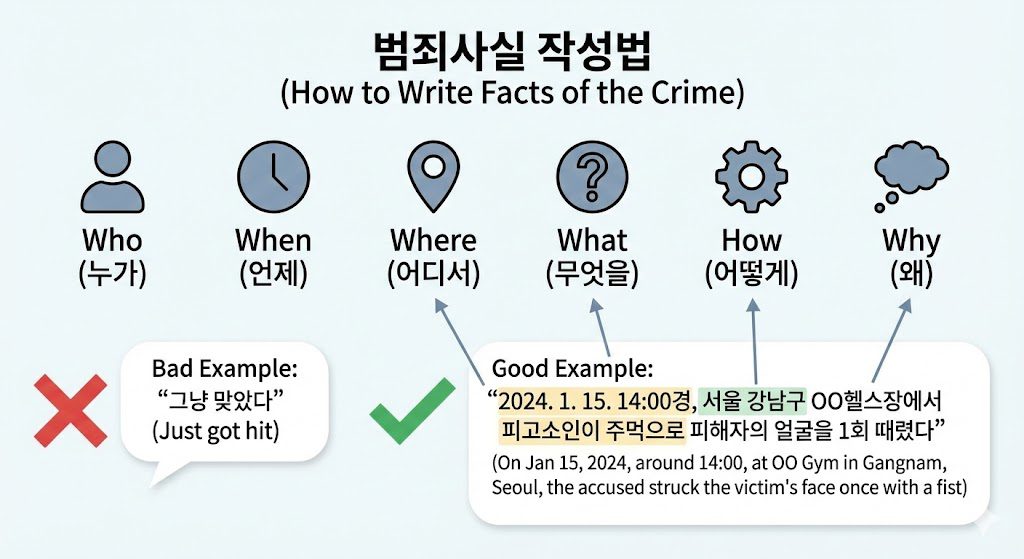
Why this works: It leaves no room for ambiguity. It tells the investigator exactly what law was broken.
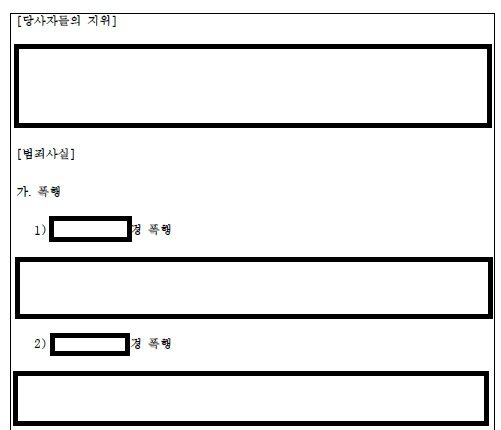
The section titled “Facts of the Crime” ([범죄사실]) shown in the image is the absolute core of your complaint, as it dictates the entire scope of the police investigation. While it may look like a simple list, this is where a lawyer’s expertise is most vital; I draft these paragraphs to mirror the precise language of a court judgment, meticulously specifying the date, time, exact location, criminal method, and the specific result of the illegal act
5. Reasons for the Complaint (고소이유)
While the “Facts” are clinical and dry, the “Reasons” provide the context and story.
- Background: Explain your relationship (e.g., “I was an employee at his gym for three months”).
- The Narrative: Describe the pattern of behavior. If there were repeated insults or a toxic environment, mention it here to show the gravity of the situation.
- The Goal: Show the investigator why this isn’t just a small misunderstanding that can be settled with an apology.
6. Evidence (증거자료)
A complaint without evidence is just a story. We categorize evidence into three types:
| Category | Examples |
| Human Evidence | Eyewitnesses (colleagues, friends). |
| Documentary Evidence | Medical certificates (진단서), text messages, bank statements. |
| Physical Evidence | CCTV footage, audio recordings, photos of injuries. |
- Pro-Tip: If you have an audio recording of the incident, have it transcribed into a formal “Transcript” (속기록). Police often prefer reading a transcript over listening to a 30-minute recording.
7. Closing & Truth Verification
The final page requires your signature and a date.
- The Warning: The form explicitly states that if you “maliciously file a false report,” you can be punished for False Accusation (무고죄).
- Final Step: You submit this to the police station with jurisdiction over the location where the crime happened or where the offender lives.
Q&A for Foreigners in Korea
Q: Will reporting a crime affect my visa?
A: Being a victim of a crime does not, by itself, negatively affect your visa status. For serious crimes—such as sexual violence or human trafficking—the authorities may even allow or extend your stay so that you can cooperate with the investigation and court process. However, please note that if you are later charged and convicted as an offender in a related or separate matter, immigration may review your case individually. If you are unsure about your specific situation, contact 112 for emergencies, 1345 (Immigration Contact Center), or a lawyer for professional advice.
Q: I don’t speak Korean well. How can I do the police interview?
A: If you do not understand Korean well, you have the right to an interpreter during police interviews and court proceedings. This right applies to everyone involved—including victims and witnesses, not just suspects. While you can request the police to provide an interpreter, it is often safer and more effective to bring your own trusted interpreter or a bilingual lawyer to ensure your testimony is recorded with absolute accuracy. For assistance, you can consult with a lawyer.
Q: What is a “Medical Certificate for Injury” (상해진단서)?
A: A “Medical Certificate for Injury” is distinct from a simple medical note. It is a formal legal document that details your injuries and specifies the expected treatment period (usually measured in weeks). This document is often used as critical evidence to elevate a charge from simple “Assault” (폭행) to “Injury” (상해). While you can still report a crime without this certificate, having one is highly advantageous for your case. If you have been hurt, visit a hospital immediately and inform the doctor that you need a certificate for a police report so they can issue the correct documentation. If you need further guidance, contact us.
Attorney Seok Jun Kang


