[2026 South Korea Labor Laws Guide] Workplace Harassment: How to File a Labor Complaint Without Losing Your Visa [LIBRO, English Speaking Lawyer]
For many foreign professionals and workers in South Korea, workplace harassment is more than just a job issue—it is a “visa crisis.” The fear that reporting a boss might lead to your sponsorship being cancelled (especially for E-7 or E-9 holders) often leads to silence.
However, as of 2026, Korean labor and immigration laws have established specific mechanisms to protect your right to stay while you fight for justice. You do not have to choose between your dignity and your visa. (2026 South Korea Labor Laws Guide)
1. What Qualifies as Workplace Harassment?
Under Article 76-2 of the Labor Standards Act (LSA), workplace harassment is defined by three essential elements. If all three are met, it is a violation of the law.
| Element | Description | Examples |
| 1. Use of Superiority | Leveraging position, rank, or relationship superiority. | Boss to subordinate, or senior to junior. |
| 2. Beyond Work Scope | Actions that go beyond what is “socially acceptable” or necessary. | Racial slurs, private errands, or constant weekend messaging. |
| 3. Suffering & Damage | Actions causing physical/mental pain or a hostile environment. | Depression, anxiety, or being ignored by the whole team. |
2. 🛡️ Visa Protection: Staying in Korea While Seeking Justice
The most common myth is that losing your job means instant deportation. Here is the 2026 Reality for different visa categories:
A. For E-9 (Non-Professional) Holders
- Workplace Change: Under Article 25 of the Act on Foreign Workers’ Employment, if harassment or human rights violations are recognized, you can apply to change your workplace.
- No “3-Time” Limit: While E-9 holders are usually limited to three changes, cases involving harassment are treated as unavoidable causes, meaning they may not count toward your limit.
B. For Professional Visas (E-7, etc.)
- Permission to Change: If you leave due to harassment, you can seek a new employer and apply for a “Change of Workplace” permission under Article 21 of the Immigration Act.
- Employer Consent: While normally difficult, documented harassment provides a strong legal basis to move without a “Letter of Release.”
C. The G-1 (Labor Dispute) Visa
If your original visa is expiring but your labor dispute is ongoing, you may apply for a G-1 (Miscellaneous) visa status.
- This allows you to stay in Korea legally until the Ministry of Employment and Labor (MOEL) finishes its investigation or the court case ends.
- Note: This is granted based on your MOEL filing receipt and is subject to the Ministry of Justice’s discretion.
3. Step-by-Step Action Plan
STEP 1: Evidence Collection (The Golden Rule)
Without evidence, it is your word against theirs. Start collecting these immediately:
- The Logbook: Record dates, times, locations, and the specific words used.
- Audio Recordings: In Korea, recording a conversation you are a part of is generally legal and is a powerful tool in labor disputes.
- Digital Trail: Save all KakaoTalk messages, emails, and call logs. Do not delete them.
- Medical Certificates: If you suffered stress or depression, get a doctor’s note. This proves “mental suffering.”
STEP 2: Formal Filing (MOEL)
You can file a petition with the Ministry of Employment and Labor (MOEL).
- Online: Use the MOEL website.
- In-Person: Visit the local Labor Office (Jibang Goyong Nodong-cheong) with jurisdiction over your workplace.
- Interpretation: MOEL provides interpretation services for major languages to assist foreign workers during investigations.
STEP 3: Protection Against Retaliation
Under Article 76-3(6) and 109 of the LSA, it is a criminal offense to fire or mistreat a worker for reporting harassment.
- The Penalty: Employers who retaliate can face up to 3 years in prison or a fine of up to 30,000,000 KRW.
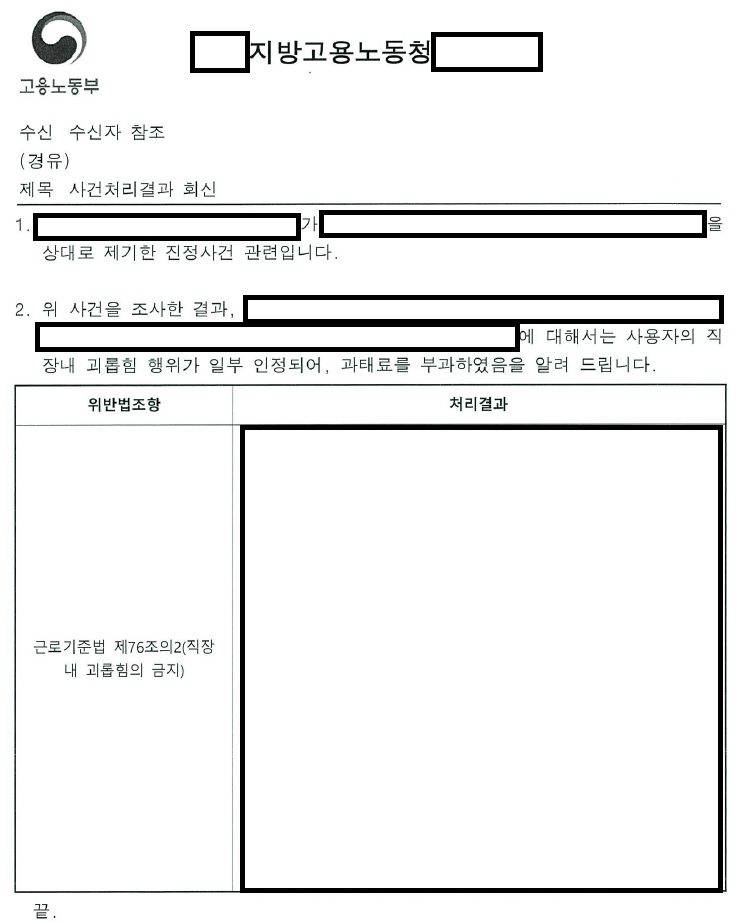
[This official notification from a Regional Employment and Labor Office confirms the conclusion of a workplace harassment investigation initiated by a petitioner against their employer. The investigation partially recognized the employer’s conduct as a violation of Article 76-2 of the Labor Standards Act, which prohibits the use of superiority in the workplace to cause physical or mental suffering or deteriorate the working environment. As a result of this finding, the regional authorities have moved beyond a simple warning and imposed a formal administrative fine on the employer, providing a legal confirmation of the breach and a formal remedy for the reported harassment.]
4. Frequently Asked Questions (FAQ)
Q: Can I get “Workers’ Comp” (Industrial Accident) for mental suffering?
A: Yes. If workplace harassment leads to depression, anxiety, or PTSD, you can apply for Occupational Accident benefits through the Korea Workers’ Compensation & Welfare Service.
Q: My harasser is a colleague, not my boss. Am I still protected?
A: Yes. The LSA covers harassment by both “employers and other workers.” The employer is legally obligated to investigate and take action (like separating you from the harasser) even if the harasser is your peer.
Q: What if the company ignores my report?
A: Employers are legally required to conduct an “objective investigation” without delay. If they ignore you, the company itself can be fined or reported to the MOEL for administrative action.
💡 Lawyer’s Insight
“Workplace harassment is not a private conflict—it is a clear illegal act. When an employer uses your visa as a ‘weapon’ to threaten you, it may cross the line into criminal behavior such as intimidation or coercion.
In 2026, Korean authorities are increasingly protective of victims in labor disputes. Don’t let the fear of deportation keep you in a toxic environment. Consulting a legal professional early can help you secure a safe G-1 stay or a workplace transfer without jeopardizing your future in Korea.”
📞 Official Support Resources
- Foreign Worker Support Center (Call 1577-0071): 13 languages available.
- Korea Legal Aid Corporation (Call 132): Free legal advice for eligible foreigners.
⚠️ Disclaimer
This guide provides general information based on Korean laws as of February 2026 and does not constitute formal legal advice. Legislative changes and administrative discretion at Immigration may affect individual cases. Always consult an attorney regarding your specific visa and labor situation.
Contact LIBRO Global Client Services. [LIBRO] – English Speaking Legal Expert
Attorney Seok Jun Kang


