
[2026 Guide] Are You a Freelancer? You Might Still Be Entitled to Severance Pay (Taejikgeum) [LIBRO, English Speaking Lawyer]
Introduction
Many foreigners working in South Korea as “Freelancers” or “Independent Contractors” often assume they have no right to severance pay. However, your legal rights are determined by the actual nature of your work, not just the title on your contract. If you have worked for more than a year and are preparing to leave, this guide will help you understand your potential entitlements under Korean labor law. (2026 Severance Pay Korea Guide)
1. The 2026 Legal Trend: Strengthening Worker Protections (2026 Severance Pay Korea Guide)
In 2026, South Korea is actively moving toward a more protective legal framework for platform workers and those in special employment categories.
- Move Toward “Presumption of Worker Status”: The government is currently pushing for a new system that will shift the burden of proof to employers. If passed, the employer would need to prove that a person is not a worker, rather than the worker having to prove their status.
- Substance Over Form: This legislative direction aligns with the long-standing principle of “Substance Over Form” maintained by the Supreme Court and the Ministry of Employment and Labor (MOEL). Regardless of being labeled a “Freelancer,” you are a worker if you are under the employer’s actual direction and supervision.
2. Checklist: Do You Qualify as a “Worker”?
The Supreme Court (e.g., Decision 2004Da29736) looks at several factors to determine if a “subordinate relationship” exists. While a full legal review considers over ten different elements, these five indicators are critical:
| Criteria for Worker Status | Yes | No |
| 1. Does the company dictate your work content and provide specific instructions? | □ | □ |
| 2. Are you bound by specific working hours and a designated location? | □ | □ |
| 3. Does the company provide the equipment and tools necessary for your work? | □ | □ |
| 4. Are you prohibited from hiring a third party to substitute for your work? | □ | □ |
| 5. Do you receive a fixed monthly or hourly wage as opposed to profit-sharing? | □ | □ |
Important Note: Paying a 3.3% business tax is often a formality chosen by the employer and does not automatically disqualify you from being a worker.
3. Case Study: A Typical Scenario for Expats
Consider “Jane,” an English instructor at a private academy who signed a freelancer agreement. Despite the contract, she had a fixed schedule (2 PM–9 PM) and followed a curriculum strictly set by the director. She could not hire a substitute without permission.
In cases similar to this, the Labor Office often recognizes the instructor as a “worker in substance”. When such a worker leaves after two years, they are typically awarded unpaid severance pay equivalent to several months of their salary. ※ Note: This is a reconstructed case study based on common legal precedents.
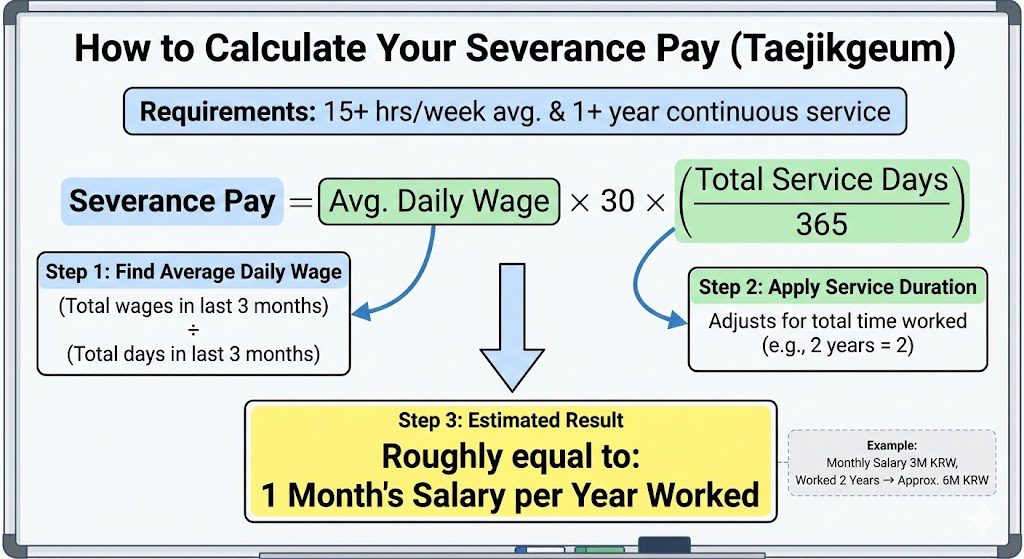
4. How to Calculate Your Severance Pay
To be eligible for severance pay (Taejikgeum), you must meet two criteria:
- Continuous Employment: More than 1 year.
- Working Hours: An average of 15+ hours per week.
The Calculation Formula:

- Average Daily Wage: Your total wages for the last 3 months divided by the total number of days in those 3 months.
- Simple Rule of Thumb: You generally receive approximately one month’s salary for every year of service.
5. Frequently Asked Questions (FAQ)
Q: I worked at an unregistered location on my visa. Can I still claim pay?
A: Yes. Under Korean law, even those working without proper authorization or outside their visa’s registered workplace are entitled to wages and severance pay for work actually performed. However, this may involve immigration risks, so legal counsel is advised.
Q: I signed a waiver saying I won’t ask for severance pay. Is it valid?
A: No. Agreements made in advance to waive mandatory severance pay are generally considered null and void as they violate the Labor Standards Act.
Q: Will filing a complaint get my visa cancelled?
A: Filing a labor complaint is not a ground for visa cancellation. In many cases, you may be eligible for a G-1 visa (Dispute-related stay) while your case is pending, though this is decided on a case-by-case basis by immigration authorities.
Q: Is there a time limit for my claim?
A: Yes. The right to claim severance pay expires 3 years from the date of your resignation according to Act On The Guarantee Of Employees’ Retirement Benefits(Article 10). Do not delay starting the process.
🛡️ Expert Legal Support for Expats
Navigating the Ministry of Employment and Labor (MOEL) involves complex legal arguments and potential immigration side effects. Our firm specializes in protecting the rights of foreign professionals in Korea.
[Legal Disclaimer] This post is for general informational purposes only and does not constitute formal legal advice. Legislative changes regarding the “Presumption of Worker Status” are currently in the proposal/policy stage. Legal outcomes depend on individual facts and current immigration policies. Always consult with a qualified attorney for your specific case.
Contact LIBRO Global Client Services. [LIBRO] – English Speaking Legal Expert
Attorney Seok Jun Kang


