
2026 Plastic Surgery Korea Guide – Protecting Your Rights and Ensuring Safety [English Speaking Lawyer. Libro]
Introduction: Quality Care Meets Legal Responsibility (2026 Plastic Surgery Korea Guide)
South Korea is globally recognized for its advanced medical technology and highly skilled plastic surgeons. While most clinics offer world-class services, it is vital for foreign patients to understand their legal rights and the protective measures provided by Korean law. Informed patients are safe patients.
This guide outlines the essential legal and practical steps to take before, during, and after your procedure in Korea.
1. Research & Selection: Verifying Professionalism
While many clinics are excellent, some may engage in excessive marketing or provide insufficient explanations of risks.
- Check Board Certification: In Korea, a “Specialist” has undergone more rigorous training than a “General Practitioner.” Verify your surgeon’s credentials on the Korean Property of Plastic and Reconstructive Surgeons website.
- Analyze Patient Reviews: Use popular Korean apps like Gangnam Unni or Babitalk. Look for consistent mentions of safety protocols and post-operative care. Be cautious of clinics where medical malpractice or “shadow doctors” (substitute surgeons) are repeatedly mentioned.
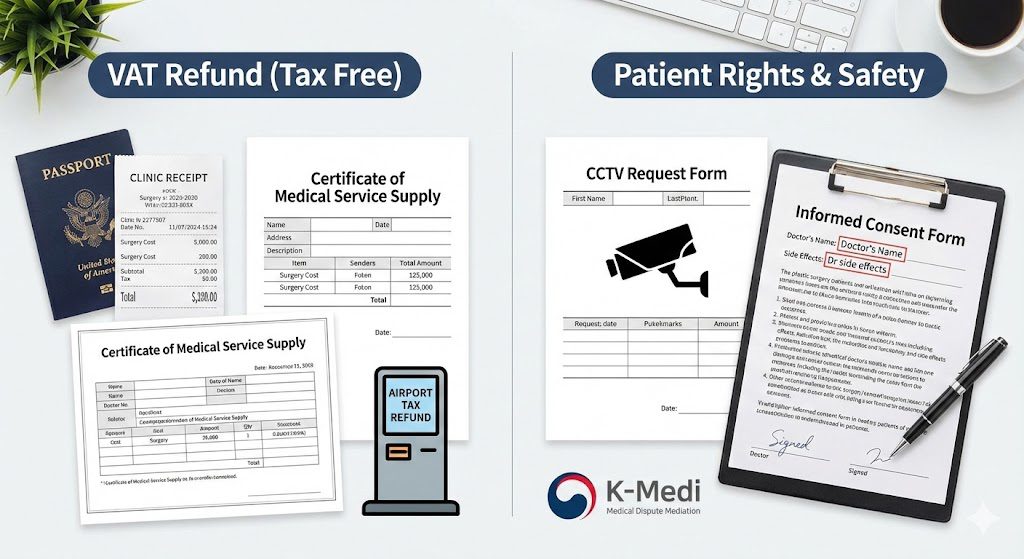
2. Costs and VAT Refunds (Tax Free)
Under the Special Tax Treatment Control Act (Art. 107-3), foreign tourists are eligible for a VAT refund on specific cosmetic procedures.
[Table 1] Foreigner Plastic Surgery Costs & Refund Guide
| Item | Details | Notes |
| Claimed Costs | Surgery fee + Post-operative care | Varies significantly by clinic |
| Eligible Persons | Foreign tourists treated at registered institutions | Excludes residents; must depart within 3 months |
| Eligible Surgeries | Double eyelid, rhinoplasty, breast surgery, liposuction, facelifts, etc. | Surgeries for disease treatment are tax-exempt |
| Refund Rate | Total VAT amount (approx. 10% of surgery cost) | Minus refund operator service fees |
| Required Docs | Passport, Certificate of Medical Service Supply | Issued by the clinic |
| How to Claim | Apply at an airport or downtown refund kiosk | Within 3 months of the procedure |
💡 Important: Not all clinics are eligible for VAT refunds. Before booking, ensure the clinic is a “Registered Medical Institution for Foreign Patients”. These are institutions registered with the local government and the Ministry of Health and Welfare. For the highest safety standards, check if the clinic has received the KAHF (Korean Accreditation Program for Hospitals Serving Foreign Patients) certification.
3. Confirming Legal Rights: CCTV and Explanation
The Right to Request CCTV
While blanket mandatory recording is not universal, under current law, patients may request the hospital to record the surgery to ensure transparency and prevent “shadow doctors.”
- Action: Request in writing: “I want CCTV recording of my surgery and preservation of the footage.” Confirm this during your consultation, as some clinics may still legally refuse.
The Physician’s Mandatory Duty to Explain
Under Article 24-2 of the Medical Service Act, a physician must explain the following in writing and obtain your signed consent:
- Diagnosis: The name of the symptom or condition.
- Necessity & Method: Why the surgery is needed and how it will be performed.
- Surgeon’s Name: The name of the doctor actually performing the surgery.
- Side Effects: Typical expected complications or risks.
- Post-op Instructions: What the patient must follow after the surgery.
💡 Note: For cosmetic surgery, the duty to explain is even stricter. Doctors must ensure the patient fully understands the expected results and potential risks. Always keep a copy of your signed consent form.
4. Emergency Response: If Complications Arise
If you experience side effects, do not rely solely on the clinic’s advice to “just wait.” Follow these legal steps:
- Immediate Record: Notify the clinic immediately. Keep a detailed log of your symptoms and, if possible, record conversations (ensure you are a participant in the conversation for legal recording).
- Evidence Collection: Take daily photos of the affected area under consistent lighting and angles.
- Secure Medical Records: You have a legal right to access and copy your medical records. Request these immediately to prevent any later modifications.
- Third-Party Diagnosis: Visit a university hospital or another specialist for an objective diagnosis and obtain a Medical Opinion (So-gyeon-seo) or Injury Certificate (Sang-hae Jin-dan-seo).
- Certification of Contents: Send a formal letter (Certification of Contents) to the clinic director outlining the facts and your demands (revision, compensation, etc.). This serves as official evidence for future legal disputes.
5. Dispute Resolution via K-Medi
Before hiring an expensive lawyer, utilize the Korea Medical Dispute Mediation and Arbitration Agency (K-Medi).
- Mediation: Experts determine if negligence occurred and calculate fair compensation. This is much faster and cheaper than a lawsuit.
- Payment in Advance: If a settlement is reached but the clinic fails to pay, K-Medi can pay the victim first (Subrogation) and claim the amount from the clinic later.
- Support: They provide multilingual support in English and Chinese.
- Contact: www.k-medi.or.kr / 1670-2545.
FAQ: Plastic Surgery Legal Tips
Q1: Is it safe to use a cash discount?
A: Offering a discount for cash without a receipt is often an attempt at tax evasion. Always demand a tax invoice or cash receipt. Without an official receipt, it is extremely difficult to prove the cost of surgery during a dispute or to receive a VAT refund.
Q2: How long do I have to sue for malpractice?
A: Under the Korean Civil Act (Art. 766), the statute of limitations for medical malpractice is 3 years from the day you discover the damage and the perpetrator, or 10 years from the date the act occurred. Acting quickly is essential for securing evidence.
Need Legal Assistance with a Medical Dispute?
Navigating Korean medical law requires precision.
Contact LIBRO Global Client Services for professional support in analyzing medical records and filing for mediation.
[Request Legal Consultation]
Disclaimer: This post provides general legal information and does not constitute medical advice or a specific attorney-client relationship.
Attorney Seok Jun Kang


