
2026 Korean Visa E7 Guide – The Ultimate Guide for Foreign Professionals (Requirements, Salary, and Codes) [English Speaking Lawyer. LIBRO]
Introduction: The “Gold Standard” of Work Visas (2026 Korean Visa E7 Guide)
So, you have found a job in South Korea, or you are actively looking. If you are not an English teacher (E-2) and not working in manual labor (E-9), you are likely aiming for the Korean Visa E-7 (Specific Activity).
The E-7 visa is designed for foreign nationals who have specialized knowledge or skills that are needed by Korean companies. It covers a wide range of professions, from Software Engineers and Sales Managers to Chefs and Designers.
However, the E-7 is notoriously difficult to obtain because Immigration wants to ensure you are not “replacing” a Korean worker but rather “adding value” they cannot find locally.
This guide will break down the eligibility, the complex “Job Codes,” and the application process to help you secure your Korean Visa E-7.
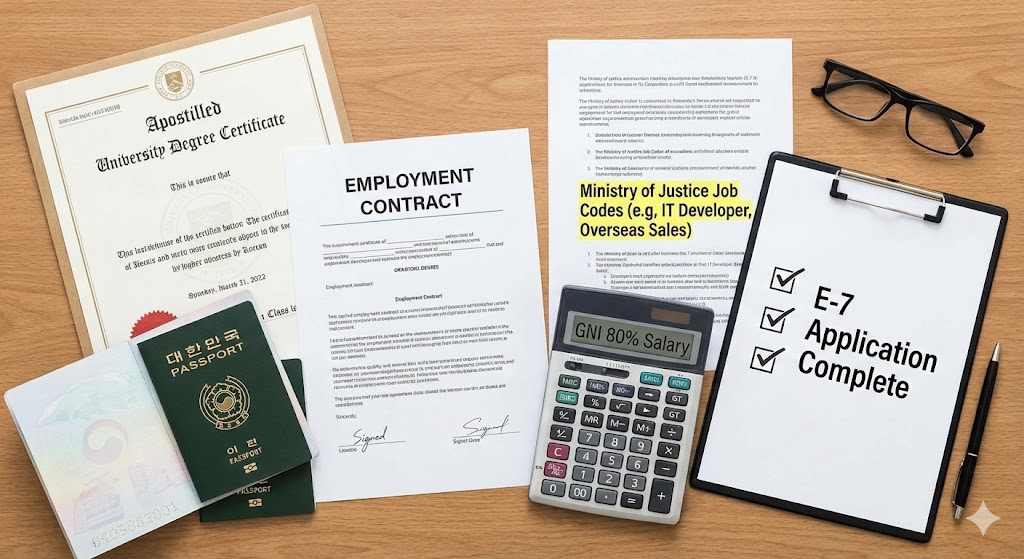
1. Am I Eligible? (The Basic Requirements)
Before applying, you must meet one of the following criteria. This is the first hurdle.
[Table 1] Education & Experience Checklist
| Category | Requirement | Note |
| A. Master’s Degree+ | Degree in any field (Must be related to the job). | No work experience needed. |
| B. Bachelor’s Degree | Degree + 1 Year of Work Experience. | Experience must be in a field directly related to your degree and the job. |
| C. No Degree | 5 Years of Work Experience. | Must prove 5 years of experience in the specific industry you want to work in. |
| D. Korean Graduate | Bachelor’s or Master’s from a Korean Uni. | Work experience waived. (This is the most favorable track for D-2 students). |
⚠️ Critical Note: Even if you have a Master’s degree, your major must be closely related to the job you are applying for. For example, a History major applying for a Marketing role faces a high risk of rejection unless they have significant relevant experience.
2. The Company’s Responsibility
You cannot apply for a Korean Visa E-7 on your own. You need a sponsoring company. But not just any company can sponsor you.
The “20% Rule” (Korean Employment Protection)
To protect domestic jobs, the government enforces a ratio of foreign to Korean employees.
- General Rule: For most E-7 categories, the number of foreign employees should not exceed 20% of the total Korean staff.
- Practical Implication: A company typically needs at least 5 Korean employees to hire 1 foreigner.
- Exceptions: This rule may be waived for certain high-tech industries, start-ups with significant investment, or specific job codes. Always check the specific requirements for your industry.
Other Company Requirements:
- Tax Compliance: The company must have no unpaid taxes (National or Local).
- Financial Health: Startups with no revenue often face rejection unless they can prove future potential through investments or contracts.
3. The “Salary” Hurdle (GNI 80%)
This is a common reason for E-7 rejection.
To prevent companies from hiring “cheap foreign labor” for professional roles, the government sets a minimum salary threshold.
[Table 2] Minimum Salary Requirement (2026 Estimate)
| Company Type | Minimum Salary Rule | Estimated Monthly Pay |
| General Company | 80% of GNI per capita (Previous Year) | Approx. 2.9M ~ 3.2M KRW |
| SME / Venture / Non-Seoul | 70% of GNI (Special Exception) | Approx. 2.5M ~ 2.7M KRW |
- Note: The exact GNI figure changes annually based on Bank of Korea announcements. As of 2026, many practitioners expect the standard minimum to be in the low 3 million KRW range. You must confirm the exact figure with Immigration or a lawyer before signing your contract.
4. Understanding the “Job Codes”
The E-7 visa is not one single visa; it is a collection of around 80 designated occupation codes. You must fit your job description into one of these codes.
Common Professional Categories (E-7-1):
Instead of listing all codes, here are the most common ones for foreign professionals:
- Sales & Management: Overseas Sales Manager, Product Manager.
- Tech & Engineering: Software Developer, Data Analyst, Network Engineer.
- Creative: Web Designer, Interior Designer, Fashion Designer.
- Others: Translator/Interpreter, Chef (E-7-4), Skilled Mechanic.
⚠️ Warning: Do not just guess your code. If your job description doesn’t perfectly match the official Ministry of Justice definition for that code, your application will be denied. Consulting a professional to select the right code is crucial.
5. Required Documents Checklist
Collecting documents is time-consuming, especially if you are applying from outside Korea.
[Table 3] Document Checklist
| For Applicant (You) | For Company (Sponsor) |
| Application Form & Passport Copy | Employment Contract (Signed) |
| Diploma/Degree (Apostilled/Verified + Translated) | Company Registration Certificate |
| Proof of Career (Apostilled/Verified + Translated) | Tax Payment Certificates |
| Resume (CV) | Financial Statements (Previous Year) |
| ID Photo (3.5 x 4.5cm) | Employment Necessity Statement (Go-yong-sa-yu-seo) |
💡 The “Employment Necessity Statement”: This is the most critical document. The company must explain why they need YOU specifically and why a Korean national cannot fill this role. A generic letter will lead to rejection.
6. How to Apply
Scenario A: You are already in Korea (e.g., D-10 or D-2)
- Process: Apply for a “Change of Status of Sojourn” at your local Immigration Office.
- Timeline: Typically 2 ~ 4 weeks, but can be longer during busy seasons or if additional documents are requested.
Scenario B: You are abroad
- Process: The company applies for a “Visa Issuance Confirmation Number” (Vin#) at the Korean Immigration Office.
- Step 2: Once approved, they send you the number.
- Step 3: You take this number to the Korean Embassy in your country to collect the actual visa.
FAQ: Korean Visa E-7
Q1: Can I work part-time on an E-7 visa?
A: Generally, No. The E-7 is strictly tied to your sponsoring employer. To work elsewhere (even part-time), you need prior permission (Permission for Activities Outside Status of Sojourn) from Immigration.
Q2: What happens if I quit my job?
A: Your visa is tied to the company. If you quit, you must report the change to Immigration within 14 days. You can apply to switch to a D-10 (Job Seeker) visa to look for a new job, but approval depends on your previous salary and compliance record.
Q3: Why was my application rejected?
A: Common reasons include:
- Low Salary: Contract is below the GNI requirement.
- Mismatch: Your major/experience does not match the Job Code.
- Company Ratio: The company has too many foreigners compared to Koreans (violating the 20% rule).
Summary
Getting a Korean Visa E-7 is a complex process that requires perfect alignment between Your Skills, Your Degree, and The Company’s Needs.
- Check Eligibility: Do you have the right Degree + Experience?
- Check Salary: Does it meet the GNI 80% (or 70% exception) rule?
- Select Code: Choose the correct Job Code carefully.
- Draft Necessity Statement: This is your main argument to Immigration.
Need Help Securing Your E-7 Visa?
One mistake in the “Employment Necessity Statement” or Job Code selection can lead to a denial.
Contact LIBRO Global Client Services for professional assistance. We handle the paperwork, draft the necessity statement, and guide your company through the process.
If you want to switch Korean Visa E7 to D10, Go to How to Switch Korean Visa E-7 to D-10 (Lawyer’s Guide).
[Contact Us for E-7 Consultation]
Attorney Seok Jun Kang


