
2026 Korean Real Estate Compulsory Auction Guide – How to Force-Sell Their House [English Speaking Lawyer. LIBRO]
[DIY Legal Guide] “The Landlord Won’t Pay!”
How to Force-Sell Their House (2026 Korean Real Estate Compulsory Auction Guide)
Introduction: Your Judgment is Not Money (Yet)
You fought hard in court and received a judgment: “The Defendant shall pay the Plaintiff 210,000,000 KRW.”
But the landlord (debtor) is ignoring you. They say, “I have no cash. Wait for the next tenant.”
Don’t wait. In Korea, the most powerful way to collect a large debt is “Real Estate Compulsory Auction” (Bu-dong-san Gang-je-gyeong-mae). You ask the court to seize the landlord’s property, sell it to the highest bidder, and give you the money.
Based on actual 2025 case, here is how you can do this yourself.
Phase 1. The Checklist: 5 Documents You Need
Before going to the court, you must have these 5 items. Without them, your application will be rejected.
| No. | Document Name | Where to Get | Cost (Approx) |
| 1 | Judgment with Execution Clause (Jip-haeng-mun) | Court Civil Application Desk | ~500 KRW |
| 2 | Certificate of Service & Finality (Song-dal/Hwak-jeong) | Court Civil Application Desk | ~500 KRW each |
| 3 | Real Estate Registry (Deung-gi-bu-deung-bon) | Internet Registry Office | ~1,000 KRW |
| 4 | Debtor’s Resident Registration (Cho-bon) | Jumin Center (Show your Judgment) | ~400 KRW |
| 5 | Registration Tax Receipt | Local District Office (Gu-cheong) Tax Div. | ~0.24% of Claim |
💡 Lawyer’s Tip: Just having the “Judgment” is not enough. You must go to the court clerk and ask for the “Execution Clause” (Jip-haeng-mun). It is a special page stapled to the back of your judgment that says: “This judgment can be executed against the Defendant.”
Phase 2. Writing the “Auction Application” (DIY Form)
You don’t need a lawyer if you follow this format. The application is standard.
[Real Estate Compulsory Auction Application]
Creditor: [Your Name] (Address: Your current address)
Debtor: [Landlord’s Name] (Address: Address on their ID)
1. Claim Amount (Cheong-gu-chae-kwon)
You must calculate the exact total based on the interest rate stated in your judgment.
“219,717,533 KRW (Principal 210,000,000 KRW + Interest calculated at 5% and 12% until the application date).”
2. Title of Execution (Jip-haeng-gwon-won)
“Judgment of [Court Name] Case No. 2025Ga-Dan*****, with Execution Clause.”
3. Purpose of Application (Shin-cheong-chwi-ji)
“To satisfy the creditor’s claim against the debtor, initiate compulsory auction procedures for the real estate listed in the attached list and seize it for the creditor.” (Standard Korean phrase: 별지 목록 기재 부동산에 대한 강제경매절차를 개시하고 채권자를 위하여 이를 압류한다.)
4. Reason for Application (Shin-cheong-i-yu)
“The creditor has an enforceable judgment against the debtor, but the debtor has failed to pay. Therefore, I apply for this auction to recover the debt.”
5. Attached List of Real Estate (Byeol-ji)
- Copy the “Property Description” exactly from the Real Estate Registry (Address, Floor area, Structure).
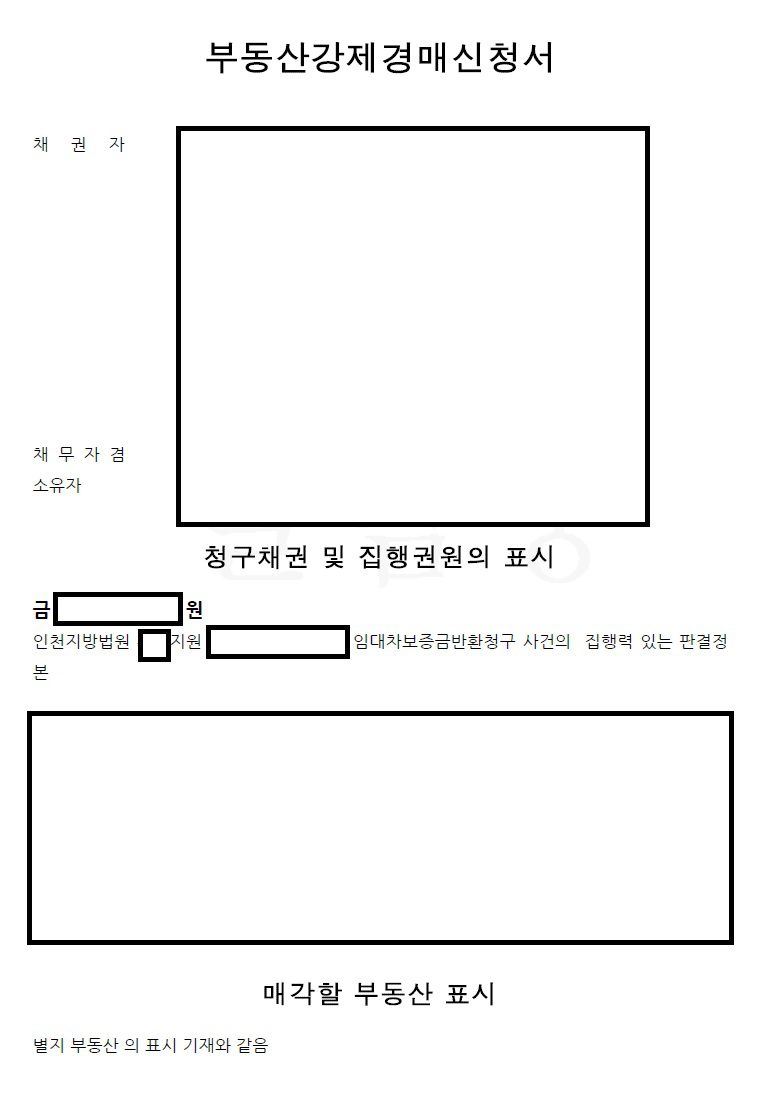
[This document is a formal Application for Compulsory Real Estate Auction (부동산강제경매신청서) filed to recover a debt through the judicial sale of a debtor’s property. The creditor is seeking the collection of a specific monetary sum based on an enforceable final judgment (집행력 있는 판결정본) issued by a branch of the Incheon District Court regarding a “Lease Deposit Return Claim”. By submitting this application, the creditor initiates the legal process for the court to seize and auction the real estate owned by the debtor—as detailed in the attached property list—to satisfy the unpaid judgment debt.]
Phase 3. The Cost: How Much to Start?
Auction is not free. You must advance the money (which you get back later from the sale Priority 0).
- Registration Tax (Deung-rok-myeon-heo-se): Typically 0.2% of your claim amount + Education Tax (20% of that).
- Example: For a 210 Million KRW claim, tax is approx. 504,000 KRW.
- Auction Deposit (Ye-nap-geum): This pays for the appraisal, court notifications, and auction fees.
- Example: For a typical apartment auction in the Seoul metro area, expect to deposit 2,000,000 ~ 3,000,000 KRW. (Amount varies by property value and number of creditors).
Phase 4. The Competition: Who Else Wants Money?
Once the auction starts, the court sends letters to everyone the landlord owes money to. They will send “Claim Statements” (Chae-kwon-gye-san-seo).
You need to know who your rivals are to see if you will actually get paid.
[The “Dividend Table” Simulation]
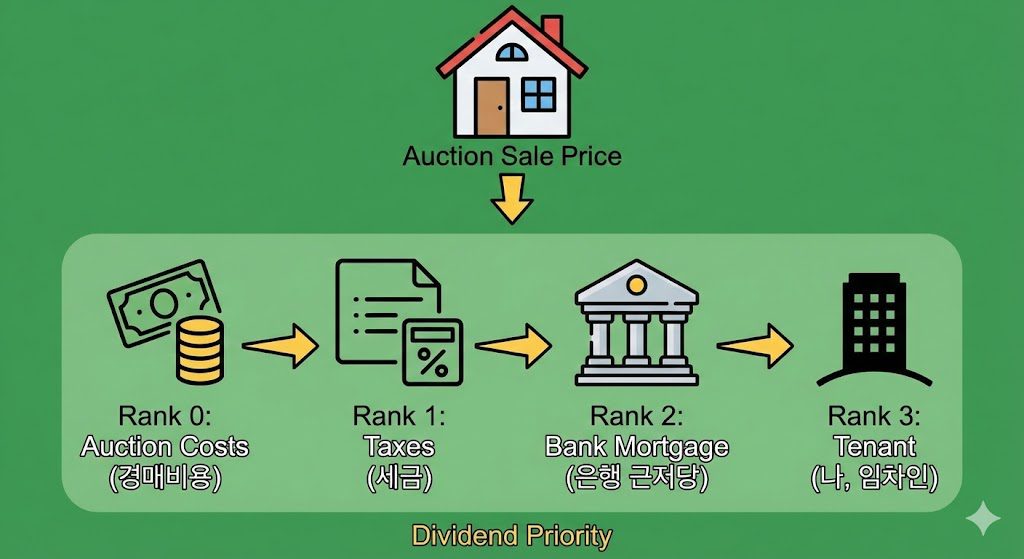
Based on the file you uploaded, here is the hierarchy of creditors for this house:
| Rank | Creditor Name | Type of Claim | Priority Level | Note |
| 0 | You (Applicant) | Auction Costs | Top Priority | You get your ~3M KRW deposit back first. |
| 1 | City Hall A & B | Property Tax (Dang-hae-se) | High Priority | “Statutory Taxes” on the house itself are paid before rent. (Approx. 2~3M KRW in your case). |
| 2 | Bank A | Mortgage (Geun-jeo-dang) | Priority | If the Bank’s mortgage date is before your Move-in+Fixed Date, they take all their money first. (Claim: ~3.9 Billion KRW). |
| 3 | You (Tenant) | Security Deposit | Priority | If your Fixed Date is faster than other liens, you get paid here. |
| 4 | HUG (Guarantor) | Provisional Attachment | Low Priority | Unsecured creditors share what is left. Note: If HUG paid your deposit, they step into your shoes (Subrogation). |
⚠️ Critical Check: Look at the “Claim Statement” from Bank A. They are claiming 3.9 Billion KRW.
- Scenario A: If your lease started before the Bank’s mortgage -> You are Safe. The buyer must pay your deposit, or you get paid first from the auction.
- Scenario B: If your lease started after the Bank’s mortgage -> Danger. The Bank takes 3.9 Billion first. If no money is left, you get nothing.
Phase 5. The End Game: Winning the Bid
The process typically takes about 6 to 12 months.
- Appraisal: The court sets a price (e.g., 500 Million KRW).
- Bidding: If nobody buys it, the price drops by typically 20-30% each month (varies by court).
- Dividend: The house is sold, and money is distributed according to rank.
Strategy: “Offsetting” (Sang-gye-sin-cheong)
If nobody buys the house because the debt is too high, YOU can buy it.
- Instead of paying full cash, you can “pay” by offsetting the purchase price with the money the landlord owes you (up to your dividend amount).
- You become the owner of the house. You can then sell it later or live in it.
FAQ: Real Estate Auction
Q1: Will I get 100% of my money back?
A: Not guaranteed. It depends on the “Market Value” minus “Senior Debts” (Banks/Taxes). If the house sells for 300M, but the Bank takes 200M, only 100M is left for you. Always check the Registry (Deung-gi-bu) to see how much debt is ahead of you.
Q2: The City Hall claims taxes. Does the government take everything?
A: In the uploaded file, the tax claims are small (~5M KRW total). These “Statutory Taxes” do come first, but usually won’t wipe out your deposit. However, watch out for large National Taxes (Comprehensive Real Estate Tax).
Q3: Can I do this without a lawyer?
A: Yes. The application form is simple (Phase 2). The hard part is the “Dividend Analysis” (Phase 4). If you are unsure about your ranking vs. the Bank, consult a professional for a “Rights Analysis” before applying.
Q4: Can I live in the house during the auction?
A: Yes. You have the right to stay until you receive your deposit back (or until the new owner evicts you after paying you). Do not move out or change your address, or you will lose your “Opposing Power” (Dae-hang-ryeok).
Summary Checklist
- Get Judgment: Make sure it has the “Execution Clause” attached.
- Check Debts: Get a fresh Registry Copy. Calculate if the house value > Bank Debt.
- Apply: Submit the “Real Estate Compulsory Auction Application” to the court.
- Pay: Pay the tax and court deposit.
- Wait & Watch: Monitor the “Claim Statements” arriving from Banks and Tax Offices.
- Dividend: Receive your money on the court-designated Dividend Date.
Attorney Seok Jun Kang


