
How to Sue & Get Settlement Money in Korea (2026 Defamation Laws in Korea Guide) [English Speaking Lawyer. LIBRO]
Introduction: The “Keyboard Warrior” Shock (2026 Defamation Laws in Korea Guide)
You wake up to find a nasty comment on your Instagram, a malicious rumor in a university group chat (Everytime), or lies spread about you in a KakaoTalk Open Chat.
In many countries, this is just “freedom of speech” or “internet drama.”
In Korea, this is a crime.
Korea has some of the strictest Cyber Defamation laws in the world. You can be criminally punished even for telling the truth if it damages someone’s reputation publicly.
If you are a victim, you have the power to file a criminal complaint and demand compensation. This guide explains how.

1. The Two Main Crimes: Insult vs. Defamation
Before you sue, you must know what crime was committed.
[Table 1] Insult (Mo-yok) vs. Defamation (Myeong-ye-hwe-son)
| Feature | Insult (Mo-yok) | Defamation (Cyber) |
| Definition | Abstract, abusive language that lowers social standing. | Stating specific facts (true or false) to damage reputation. |
| Examples | “You are trash,” “F*** off,” “Retard.” | “John stole money from the company,” “Sarah is cheating on her husband.” |
| Punishment | Max 1 Year Prison or 2M KRW Fine. | Truth: Max 3 Years / 30M Fine. Falsehood: Max 7 Years / 50M Fine. |
| Complaint | Complaint Required (Chin-go-joe). Must file within 6 months. | Complaint Required (Ban-eui-sa-bul-beol-joe). Can be prosecuted without, but usually requires victim’s will. |
⚠️ The “Truth” Trap & Public Interest:
Even if John did steal money, posting about it publicly can get you sued for “Fact-based Defamation”. However, if the post was made solely for the “Public Interest” (Article 310 of Criminal Act), punishment may be waived. This is a complex legal defense.
2. Step 1: Evidence Collection (The “PDF” Rule)
The police cannot help you if the post is deleted. Screenshots are not enough. You need forensic-quality evidence.
Why PDF is Better
A simple screenshot can be easily manipulated. Police prefer PDF Captures that show the source code or full browser context because they are harder to fake and have higher evidential value.
The Evidence Checklist:
- Full Screen: Capture the entire browser window, including the URL bar and the Windows/Mac clock in the corner.
- PDF Print: Use the “Print to PDF” function in your browser to save the entire webpage including comments.
- Identity: Capture the perpetrator’s Profile ID, unique URL (e.g.,
instagram.com/userid), and any previous chats that prove who they are. - No Cropping: Do not crop the image. Submit the raw file.
3. Step 2: Drafting the Complaint (The 3 Requirements)
To win a Cyber Defamation case, you (the Complainant/Go-so-in) must prove three specific legal elements. If one is missing, the police will issue a “Non-Transfer Decision” (Case Closed).
1. Public Performance (Gong-yeon-seong)
- Requirement: The insult must be seen by “unspecified or multiple people.”
- Yes: Public Instagram comments, KakaoTalk Group Chat (even with 3 people), Everytime boards.
- No: A 1:1 Direct Message (DM) or private whisper. (Unless the receiver spreads it to others).
2. Specificity (Teuk-jeong-seong)
- Requirement: Third parties must be able to recognize that the victim is YOU.
- Easy: They used your full name or posted your photo.
- Hard: They used your nickname or initials (“Mr. K”).
- Defense Strategy: If they used a nickname, you must provide evidence (witness statements) that your friends/colleagues knew “Mr. K” referred to you.
3. Intention to Slander (Bi-bang-eui Mok-jeok)
- Requirement: The post was made specifically to hurt you, not for the “public good.”
4. Step 3: The Settlement (Getting Paid)
Once the police track down the perpetrator (via IP address), the perpetrator will likely beg for a Settlement (Hap-ui) to avoid a criminal record.
How much should you ask for?
There is no fixed price, but here are typical ranges for 2026 (varies by case severity and defendant’s income):
- Simple Insult (Curse words): 1,000,000 ~ 2,000,000 KRW.
- Defamation (Rumors): 2,000,000 ~ 5,000,000 KRW.
- Severe Defamation (Sexual rumors, persistent harassment): 5,000,000 ~ 10,000,000 KRW+.
The “Hap-ui-seo” (Settlement Agreement)
You must write a formal agreement. It should include:
- Payment Terms: Amount and deadline.
- Apology: Admission of guilt.
- Deletion: Immediate removal of posts.
- Non-Punishment Clause (Cheo-beol-bul-won): “The victim does not want the perpetrator punished.” (This effectively ends the criminal prosecution).
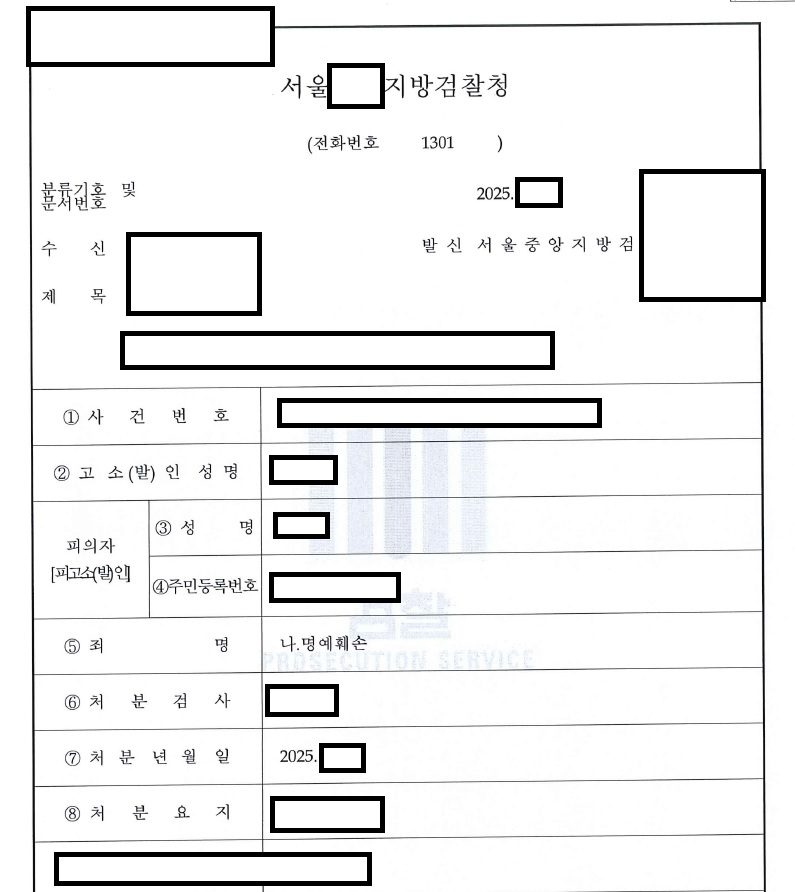
[This document is an official Notice of Reasons for Non-Prosecution (불기소 이유 통지) issued by the Seoul Central District Prosecutors’ Office in 2025 regarding a criminal complaint filed for defamation (명예훼손). The notice informs the complainant that, after reviewing the case, the prosecutor has reached a formal decision not to indict the suspect. It contains key administrative details, including the specific case number, the suspect’s identity, the date of the decision, and a summary of the legal and factual grounds for the dismissal. In the South Korean legal system, this notice serves as the formal justification for closing the case and provides the necessary basis for the complainant should they wish to pursue further legal remedies, such as filing a prosecutor’s appeal or a request for adjudication.]
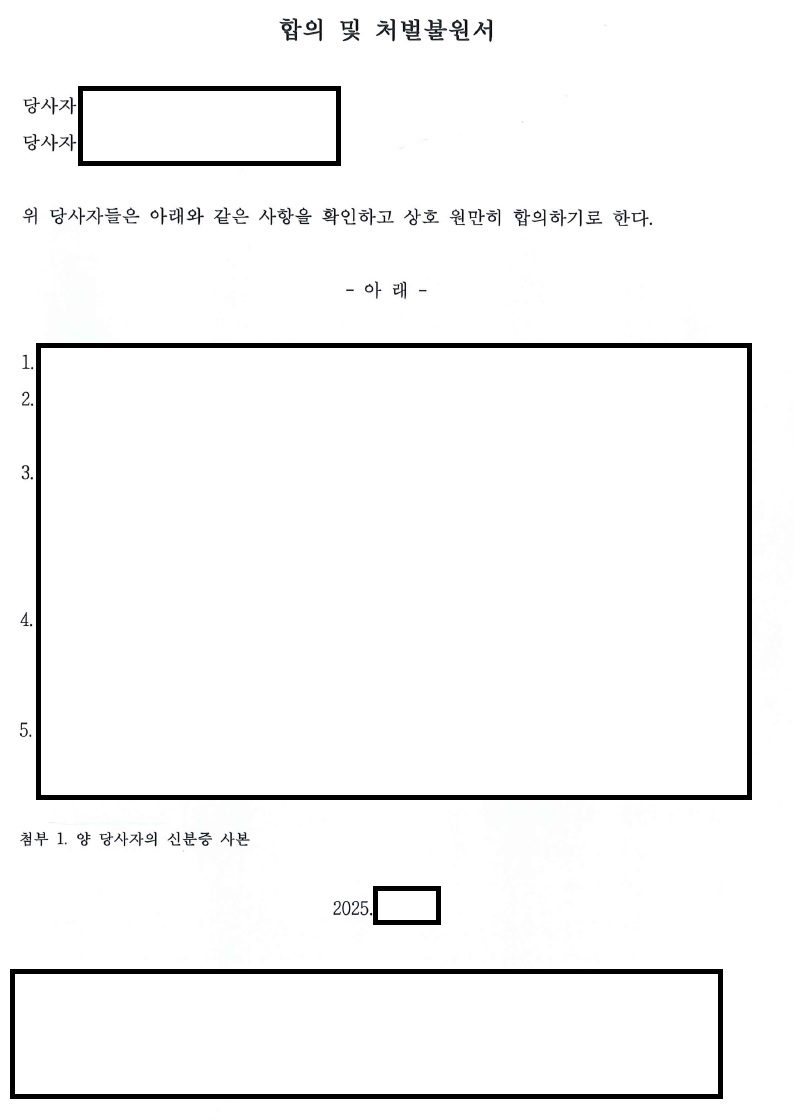
[This document is a formal Settlement Agreement and Non-Punishment Petition (합의 및 처벌불원서) from 2025, which serves as a critical legal instrument in resolving disputes between two parties. By signing this document, the parties officially declare that they have reached an amicable settlement regarding a specific incident, with the victim explicitly stating their desire for the offender not to be punished. The agreement allows for the insertion of specific terms—such as compensation amounts or behavioral conditions—and requires the attachment of identification copies from both parties to verify its authenticity. In the South Korean legal system, submitting this petition to the police, prosecution, or court is a vital step that can lead to the dismissal of charges in certain crimes or serve as a significant mitigating factor to reduce the severity of a sentence.]
FAQ: Cyber Crimes in Korea
Q1: The poster is anonymous (e.g., Everytime, DC Inside). Can police catch them?
A: Yes. Korean police can issue a warrant to the website administrator to reveal the IP address and user logs. However, if the server is foreign (e.g., Telegram, sometimes Instagram/Twitter) and the crime is minor, cooperation may be slow or refused.
Q2: They posted in English. Is it still a crime?
A: Yes. The language does not matter. If the content fits the legal definition of Insult/Defamation and the victim is in Korea (or the offender is Korean), Korean law applies. You will need a certified translation of the posts for the police.
Q3: Can I be countersued?
A: If you publicly post: “This person sent me hate mail!” and show their ID, YOU can be sued for Defamation (Fact-based). Always handle this through the legal system, not by “exposing” them back.
Q4: I don’t want money; I just want them punished. Is that possible?
A: Yes. You can refuse settlement. The perpetrator will then likely be fined by the court (Summary Order). They will have a permanent criminal record (Jeon-gwa).
Summary Checklist for Victims
- Don’t React: Do not fight back online.
- Capture: Save PDF evidence immediately.
- Check: Does it meet “Publicity” and “Specificity”?
- File: Submit a complaint to the police station (Cyber Team).
- Negotiate: Wait for them to offer a settlement.
Attacked online?
Don’t let keyboard warriors ruin your reputation.
Contact LIBRO Global Client Services to draft a watertight Criminal Complaint and handle Settlement Negotiations on your behalf.
Attorney Seok Jun Kang


