
Voice Phishing Job Scam: “I Didn’t Know” & How to Avoid Prison (Lawyer’s Guide 2026)[English Speaking Lawyer. LIBRO]
Voice Phishing Job Scam : The “Honey Job” Trap
Are you a victim of a Voice Phishing Job Scam? You are an international student or expat looking for extra cash. You find a job ad on Facebook, Telegram, or a job board:
“High pay for simple errands. Pick up packages/money. 200,000 KRW per day. No visa required.”
You think it’s a lucky break.
In reality, there is a very high chance you are about to become a “Sug-eo-chaek” (Cash Collector) for a voice phishing syndicate.
In Korea, carrying cash for these criminals is not just a “part-time job mistake.” It is a serious crime (Fraud or Aiding Fraud) punishable by up to 10 years in prison. “I didn’t know” is rarely accepted as a full excuse in court.
Here is your Ultimate Survival Guide to spotting the Job Scam and what to do if you are already involved. Voice Phishing Korea.
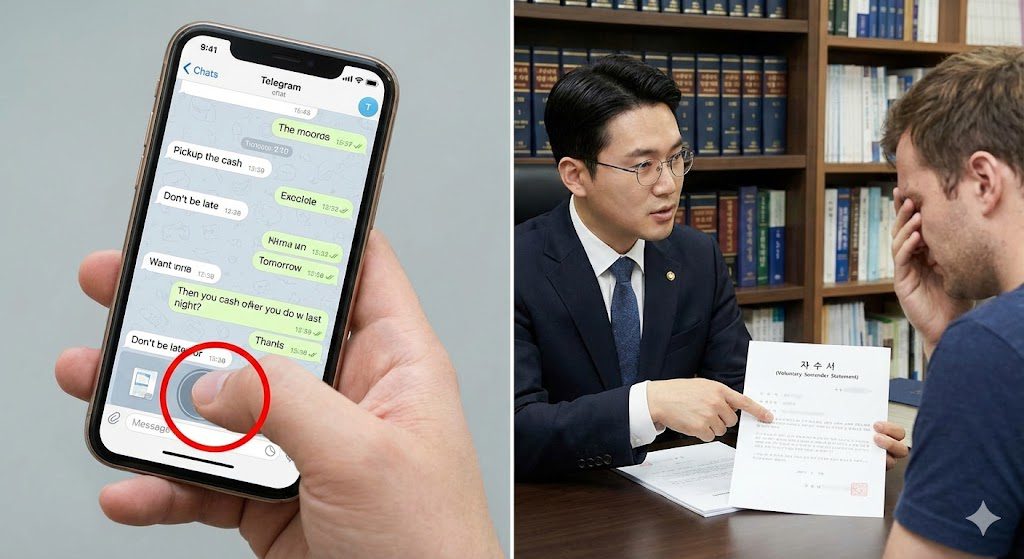
1. The “3-Point” Safety Checklist: Is My Job a Scam?
If your job involves even one of these 3 points, stop immediately. It is highly likely to be a scam.
[Table 1] Normal Job vs. Voice Phishing Mule
| Feature | Normal Part-time Job | Voice Phishing Scam (Mule) |
| Hiring Process | Face-to-face interview, Contract signed, ID checked. | 100% Online (Telegram/KakaoTalk). You never meet the boss. |
| The Task | Serving, Cleaning, Teaching, Office work. | Picking up cash from strangers or withdrawing cash from ATMs. |
| Money Transfer | Salary is sent to your bank account. | You are asked to send money to others using someone else’s name/ID. |
The 3 Critical Red Flags:
- Telegram Only: They refuse to meet in person. They give instructions solely via Telegram “Secret Chat.”
- Cash Collection: They ask you to meet a “client” (victim) in a parking lot, cafe, or subway station to take an envelope of cash.
- “Financial Assistant” Title: They claim to be a “Loan Company” or “Currency Exchange,” asking you to deposit cash into various accounts to “avoid tax.”
2. “I Already Did It…” 5 Steps to Survive the Crisis
If you realized you just moved stolen money, DO NOT RUN. Attempting to flee usually leads to arrest at the airport. You must act fast to reduce your sentence.
Step 1. STOP All Activities Immediately
Do not deliver the money you are holding. Do not contact the “boss” to say you are quitting (they will threaten you). Just stop.
Step 2. Preserve Evidence (Do NOT Leave the Chat)
This is the most critical mistake foreigners make. You get scared and delete Telegram. Do not do this.
- Why? You need to prove you were tricked and followed orders, not that you were a mastermind.
- Action:
- Take screenshots of every conversation.
- Use the “Export Chat History” function.
- Save photos of the cash, locations, and bank account numbers they gave you.
Step 3. Hire a Lawyer Immediately (The “Golden Time”)
In Korea, you have the right to an attorney from the very first moment.
- Why now? You need a lawyer to arrange your “Voluntary Surrender” (Ja-su).
- Benefit: Surrendering before the police catch you is a major mitigating factor in sentencing (Criminal Act Article 52).
Step 4. The “Ja-su” (Surrender) Strategy
Walk into the police station with your lawyer and the evidence.
- Statement: “I was looking for a job, I was deceived, and the moment I realized it was a crime, I stopped and came here.”
- Result: While not guaranteed, this significantly lowers the risk of immediate detention (jail while waiting for trial).
Step 5. Settlement with Victims (Hap-ui)
To avoid prison, you may need to pay back some of the money to the victims. A lawyer negotiates this to ensure it counts towards your leniency.
3. Korean Criminal Procedure: When Can I Get a Lawyer?
Foreigners often ask: “Do I wait until court to get a lawyer?”
NO. The most important battle happens at the Police Station.
[Table 2] Timeline of Criminal Defense in Korea
| Stage | What Happens | Role of Lawyer (Why you need one) |
| 1. Police Investigation | You are summoned for questioning. (Most critical stage). | Crucial. Attend the interview with you. Prevent you from confessing to things you didn’t do. |
| 2. Warrant Review | Police ask a judge to put you in jail (Detention Center). | Vital. Argue against detention so you can stay at home during the trial. |
| 3. Prosecution | Prosecutor decides: Indict (Trial) or Drop Case? | Submit “Attorney’s Opinion” to aim for Suspension of Indictment (Best outcome). |
| 4. Criminal Court | Trial and Sentencing. | Argue for Probation (Suspended Sentence) instead of actual prison time. |
⚠️ Lawyer’s Insight: “The first police statement becomes the main evidence. If you speak poorly in broken Korean or admit to ‘guessing it was illegal’ without a lawyer present, it is very difficult to fix later.”
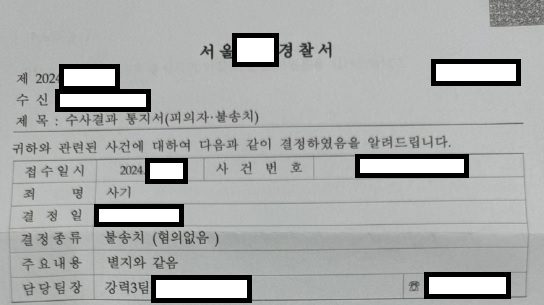
[This document is an official Notice of Investigation Result issued by the Police Station on 2024, regarding a fraud allegation related to a voice phishing case. Following an investigation that began in 2024, the police reached a final decision of “Non-referral due to No Suspicion” (불송치/혐의없음). This legal determination signifies that the investigative authorities found no evidence or legal grounds to support the criminal charges against the suspect. As a result, the case has been officially closed at the police level without being transferred to the prosecution for indictment, effectively exonerating the individual from the suspected fraud.]
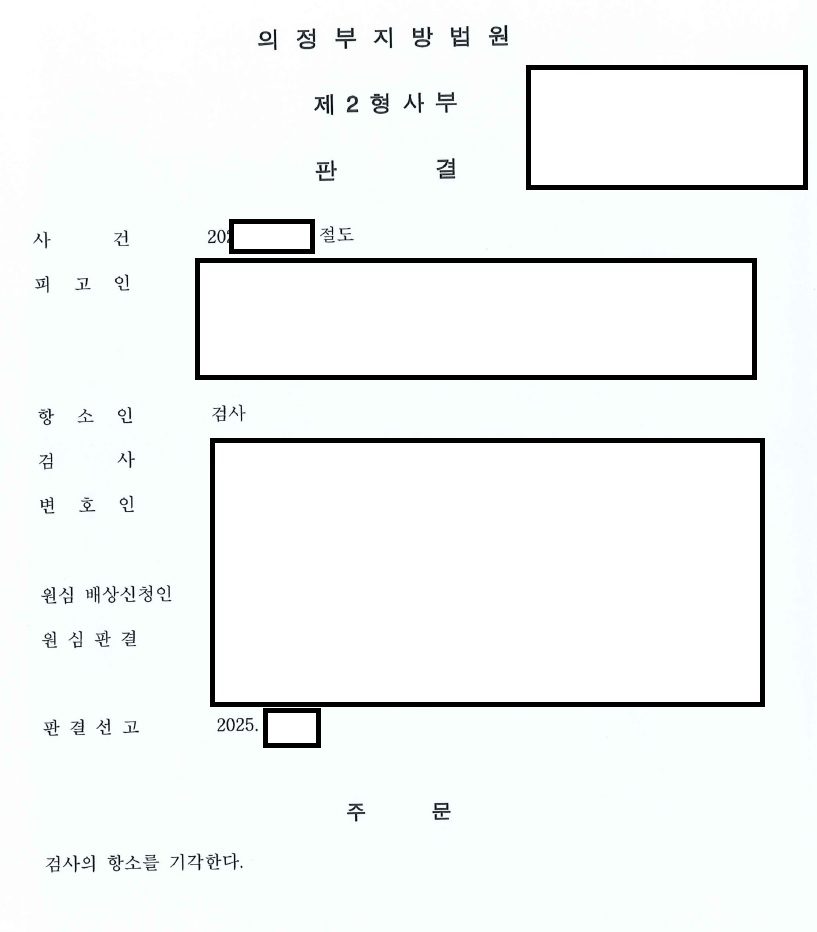
[This document is an appellate court judgment issued by the Uijeongbu District Court in 2025 regarding a voice phishing case where a foreign national was charged as a “money collector” (runner). After the defendant was acquitted in the court of first instance, the prosecutor filed an appeal to contest the “Not Guilty” verdict. However, the court’s 2nd Criminal Division officially dismissed the prosecutor’s appeal, thereby upholding the original acquittal and finalizing the defendant’s innocence. This ruling confirms that the prosecution failed to provide sufficient evidence to overturn the lower court’s decision, effectively clearing the foreign national of all criminal charges related to the case.]
FAQ: High-Risk Part-Time Jobs
Q1: I really didn’t know it was a scam. Can I still go to prison?
A: Yes. Korean courts often apply “Willful Negligence” (Miphil-jeok Goi). If a normal person should have suspected it was illegal (e.g., handling huge cash for high pay), the court assumes you did know. You need a professional legal defense to prove your innocence.
Q2: Will I be deported?
A:
- Prison Sentence: Yes, almost certainly.
- Suspended Sentence (Probation): High risk of deportation.
- Fine (over 3 Million KRW): Strong grounds for deportation review.
- The Goal: Your lawyer’s goal is to get a “Suspension of Indictment” or a “Not Guilty” verdict. This offers the best chance to keep your visa.
Q3: Can I just leave Korea now?
A: Likely No. Once the victim reports the crime, police typically request an Exit Ban (Chul-guk-geum-ji). If this ban is in place, you will be stopped and likely arrested at Incheon Airport.
Q4: The boss on Telegram has my passport photo. Will they hurt me?
A: While 100% safety cannot be guaranteed, physical retaliation is rare. These scammers are usually based overseas (China/Philippines) and fear police detection. Do not let fear force you into committing more crimes.
Summary Checklist
- Check: Does the job involve picking up cash? STOP.
- Evidence: Screenshot everything. Do NOT delete chats.
- Action: Do NOT wait for the police to call you.
- Defense: Contact a lawyer to arrange Voluntary Surrender (Ja-su) immediately.
Suspect your job is a scam?
Every hour counts. Surrendering voluntarily with a lawyer is your best chance to avoid prison.
[Contact LIBRO Global Client Services for Urgent Defense]
LIBRO Global Client Services
Attorney Seok Jun Kang


