
“My Spouse Will Cancel My Visa!” 3 Ways to Get an F-6 Visa Extension After Divorce (2026 Korea Divorce Guide)[English Speaking Lawyer. LIBRO]
Introduction: The “Visa Threat” vs. F-6 Visa Extension After Korea Divorce
“If you divorce me, I will call Immigration and cancel your visa. You will be deported in 2 weeks.”
This is the #1 threat foreign spouses hear during marital conflicts in Korea. It is designed to paralyze you with fear so you give up child custody or property rights.
Here is the legal truth for 2026:
Your Korean spouse cannot simply “cancel” your visa with a single phone call. The Immigration Office decides your status, not your angry spouse.
However, you must be careful. If your spouse reports false information (e.g., claiming you ran away or it was a sham marriage), Immigration may investigate. To stay in Korea without your spouse, you must legally fit into 1 of these 3 specific categories:
- F-6-2: You are raising (or actively visiting) a minor Korean child.
- F-6-3: The marriage breakdown was primarily the Korean spouse’s fault (e.g., infidelity, violence).
- F-6-3: Your spouse passed away or disappeared.
This guide provides a 5-Step Action Plan to securing your stay under the most complex categories: Proving Fault (F-6-3) and Child Rearing (F-6-2). This guide explains exactly how to secure an F-6 Visa Extension After Divorce even if your spouse refuses to help.
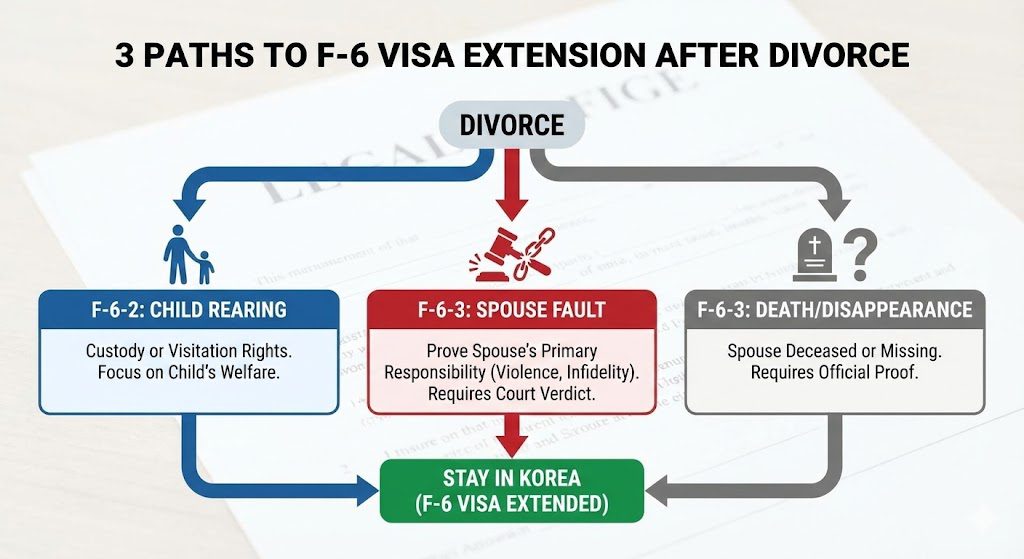
1. 3 Paths to F-6 Visa Extension After Divorce
Most people just know “F-6.” But in the immigration system, your specific visa code changes after the marriage ends. You must aim for one of these 3 Targets.
[Table 1] The 3 Post-Divorce Visa Targets
| Visa Code | Target Category | Key Requirement | Difficulty Level |
| F-6-1 | Married & Living Together | Spouse’s Guarantor Letter (Reference) | Easy (if happy) |
| F-6-2 | Child Rearing | Custody or faithful implementation of Visitation Rights | Moderate |
| F-6-3 | Spouse at Fault | Verdict proving “Primary Responsibility” lies with the spouse | Hard (Requires Evidence) |
⚠️ Critical Warning: If you agree to a “Mutual Divorce” (Hyeop-ui Ihon) citing simple “personality differences” and have 0 children, it is very difficult to extend your F-6 visa. You may need to switch to another visa (D-2, E-7) or leave Korea.
2. Scenario A: The “F-6-3” Path (Proving Fault)
If you are a victim of domestic violence, infidelity, or abandonment, you can stay in Korea alone. But you need to collect 3 Types of Evidence to prove the breakdown was “primarily the Korean spouse’s responsibility.”
Step 1: Collecting Evidence for F-6-3 (Spouse Fault)
Immigration will not believe your story without proof. You must secure these 5 documents before you leave the house.
- Medical Injury Certificate (Sang-hae Jin-dan-seo): Go to a hospital immediately. Ensure the doctor records: “Patient states spouse hit them.” (A general certificate is weak; get the Injury Certificate).
- Photos of Damage: Take 10+ photos of bruises, broken furniture, or torn clothes immediately.
- 112 Police Report History: If police came, go to the station and request the “Confirmation of Report Processing” (Sa-geon Sa-go Sa-sil Hwak-in-won).
- Chat Logs (KakaoTalk): For infidelity, save screenshots of romantic messages with the third party.
- Recordings: In Korea, recording a conversation you are participating in is legal without consent. Record their threats or admissions of violence.
Step 2: Why You Need a Court Verdict (Not Mediation) to Stay in Korea
You likely cannot do a “Mutual Divorce.” You must file a lawsuit.
- The Goal: You need a Court Verdict (Pan-gyeol-mun) that implies: “The marriage broke down due to the Defendant (Korean spouse)’s actions.”
- Immigration’s Rule: If the verdict says “Mutual Fault” (50/50 responsibility), Immigration often denies the F-6-3 extension because the “primary responsibility” requirement is not met. You must fight to prove their fault is greater.
3. Scenario B: The “F-6-2” Path (Child Rearing)
If you have a child with your Korean spouse, this is your strongest shield.
The “Child-Centric” Rule
The Korean Supreme Court and Immigration recognize that a child needs their foreign parent.
- Custody: If you have custody and raise the child, F-6-2 is generally granted.
- Visitation Rights: Even if you do not have custody, if you have Visitation Rights (Myeon-jeop-gyo-seop) and meet the child regularly (e.g., every weekend), Immigration may grant an F-6-2 visa to allow you to fulfill your parental duty.
Note: Immigration conducts a comprehensive review of your financial ability, bonding with the child, and living stability before granting this.
[Table 2] F-6-2 Visa Documents Checklist
| Document | Purpose | Where to Get |
| Family Relation Certificate | Prove parentage (your name is on it). | Community Center (Dong-jumin-center) |
| Basic Certificate (Child) | Prove child’s Korean nationality. | Community Center |
| Divorce Decree / Verdict | Prove you have Custody or Visitation Rights. | Family Court |
| Photos with Child | Prove ongoing emotional bond. | Your phone |
| Child’s School Record | Prove you are the guardian/contact person. | School/Kindergarten |
4. The Family Investigator Interview: 3 Key Talking Points
During a divorce trial, the court appoints a Family Investigator (Gasa-josa-gwan). Their report determines your visa destiny.
Do NOT just complain about your spouse. Use these 3 Scripts:
- Focus on the Child: “I am the one who feeds, bathes, and puts Min-su to sleep every night. If I leave Korea, Min-su will suffer emotional trauma.”
- Focus on Integration: “I speak Korean (TOPIK Level 3), I have a steady job, and I want to raise my child as a proud Korean citizen.”
- Regarding Fault: “I tried to save the marriage (show counseling records), but his violence/affair made it impossible to stay.”
5. Countering the “Guarantor Withdrawal” Threat
Since 2011, the “Letter of Guarantee” (Sin-won-bo-jeung-seo) is not strictly mandatory by law for F-6 extensions (it is mainly for the initial visa). However, some Immigration offices may still request it in practice to verify the marriage is intact.
The Real Danger: If your spouse calls Immigration and falsely reports “She ran away” or “It’s a fake marriage,” Immigration will investigate.
Your 2 Counter-Moves:
- The “14-Day” Address Rule: If you separate, you must report your new address to Immigration within 14 days. Failure to do so leads to fines and suspicion of being a “runaway.”
- Submit a Pre-emptive Petition: Write a “Petition” (Tan-won-seo) to Immigration explaining: “We are undergoing divorce proceedings (Case #2026-Deu-Dan-XXXX). Please hold any cancellation actions until the court verdict.”
FAQ: 4 Common Questions on F-6 Divorce
Q1: Can I work while the divorce lawsuit is ongoing?
A: Yes. Until the divorce is finalized and your visa is officially cancelled or changed, you maintain your F-6 status and can work legally. If the lawsuit takes 1~2 years, you can apply for visa extensions using the “Certificate of Lawsuit Filing”.
Q2: My husband says he will cancel his “sponsorship.” Will I be deported immediately?
A: No. He cannot legally “cancel” your visa unilaterally. However, if your visa expires during the fight, renewal (F-6-1) becomes difficult. In this case, your status is often switched to a temporary G-1 (Miscellaneous) visa until the lawsuit finishes. Once you get the verdict proving his fault, you can switch back to F-6-3.
Q3: What if the court says we are BOTH at fault (50/50)?
A: This is risky. If the verdict says “Mutual Fault,” Immigration often denies the F-6-3 visa because the requirement is that the breakdown was “primarily due to the Korean spouse.” You must legal strategy to prove his fault was greater (e.g., 70/30) or rely on child-rearing reasons (F-6-2).
Q4: Can I keep F-6 if I don’t have custody but pay child support?
A: It is possible, but not automatic. If you have Visitation Rights and see the child faithfully, Immigration reviews your case positively. However, if you simply pay money but never see the child, the visa extension may be denied. You must prove active parenting.
Lawyer’s Insight ⚖️
“A divorce involving an F-6 visa is not just a family law case; it is an immigration battle. Many foreigners lose their visa not because they were wrong, but because they agreed to a ‘Mutual Divorce’ to end the fight quickly, not realizing this counts as ‘No Fault’ for the Korean spouse.
If you want to stay in Korea without children, you must obtain a court verdict proving the Korean spouse’s primary responsibility. Do not sign any settlement papers without an immigration lawyer reviewing the visa implications.“
Is your spouse threatening your visa status?
Don’t wait for the call from Immigration. Contact us immediately to build your F-6 Defense Strategy. /Visit HiKorea
Attorney Seok Jun Kang


