
[2026 CEO’s Guide] Navigating International Disputes in Korean Courts. English Speaking Korean Lawyer [LIBRO]
As a legal partner who frequently advises foreign-invested companies in Korea, I have seen many international disputes where procedural technicalities determined the final outcome. Based on my experience with complex cross-border litigation—including cases involving international service and evidence collection—I have prepared this professional guide specifically for foreign CEOs and managers. (English Speaking Korean Lawyer)

Introduction
In a globalized business environment, a dispute is more than just a disagreement; it is a strategic battle over where you fight (Jurisdiction) and which rules apply (Governing Law). Here is the roadmap to protecting your interests in Korea.
1. Can You Sue in Korea? (International Jurisdiction)
Simply having a contract does not automatically grant a Korean court the right to hear your case. The court must have a “Real Connection” to the dispute.
- Determination Criteria: Korean courts use domestic jurisdictional rules as a baseline but ultimately decide based on the principles of fairness, accuracy, speed, and judicial economy.
- Habitual Residence: If the defendant has their primary residence or place of business in Korea, jurisdiction is generally established.
- Exclusive Jurisdiction Clauses: In international transactions between equal business entities, a valid agreement designating a specific country’s court is generally respected.
2. Which Law Applies? (Governing Law)
It is a common misconception that the court’s location dictates the law of the case. Jurisdiction and Governing Law are separate issues.
- Party Autonomy: Korean courts prioritize the “Governing Law” clause in your contract.
- Absence of Choice: If no law is specified, the court applies the law of the country with the “closest connection” to the transaction.
- Strategic Note: You may find yourself in a Korean court arguing a case based on New York or German law if your contract dictates it.
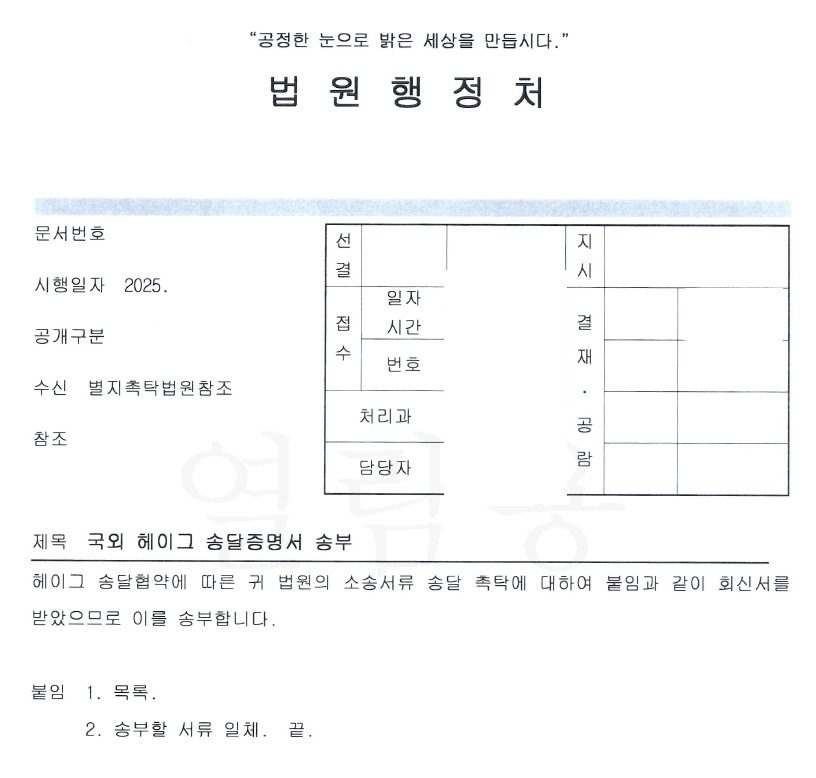
3. Serving Documents Abroad (The Hague Service Convention)
If the defendant is outside Korea, you must follow the “Convention on the Service Abroad of Judicial and Extrajudicial Documents in Civil or Commercial Matters”.
- The “Mail Service” Trap: Korea has formally objected to direct service by mail (Article 10, Paragraph 1). If a foreign court serves a Korean party only by mail, there is a high risk that the resulting judgment will be refused enforcement in Korea due to “improper service”.
- Non-Member States: For countries not party to the Hague Convention, service is conducted through Letters Rogatory (diplomatic channels), which can be significantly slower and more complex.
4. International Evidence & Pleadings (Letters Rogatory)
Key evidence, such as customs records or third-party communications, is often located abroad.
- Fact-Finding Requests: We use the court to issue official requests (Letters Rogatory) to foreign customs or corporations to verify export/import facts.
- The Power of Pleadings: Your “Pleadings” (Jun-bi-seo-myeon) must present a consistent link between facts and evidence. Inconsistency across different submissions can severely damage your credibility.
- The Risk of Admission: Unlike written submissions, if you appear in court and explicitly admit a fact asserted by the opponent, that “Admission” (In-nak) becomes binding and cannot be easily contested later.

💡 Strategic Comparison: Litigation vs. Arbitration
| Category | Korean Court Litigation | International Arbitration |
| Finality | Three-tier system (Appeals possible) | Final and binding (Single-tier) |
| Confidentiality | Public record (generally) | Strictly confidential |
| Jurisdiction Note | May be dismissed if a valid Arbitration Clause exists. | Jurisdiction is based solely on the parties’ agreement. |
| Enforcement | Based on domestic law/treaties | Easier international enforcement (New York Convention) |
❓ Frequently Asked Questions (FAQ)
Q1. What are the requirements for enforcing a foreign judgment in Korea?
A1. Under Article 217 of the Civil Procedure Act, four conditions must be met:
- The foreign court had valid jurisdiction.
- The defeated party received proper service (Public Notice Service is generally insufficient).
- The judgment does not violate Korea’s “Public Policy”.
- Reciprocity (Mutual Guarantee) exists between the two countries.
Q2. What if my address changes during the lawsuit?
A2. You must notify the court immediately. If you fail to do so, the court may send documents to your old address, and they will be legally deemed as served, potentially leading to a default judgment against you.
Q3. Can I manage my Korean case online?
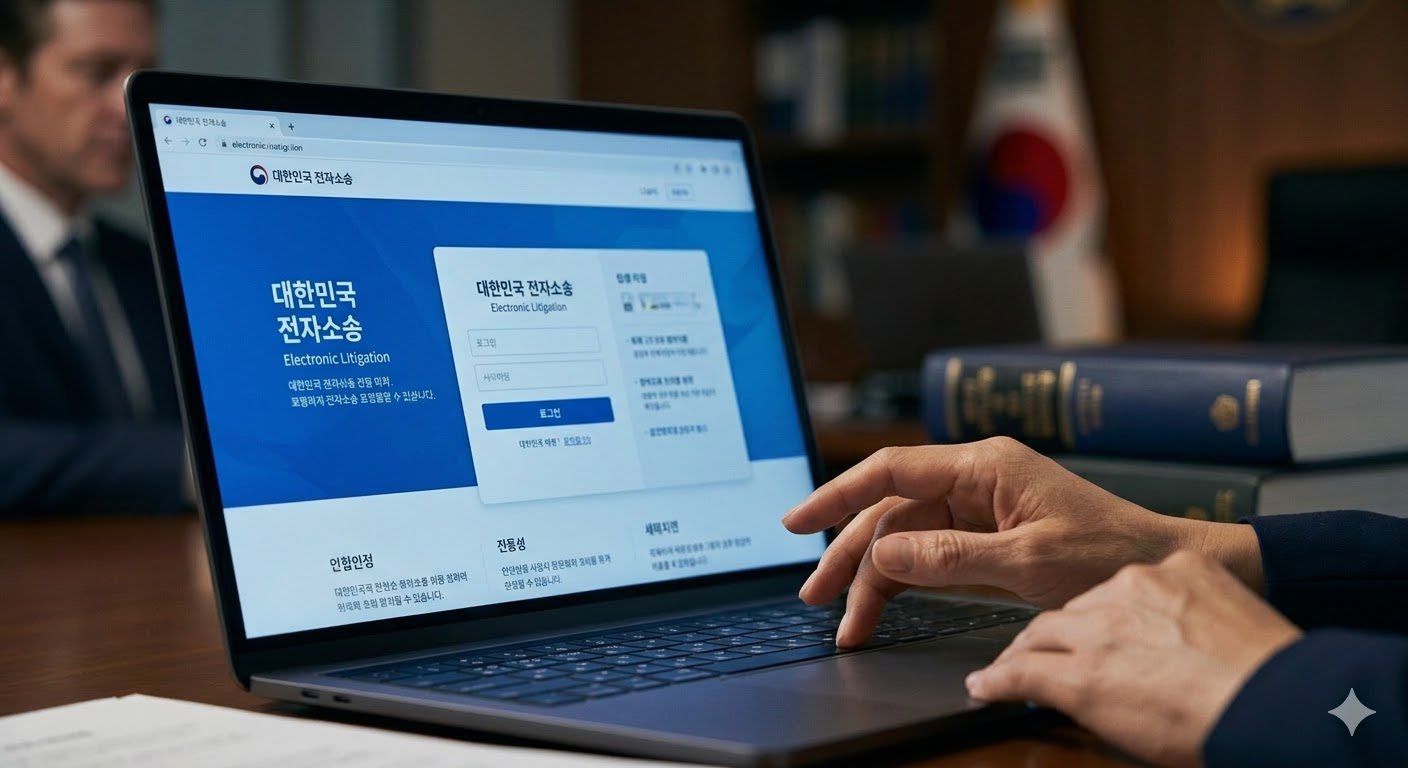
A3. Did you know that the Korean Electronic Litigation website is accessible in English? While available, foreign parties often face hurdles with digital authentication. Most international clients still find it more effective to utilize a local legal representative to manage the E-Litigation portal.
[Notice] This guide is provided for general informational purposes and does not constitute formal legal advice. Outcomes may vary based on specific case facts. Always consult with a qualified legal professional for your specific matter.
Attorney Seok Jun Kang


