[2026 CEO’s Guide] How to Recover Unpaid Receivables in Korea: From Asset Freezing to Final Inquiry. English Speaking Korean Lawyer [LIBRO]
As a legal partner who frequently advises foreign-invested companies in Korea, I understand that unpaid invoices are more than just a financial nuisance—they can jeopardize your entire local operation. Based on my experience with complex debt recovery cases, I have prepared this comprehensive guide to help you navigate the Korean legal system and secure your funds. (English Speaking Korean Lawyer)
Introduction
When a Korean partner delays payment citing “liquidity issues,” or if you suspect they are preparing to close their business, you must act decisively. In Korea, debt recovery is a battle of speed and procedural precision.
Step 1: Freeze Their Assets (Provisional Attachment)
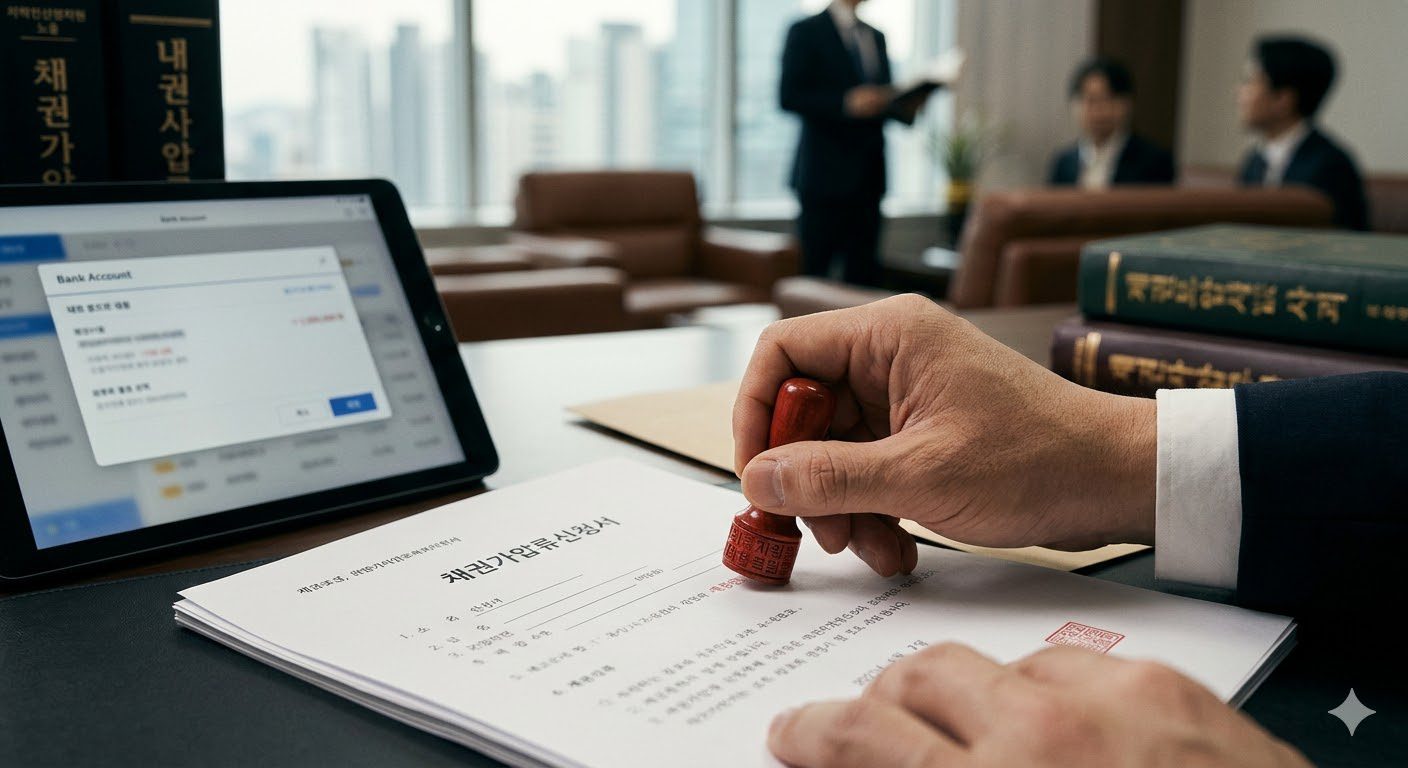
Before filing a formal lawsuit, you must ensure there is money left to collect. Provisional Attachment (Ga-ap-ryu) “freezes” the debtor’s assets so they cannot be hidden or transferred.
- How it works: Once granted, the bank (the third-party debtor) is prohibited from paying out funds to the debtor. This effectively locks the debtor’s account.
- The 3-Year Rule: If you do not file a main lawsuit within three years after the provisional attachment is executed, the debtor or interested parties may apply to the court to cancel the attachment.
- Order to Commence Suit: If the debtor applies for an “Order to Commence Suit” (Jeso-myeongnyeong) and you fail to submit proof of a lawsuit within the court’s deadline, the court may cancel the attachment.
Step 2: Secure Your “Key” to Enforcement (The Main Lawsuit)
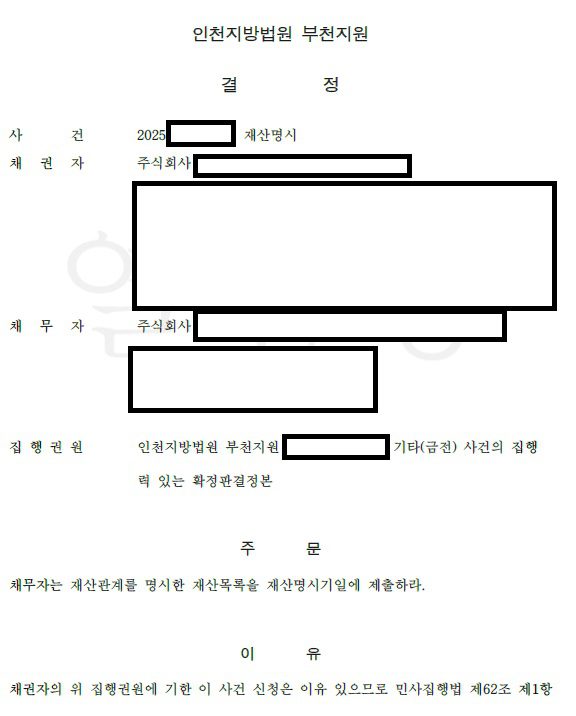
To legally force a payment, you need a “Title of Execution” (Jip-haeng-gwon-won), which is typically a final court judgment.
- The Judgment: The court will order the defendant to pay the principal amount plus late interest (usually 6% to 12% per annum).
- Enforcement Writ: Once the judgment is final, the court issues a “Writ of Execution” (Jip-haeng-mun), allowing you to begin the actual seizure of assets.
Step 3: Track Down Hidden Wealth (Asset Disclosure & Inquiry)
If the debtor still refuses to pay, claiming they have no money, you can use the court’s power to find their hidden assets.
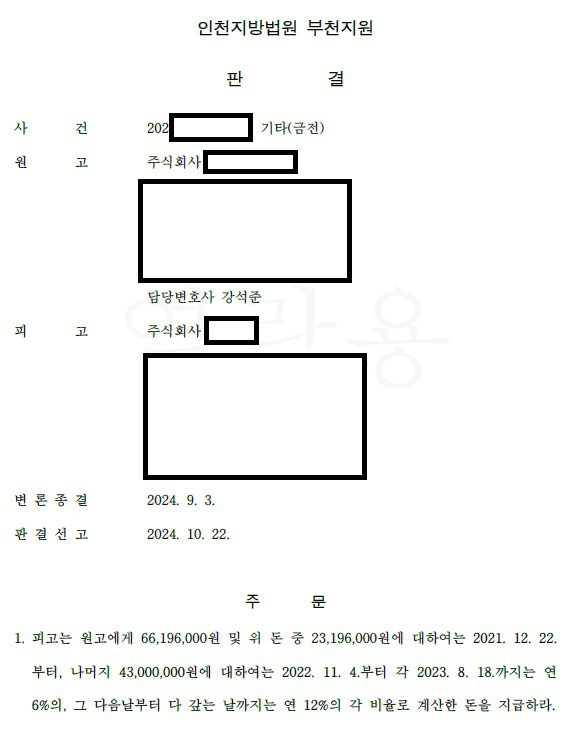
- Asset Disclosure (Jae-san-myeong-si): The court orders the debtor to appear and list all their assets under oath.
- Failure to Comply: If the debtor fails to appear or refuses to take an oath without a valid reason, the court may order detention for up to 20 days (Gam-chi).
- False Reporting: If the debtor submits a false asset list, they face imprisonment for up to 3 years or a fine of up to 5 million KRW. As a criminal penalty, this will result in a permanent criminal record (Jeon-gwa), providing significant leverage.
- Asset Inquiry (Jae-san-jo-hoe): Once you have obtained a Title of Execution, you can request the court to query financial institutions and government agencies directly to find real estate, vehicles, or bank accounts.
💡 Comparison of Enforcement Methods
| Category | Movable Asset Seizure | Claim/Bank Account Seizure | Asset Inquiry |
| Target | Office furniture, machinery, inventory | Bank deposits, trade receivables | Real estate, cars, stocks, deposits |
| Advantage | High psychological pressure (“Red Tags”). | Fastest way to recover actual cash. | Exhaustive search of hidden wealth. |
| Constraint | Low resale value for used items. | Difficult if the bank name is unknown. | Requires a prior judgment & fees. |
❓ Frequently Asked Questions (FAQ)
Q1. What if the debtor company has already closed down? A1. Do not give up immediately. We check if the “corporate veil” can be pierced to hold the owner personally liable, or if the closure involved a fraudulent transfer of assets to a third party (Sa-hae-haeng-wi), which can be reversed by a separate lawsuit.
Q2. Does the “loser pay” rule for legal fees apply in Korea?
A2. In principle, yes. The prevailing party can claim litigation costs from the losing party. However, the court has the discretion to adjust the specific amount and scope of burden, and in rare cases, a winner might still bear a small portion of the costs.
Q3. What happens if the debtor sells their property after I’ve attached it?
A3. You are protected. Even if ownership is transferred, you retain the right to receive payment from the proceeds of a future auction within the limit of your initial attachment amount.
Q4. Is the process different for foreign companies?
A4. The legal standards are identical. However, foreign companies must ensure all evidence (contracts, emails) is accurately translated and notarized for the Korean court.

Disclaimer: This guide provides general information based on standard legal procedures in Korea. Legal outcomes may vary significantly depending on the specific facts of each case. We strongly recommend consulting with a legal professional before taking any formal action.
Did you know that the Korean Electronic Litigation website is accessible in English? If you would like to visit the link, please click this button.
Attorney Seok Jun Kang


