
[2026 Guide] Korea Scam Guide: How an Ordinary Job Seeker Can become a Criminal Suspect Overnight(Voice Phishing) [LIBRO, English Speaking Lawyer]
Among foreign residents in Korea, there is a common misconception: “I only got scammed because my Korean is poor” or “Scammers only target foreigners who don’t know the system.” The reality is much more chilling. Voice phishing and recruitment scam organizations have become so sophisticated that even socially fresh Koreans—university students and recent graduates—fall into their traps. These organizations build “perfectly fake” companies to recruit innocent people as tools for their crimes.
The following story is a composite reconstruction based on multiple real-life court judgments and investigative cases. It illustrates how an ordinary job seeker can become a criminal suspect overnight. (2026 Korea Scam Guide)
🔍 The Case: A “Dream Job” at a Global Logistics Firm
Stage 1: A Flawless First Impression
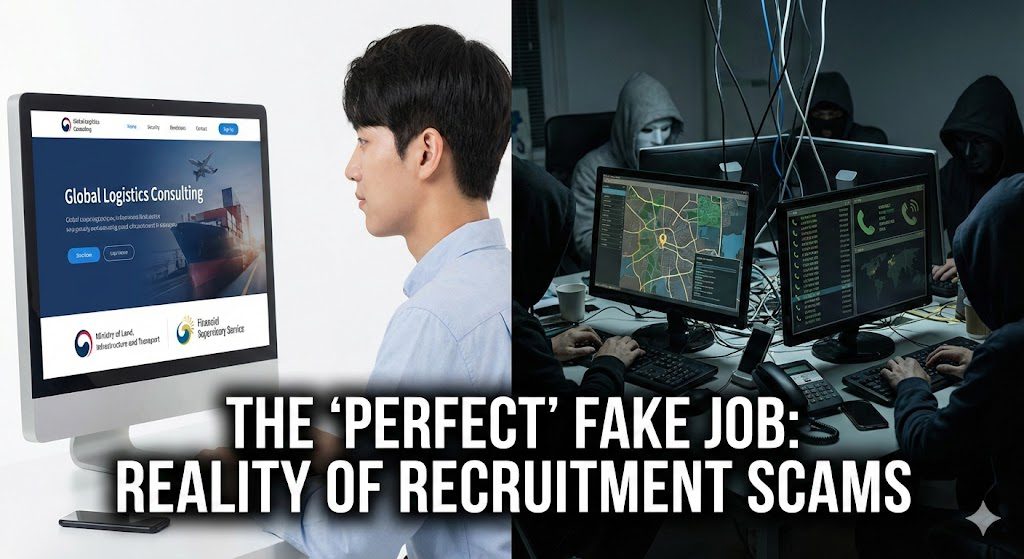
“Min-jun,” a 20-something Korean who just finished his military service, posted his resume on a famous job portal. He was soon contacted by a manager at a “Global Logistics Consulting” firm. Min-jun checked the company website, which featured professional business descriptions and—most convincingly—official logos from the Ministry of Land, Infrastructure and Transport and the Financial Supervisory Service.
Stage 2: Professional Onboarding
The scammers did not rush. They conducted a remote interview via professional channels and had Min-jun sign a “Representative Power of Attorney” and a formal employment contract. He was instructed to install “Microsoft Teams,” a standard corporate messenger, for all work-related communication. He was even given an employee ID number, making him feel like a legitimate part of the team.
Stage 3: Building Trust with “Mundane Work”
For the first few days, the work was entirely normal. Min-jun was asked to visit logistics warehouses to take photos for “site surveys” or deliver standard documents to mailboxes. His promised daily wage was deposited accurately into his bank account every evening at 6:00 PM.
Stage 4: The Sudden “Cash Collection” Instruction
Once trust was established, the manager assigned a “special task”: meeting a client to collect a “pre-paid contract fee”. When Min-jun asked why the payment was in cash, the manager claimed it was “standard industry practice for auction deposits” and told him just to receive the envelope. In reality, the “client” was a victim of voice phishing, and by delivering that money, Min-jun unknowingly became a Cash Courier for a criminal organization.
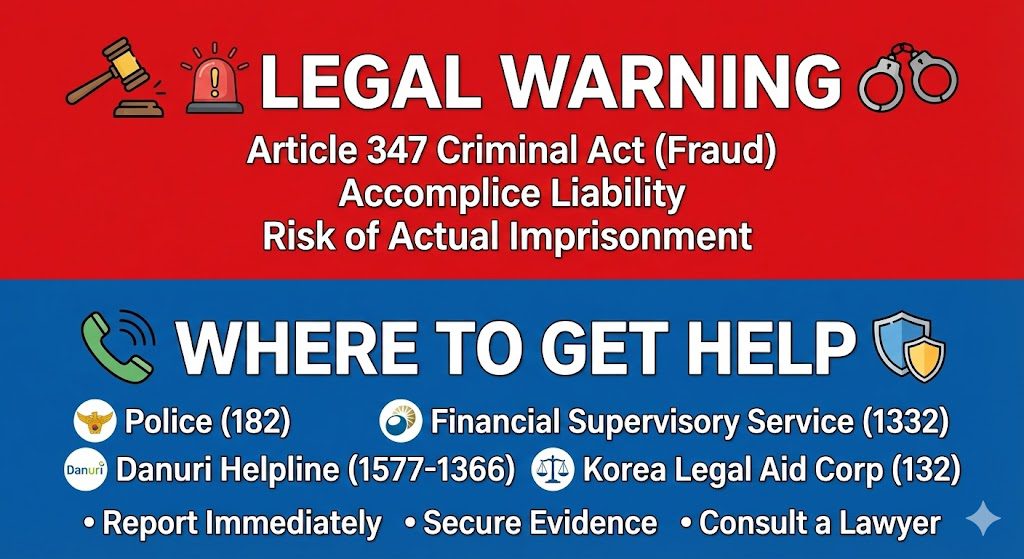
🚨 Legal Warning: Under Article 347 of the Korean Criminal Act (Fraud), such actions can lead to prosecution as an accomplice or an aider. Korean courts frequently sentence cash couriers to actual imprisonment, even if they claim they were just doing a part-time job.

💡 Checklist: Normal Company vs. Scam Organization
Scam organizations disguise their crimes under titles like “Debt Collection,” “Auction Deposit Handling,” or “Real Estate Site Survey”.
| Category | Legitimate Company | Suspicious Organization (Scam!) |
| Work Content | Matches the job description. | Sudden requests to collect/transport cash or transfer money. |
| Instructions | Official company email and landlines. | Uses only Telegram, Teams, or Kakao Open Chat; no official landline. |
| Salary | Industry standard based on experience. | Unusually high pay compared to the effort required. |
| Security | Standard NDAs for trade secrets. | Requests absolute secrecy from family; uses threats of lawsuits if told. |
| Identity | Follows Labor Standards Act. | Demands real-time location reporting under the guise of “oversight”. |
❓ Frequently Asked Questions (FAQ)
Q1: If I signed a contract and saw a website, can I still be punished?
A: Yes. Scammers forge websites and contracts specifically to bypass your suspicion. The court looks for “Willful Blindness” (Dolus Eventualis). They will check if:
- The hiring process had no face-to-face interview.
- The work differed significantly from the job ad.
- The pay was excessively high.
- Instructions were only via informal messengers.
- You performed the role of physically collecting or moving cash. Note: Not all cases result in punishment, but you must consult a lawyer to prove your lack of criminal intent.
Q2: The manager showed me an ID card from the “Financial Supervisory Service.” Is it real?
A: It is almost certainly fake. Public officials in Korea never meet civilians on the street to collect physical cash. Any arrest warrant or ID sent via messenger is a forgery.
Q3: They are threatening to sue me for violating my “Non-Disclosure Agreement.”
A: Do not be intimidated. A contract or NDA based on the execution of a crime is void under Civil Law as it violates public policy. Their threats are simply psychological tools to prevent you from reporting them.
Q4: What should I do if I have already delivered cash?
A: Stop working immediately and take these steps:
- Secure Evidence: Save all chat logs (Telegram, etc.), contracts, and payment records.
- Consult a Professional: Speak with a lawyer to determine your legal standing.
- Voluntary Confession/Reporting: Under Article 52 of the Criminal Act, a voluntary confession can be a reason for a mitigated sentence.
- Consistent Testimony: Clearly explain when and why you first began to suspect a crime. Showing that you cut ties immediately upon realization is a strong defense.
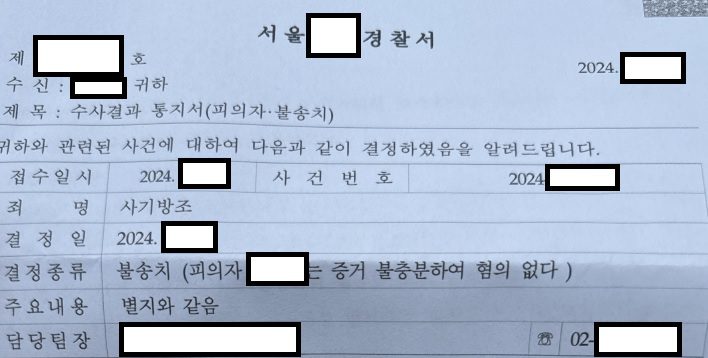
In cases involving suspects accused of aiding fraud through voice phishing, the police often issue a non-prosecution decision when there is insufficient evidence to prove “willful blindness” or criminal intent.
These individuals are frequently victims themselves, falling under the extreme psychological control of scammers who pose as high-ranking law enforcement officials. To ensure compliance, the criminal organization may use forged legal documents and demand real-time activity reports to isolate the person from their family and friends. Believing they are assisting a legitimate government investigation to prove their own innocence, the individual is tricked into delivering funds, often under the guise of “protecting assets” for fellow victims.
Ultimately, the authorities recognize that transparent conduct—such as the person using their real identity, personal vehicle, and personal credit cards during the events—serves as strong evidence that they had no awareness of participating in a crime and were instead used as an unwitting tool by the criminal organization
🌏 Special Note for Foreign Workers
Foreigners are often more vulnerable due to language barriers and a lack of familiarity with Korean law.
- Do not rely solely on the advice of “Korean friends” or coworkers; always verify with an official public agency.
- If an employer refuses to provide a standard written contract in a language you understand, it is a major red flag.
📞 Where to get help:
- Police (Voice Phishing Reporting): 182
- Financial Supervisory Service (Scam Consulting): 1332
- Danuri Helpline (Multi-language support): 1577-1366
- Korea Legal Aid Corporation: 132
Lawyer’s Advice ⚖️
Recruitment scams can happen to anyone. These organizations use sophisticated psychological tactics to exploit your desire for a good job. If your work involves meeting strangers to collect cash, stop immediately.
These “fake jobs” go beyond offering easy money; they use guilt and isolation to make it impossible for victims to leave. In our next post, we will take a deep dive into the psychological manipulation techniques used by these scammers to control their “employees.”
If you want to know about [2026 Guide] Voice Phishing Defense: From “Dream Job” to Handcuffs: A Seoul Defense Lawyer’s Diary, please refer to this link below.
If you want to know about The Trap of the Police Protocol (Jo-seo) & Your 3 Rights (2026 Korea Police Investigation Guide), please refer to this link below.
Attorney Seok Jun Kang


