
[2026 Guide] My Landlord Suddenly Changed! What Foreigners in Korea Need to Know. Foreign Resident Registration Korea [LIBRO, English Speaking Lawyer]
Introduction (Foreign Resident Registration Korea)
Finding out your landlord has sold the property while you are still living there can be a heart-racing moment. You might wonder: “Is my deposit safe?” or “Can the new owner kick me out?”
In South Korea, while the Housing Lease Protection Act (주택임대차보호법) is primarily designed for Korean citizens, Article 88-2 of the Immigration Act ensures that foreigners who have completed their Foreigner Registration and Report of Change of Residence receive substantially similar legal protections.
As a lawyer practicing in Korea, I have prepared this comprehensive guide to help you navigate this transition smoothly and securely.
If you want to know about 2026 Deposit in Korea Guide. Landlord Won’t Return Deposit? Leasehold Registration Order (Imchakwon-deunggi), please refer to this link below.
If you want to know about 2026 Korean Real Estate Compulsory Auction Guide – How to Force-Sell Their House, please refer to this link below.
1. The Golden Rule: “Succession of Status”
Under Korean law, when a property is sold, the new owner (Assignee) automatically steps into the shoes of the old landlord (Assignor). This is called “Succession of Status.”
- Contract Validity: Your existing contract remains valid. You do not necessarily need to write a new one; the terms (duration, rent, etc.) carry over.
- Deposit Responsibility: The legal obligation to return your security deposit (Jeonse or Wolse deposit) transfers to the new owner.
2. Protecting Your Rights: Opposability & Priority
To legally “fight” a new owner or other creditors, you must secure two distinct legal powers. Many foreigners confuse these, so please look at the table below carefully.
| Legal Term | Requirements | Effect (Your Power) |
| Opposability (대항력) | ① Physical Occupancy (Moving in) + ② Residence Report (체류지 신고) | The right to stay until the end of the contract and demand your deposit from the new owner. |
| Priority Repayment Right (우선변제권) | ① Opposability Requirements + ② Fixed Date (확정일자) | The right to get your money back before other creditors if the house goes to auction (Foreclosure). |
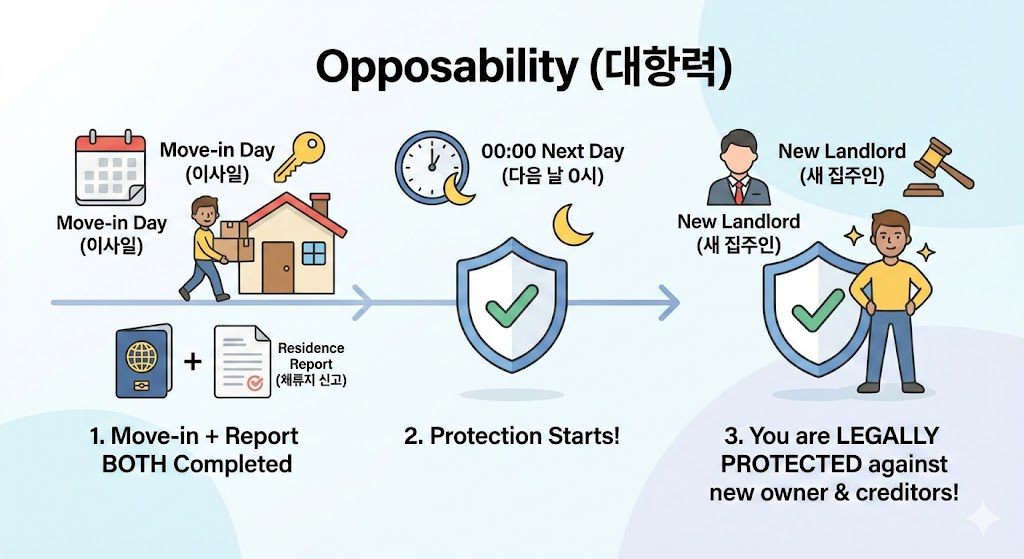
⚠️ Critical Timing (The “Next Day” Rule): > Opposability does not start the moment you visit the immigration office. It becomes effective at 00:00 (midnight) the day after you have completed BOTH physical occupancy and the residence report.
Example: If you move in on Monday and report it on Monday, your protection starts at 00:00 Tuesday. If the landlord takes a loan and registers a mortgage on Monday, the bank actually has priority over you! Always report your residence on the very day you move in.
3. Can I Reject the New Landlord?
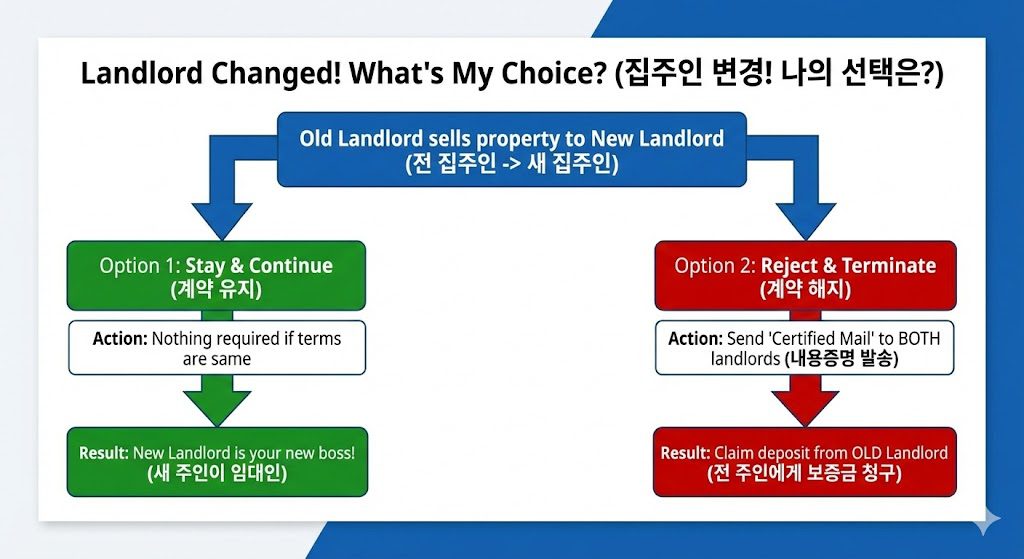
What if you don’t trust the new owner? According to Supreme Court Precedent (2001Da64615), if you do not wish for the new owner to take over the lease:
- The Right to Object: You may terminate the contract by explicitly objecting to the succession of the lease within a “reasonable period” after learning about the sale.
- Action Required: You should send a Certified Content Mail (내용증명) to both the old and new landlords stating your objection.
- Result: The contract terminates, and you can demand your deposit back from the original (old) landlord. However, if you wait too long (several months), the law assumes you have tacitly accepted the new landlord.
4. Practical Step-by-Step Checklist
- Check the Real Estate Register (등기부등본): Visit the Supreme Court e-Registry. (Note: The English interface is limited; you might need a Korean-speaking friend or a lawyer). Check if the “Owner” (갑구 section) has actually changed.
- Verify the New Owner’s Identity: Get the new landlord’s name, ID number, and contact information.
- Should I sign a new contract? * If the terms are the same, you don’t have to.
- Warning: If the new landlord asks to increase the deposit and you sign a new contract, you MUST get a new Fixed Date (확정일자) for that new contract to protect the increased amount.
5. Detailed FAQ for Foreign Tenants
Q1. The new owner wants to increase the rent immediately. Is this legal?
A1. No. The new owner must honor the existing contract until it expires. Rent increases are generally capped and can only be negotiated during contract renewal.
Q2. The new owner says, “I am moving in, so you must leave.”
A2. If your current contract period is still active, you have the right to stay. However, during the renewal window (6 to 2 months before the contract ends), the owner (or their immediate family) can refuse to renew the lease if they intend to live there personally (Housing Lease Protection Act Art. 6-3).
Q3. I reported my change of residence late, and the owner changed before that. Am I safe?
A3. This is a high-risk situation. Since your “Opposability” starts the day after the report, if the owner changed before your protection kicked in, the new owner might not be legally bound to your lease. You might have to claim your deposit from the old landlord, who may no longer have the funds. Please consult a lawyer immediately.
Q4. The new owner claims they “didn’t know” about my lease and won’t pay the deposit.
A4. This claim is legally invalid if you have Opposability. Under the law, the new owner is deemed to have known and accepted all lease obligations. Show them your original contract, your Foreigner Registration (with residence history), and the Fixed Date.
Q5. I received my deposit from the OLD landlord. Is that okay?
A5. If you agreed to terminate the contract and received your full deposit from the old owner upon moving out, that is generally fine. Just ensure you keep all records (bank transfer slips/receipts) to avoid any “double payment” disputes later.
⚠️ Final Tips for Peace of Mind
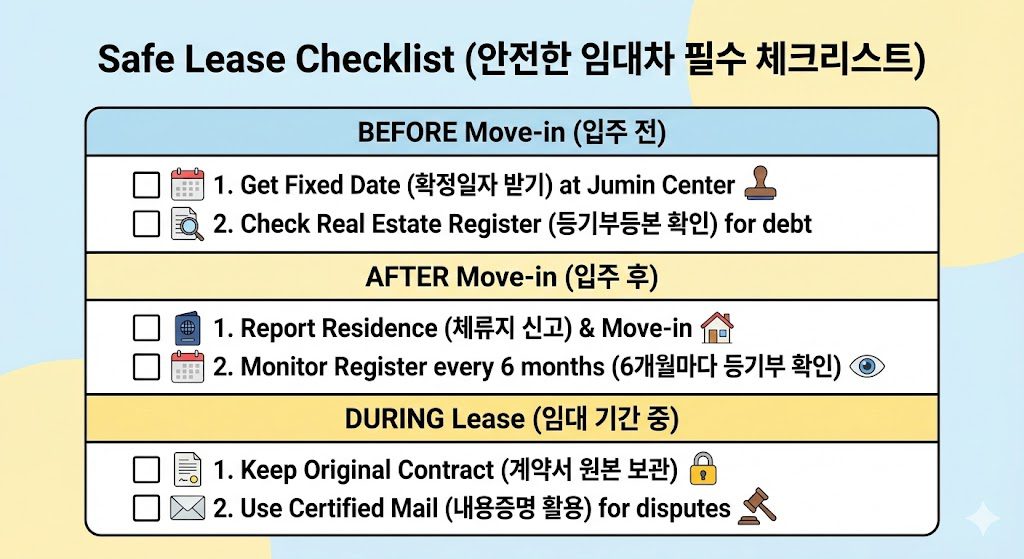
- Monitor the Register: Even if things seem fine, check the Real Estate Register (등기부등본) every 6 months. It costs about 1,000 KRW and shows you if the owner has changed or if new debts (mortgages) have been placed on the house.
- Keep Originals: Never give away your original lease contract. It is your most powerful evidence.
- Certified Mail is King: In Korea, if a dispute starts, “saying” something isn’t enough. Use Certified Content Mail (내용증명) at the post office to create a legal record of your claims.
Was this guide helpful?
Legal issues in a foreign country are daunting, but you have rights. If you have received a sudden notice from a new landlord or are struggling to get your deposit back, feel free to reach out for a professional consultation.
Attorney Seok Jun Kang


